Why AI Productivity Looks Better in Demos
A convincing demonstration measures a narrow slice of work. A useful productivity claim must follow the change through acceptance and operation.
Explore the mechanism ↓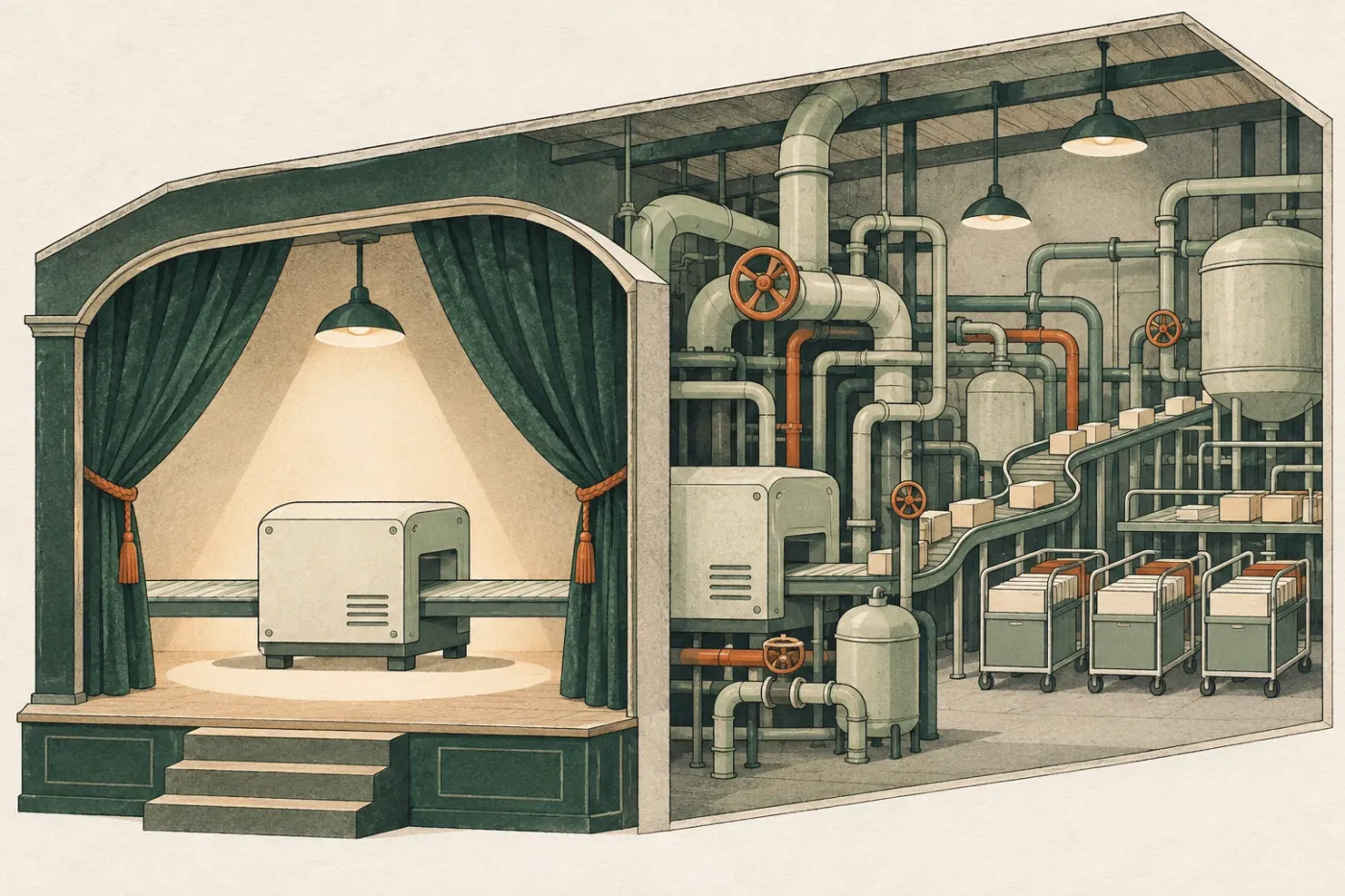
Reading tools Listen or translate
Read aloud
Uses an installed voice on your device.
Translate article
Machine translation. Code and evidence notes stay in English.
Original English text.
START WITH THE MECHANISM
Interactive companion and laboratory update: 12 November 2026. The editorial date places the topic on the timeline; this current explanation and its measured evidence retain their actual preparation and execution dates.
THE FULL INVESTIGATION
Why AI Productivity Looks Better in Demos
Dates and technology context
This is a retrospective editorial timeline. Topic context: 14 November 2025. First publicly available: 12 November 2026. Current text, visuals and laboratory revisions were prepared on 12 November 2026.
The denominator examples refer to laboratories executed in November 2026; no earlier human-productivity experiment is claimed.
Prepared on 12 November 2026, this retrospective essay evaluates the productivity question using a historical lens of 14 November 2025, not an earlier publication date.
A demonstration ends when the audience has seen enough to believe that something works. Software delivery ends later, when the organization has accepted a change and is prepared to live with its consequences.
The distance between those endpoints explains much of the confusion around AI productivity. A tool can dramatically shorten the creation of an artifact while changing the duration of the surrounding work much less. It can also make a previously impossible experiment cheap enough to attempt. Both are useful, but they are different benefits and should be measured differently.
The mistake is to treat the most visible acceleration as a complete account of the economic result. A generated interface is easy to watch. A week of negotiating requirements, checking compatibility, and resolving review questions is harder to fit into a compelling video.
My argument is that productivity claims become meaningful only after we specify the work whose completion matters. Until then, a speed comparison may be accurate about a small activity and misleading about the decision we are using it to support.
The demonstration has a legitimate job
There is nothing inherently dishonest about a demo. A demonstration can show that an approach is possible, that an interaction is usable, or that a tool removes a specific obstacle. It can help people understand a capability before they invest in a larger evaluation.
The trouble begins when the audience silently changes the question. The presenter shows that a prototype can be generated quickly. A manager hears that the next production project can be delivered proportionately faster. The claim has expanded without acquiring new evidence.
Consider a hypothetical demo that creates a booking interface from a short description. The visible flow is convincing: select a date, choose a service, confirm a reservation. This may be an excellent demonstration of rapid interface exploration.
A production booking system must also decide what happens when two people request the last available slot, when a payment succeeds but confirmation fails, when a reservation is cancelled, and when a customer disputes the outcome. It must fit the organization's accessibility, support, and operating requirements.
Those questions do not invalidate the prototype. They define the work that remains. The productive response is to ask which uncertainty the demo resolved and which uncertainties it left untouched.
A team that makes this distinction can value rapid prototyping without confusing a successful beginning with a completed system.
Local speed and completed work
01 / See the idea
The demo boundary is smaller than delivery
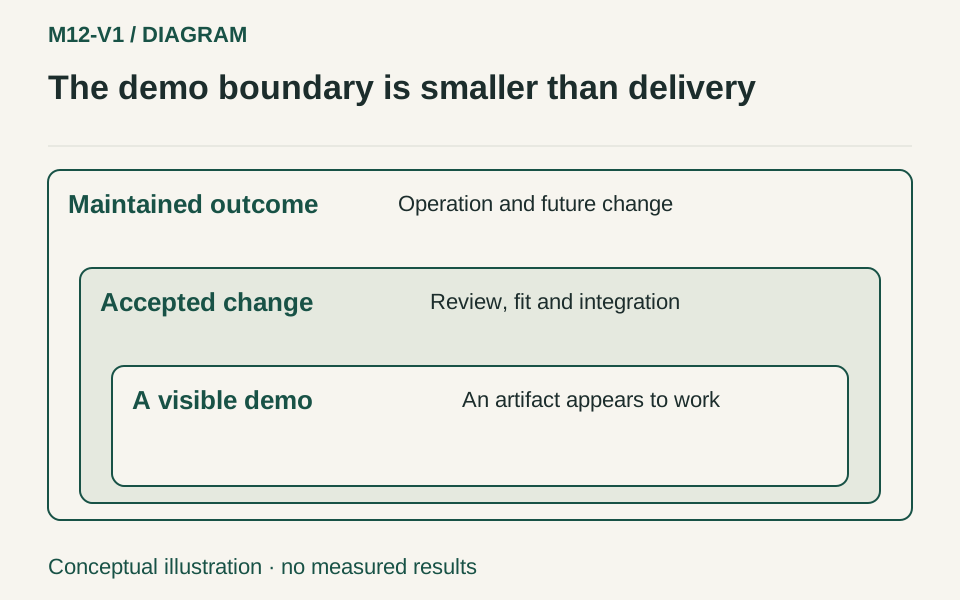
A demonstration can establish that a capability exists while leaving acceptance and operation unresolved. The nested boundaries describe different questions, not measured proportions of effort or a fixed delivery sequence.
Interpretation and evidence
- State which boundary a speed claim measures.
- Separate active effort from elapsed waiting.
- Follow the result through acceptance.
Suppose a hypothetical change requires understanding the request, finding the relevant code, implementing a modification, reviewing it, integrating it, and observing the release. An assistant may reduce implementation time while adding review effort because the resulting change is larger or less familiar to its author.
The total effect depends on both movements. It cannot be inferred from the faster step alone.
There is another complication: some work is waiting rather than active effort. A developer may finish sooner but wait for the same release window or specialist review. The saved time can still be valuable if it is used elsewhere, but the customer's elapsed waiting time may remain unchanged.
This is why an organization should distinguish several outcomes. It may care about active engineering effort, elapsed time to an accepted change, the number of useful experiments attempted, or the amount of work a small team can maintain. These measures answer different questions.
Combining them into a single claim that a team is a certain percentage more productive creates apparent simplicity at the expense of meaning. A decision about staffing needs different evidence from a decision about whether an individual should use an assistant to explore an unfamiliar API.
Even the unit of work needs care. Counting pull requests can reward splitting changes into smaller pieces. Counting generated code can reward unnecessary implementation. Counting tasks can conceal large differences in difficulty and value.
The useful unit is connected to an outcome the organization actually wants, with enough context to compare like with like.
A result that should make us more curious
METR's July 2025 randomized study found that experienced open-source contributors in its particular setting took longer when allowed to use early-2025 AI tools, despite expecting acceleration. The study does not establish that AI slows every developer or every kind of work. It does establish that perceived speed and measured completion can diverge in real tasks. METR, 10 July 2025.
The appropriate response is curiosity about the boundary, not a universal verdict. What kinds of tasks benefit? Which costs move elsewhere? How does familiarity with a codebase matter? What quality threshold defines completion?
The source page now contains a later update, but that update is outside this essay's historical frame. The relevant evidence here is the original July study.
A surprising result should make our measurements more precise. It should not become a convenient slogan for either rejecting or selling the technology.
The work a screen recording cannot easily show
02 / A concrete example
A booking screen leaves decisions open
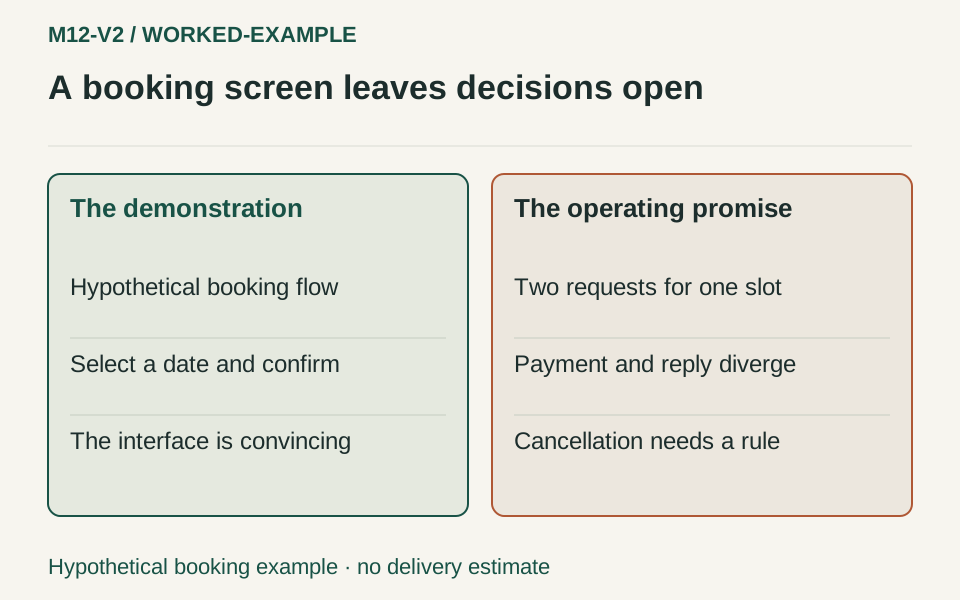
A hypothetical booking demo may resolve an interface question without resolving concurrent reservations or ambiguous payment outcomes. Those remaining decisions define the next evaluation rather than invalidate the useful prototype.
Interpretation and evidence
- Value the uncertainty the demo actually resolves.
- List the consequential work it leaves open.
- Do not extrapolate a coding speedup to a whole project.
Imagine a hypothetical engineer using AI to produce three alternative implementations instead of one. Generation is fast, and the alternatives are plausible. The engineer must now compare them, inspect their assumptions, and decide which one the team should maintain.
This additional choice can be valuable. It can also become a new cost. The difference depends on whether the alternatives resolve uncertainty that matters.
The same effect can appear in review. A developer may submit a broad change because producing it was easy, while the reviewer must understand every new behavior. If the team measures only authoring time, it records a benefit for one person and hides a cost for another.
Integration can reveal another transfer. Generated code may work in isolation but introduce a new dependency, an unfamiliar configuration path, or a different error-handling convention. The team then pays to reconcile the change with its existing system.
Maintenance extends the boundary further. A change that nobody understands can be cheap to produce and expensive to modify. That does not mean generated code is inherently unmaintainable. It means familiarity, clarity, and fit must be considered as properties of the delivered result.
These are mechanisms to investigate, not claims that every AI-assisted team experiences the same costs. Their importance is that they identify where a plausible productivity story could fail.
The strongest case for AI is not a stopwatch
A narrow measurement can underestimate benefits as well as exaggerate them. Faster experimentation may allow a team to discover that a proposed feature is unnecessary before it commits to building it. A small organization may attempt an internal tool that would otherwise remain below its investment threshold.
In those cases, comparing the time required to produce the same artifact misses part of the value. The tool changes which options are available.
Consider a hypothetical product team unsure whether a workflow makes sense. Several cheap prototypes may expose a confusing requirement before implementation begins. The benefit is not merely faster coding. It is an earlier decision made with better information.
That benefit still needs evidence. Did the prototype change the decision? Was the abandoned approach genuinely likely to proceed? Did the team learn something it could not have learned more cheaply through a conversation or sketch?
These questions prevent every unused prototype from being counted as a successful experiment. Exploration is valuable when it reduces consequential uncertainty, not simply when it produces a large collection of possibilities.
A fair evaluation should leave room for this kind of gain. It should also resist turning every intangible benefit into an untestable justification.
Design an observation around a decision
03 / Watch the mechanism
Faster creation can move work into review
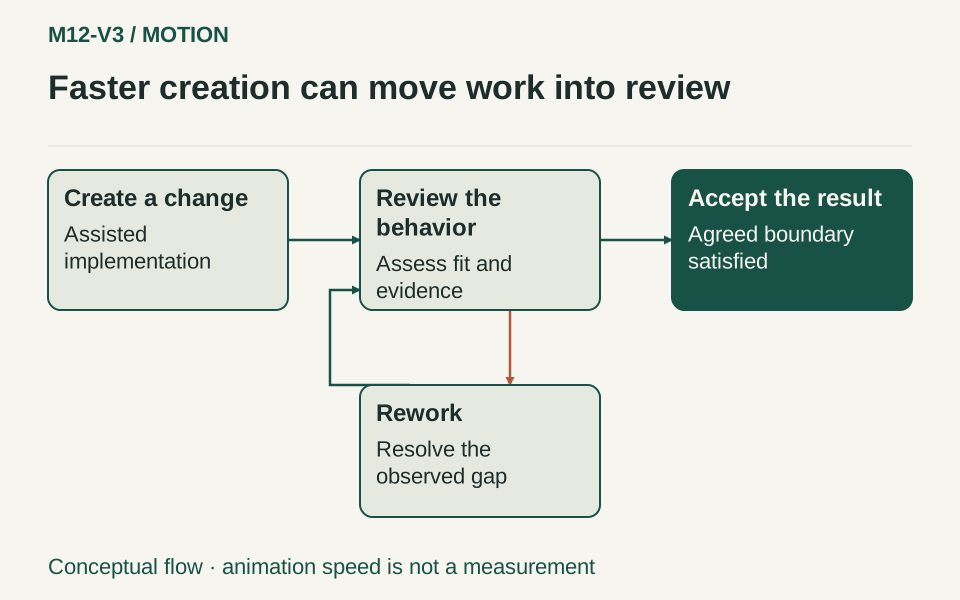
Static view. Play to see how the mechanism unfolds.
This proposed observation follows a change through review and any necessary rework. The moving token represents work changing state, not a measured rate or a claim that AI always increases review effort.
Interpretation and evidence
- Observe the recipient of generated output.
- Count rework inside the chosen boundary.
- Compare representative tasks with defined completion.
A team evaluating AI assistance should begin by stating the decision the evaluation must inform. Perhaps it wants to know whether a tool helps with routine maintenance, whether it improves onboarding, or whether it enables a particular class of experiment.
Then define completion before observing the work. For a maintenance change, that might mean accepted review, passing relevant checks, and successful integration into the supported environment. For a prototype, it might mean answering a named product question.
Select representative work, including ordinary awkwardness. A demonstration task chosen because the tool handles it elegantly is useful for learning a capability but insufficient for estimating routine value.
Observe where time and effort go. Record review and rework as well as generation. Note waiting time separately. Preserve enough context to explain why a task was unusual, while avoiding surveillance that turns the evaluation into a performance ranking of individuals.
Where feasible, compare similar tasks or vary assistance deliberately. Where a controlled comparison is impractical, acknowledge the limits of an observational account. A small team can still learn from careful notes without pretending to have produced a universal study.
The final result should inform a bounded choice. Perhaps assistance helps on one class of work and adds little on another. Perhaps it saves authoring time but requires smaller changes to keep review manageable. Such conclusions are more useful than a single promotional multiplier.
Three gains that should not share one multiplier
01 / See the idea
Three gains, three different measures
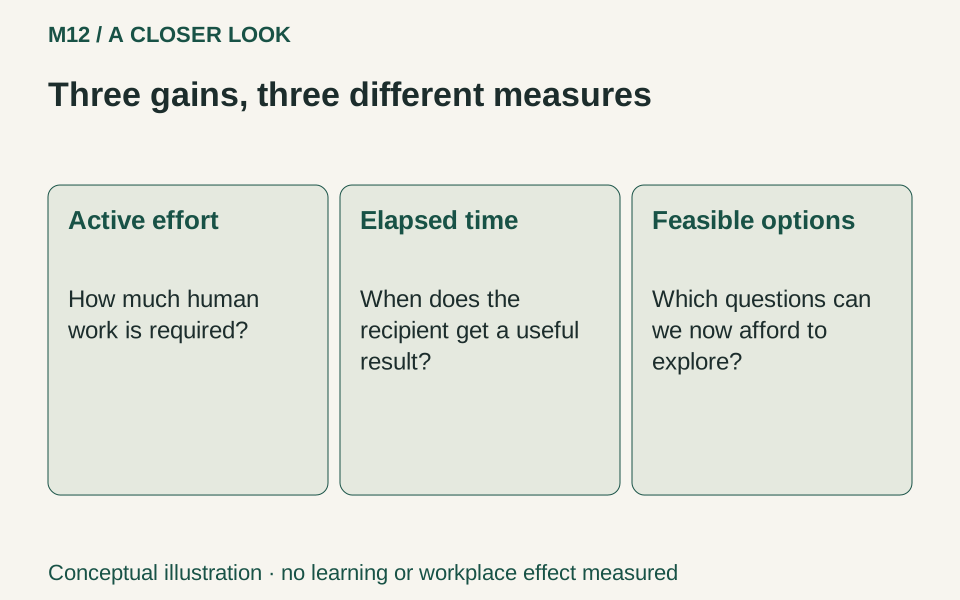
A hypothetical team may save implementation effort without moving the release date. A cheap prototype may instead create an option to learn; neither gain should be represented by the other measure.
Interpretation and evidence
- Choose a measure that matches the decision.
- Distinguish waiting from active work.
- Evaluate an experiment by the uncertainty it resolves.
It helps to distinguish three things an organization might mean by productivity. The first is reduced active effort: fewer minutes spent implementing, explaining or checking a change. The second is reduced elapsed time: a useful result reaches its recipient sooner. The third is an expanded set of feasible actions: the team can now explore an idea it would previously have left untouched.
These gains can occur together, but they do not imply one another. An engineer can spend less active time on a change that waits for the same weekly release. A prototype can make a new option feasible without shortening the work required to deliver a different existing feature. An automated check can increase machine activity while reducing the time a person waits for an answer.
Suppose a hypothetical team uses an assistant to finish a routine modification early. If the engineer uses the saved time to investigate a second problem, there may be a real benefit even when the first change reaches users on the original date. Calling the effort saving meaningless would be as mistaken as calling it an equal reduction in delivery time.
The choice of measure should follow the decision. A team deciding how to allocate engineering attention needs an account of active effort. A product owner negotiating a commitment needs evidence about elapsed delivery. A founder deciding whether to attempt a new idea needs evidence about the cost and usefulness of exploration.
One attractive multiplier cannot answer all three questions. The requirement is not to choose the most conservative measure. It is to choose the measure whose meaning matches the claim being made, then keep that meaning stable through the comparison.
A fast artifact can create several different futures
Return to the hypothetical booking prototype. There are at least three plausible next steps. The team might discard it after learning that the workflow is wrong. It might preserve the interaction design while rebuilding the implementation. Or it might choose to develop the existing code further.
The value of the prototype depends partly on which decision it enables. Discarding it can be a successful outcome if the team avoids a larger mistaken commitment. Preserving it can be sensible if its assumptions fit the intended system. Rebuilding it can be worthwhile if the prototype resolved a product question while leaving production engineering deliberately open.
None of those outcomes follows from the speed of generation alone. The team needs to say what it expected to learn and whether it learned it. Otherwise, a collection of rapidly generated prototypes can become activity without a decision.
This is also where organizational incentives matter. If a demonstration is rewarded for appearing complete, its author may hide the unresolved boundaries. If an experiment is rewarded for answering a question, an honest limitation can be valuable information.
Consider a prototype that cannot handle simultaneous reservations. That limitation may be irrelevant while testing whether users understand the interaction. It becomes central when the prototype is used to support a production deadline. The same artifact can be adequate for one decision and inadequate for another.
A fair evaluation therefore asks what stage of uncertainty the artifact was meant to address. It avoids criticizing a sketch for not being a finished service, while also refusing to let a sketch's success become evidence for a commitment it never tested.
Contradictory results can reveal different questions
An engineer can truthfully report that an assistant made a task easier while a measured comparison shows no reduction in completion time. Easier may mean less frustration, less recall effort, or a more accessible starting point. Those are meaningful experiences, but they are not identical to throughput.
Likewise, a benchmark can show a useful capability without establishing that the capability integrates well into a particular team's workflow. The environment may supply cleaner inputs, clearer acceptance criteria or more repetition than ordinary work. That does not make the benchmark worthless. It defines what the benchmark can support.
The original METR study cited earlier is valuable partly because it prevents perception from settling the question alone. Its bounded result should coexist with the possibility that other tasks, users or workflows benefit. The mistake would be to use one finding as permission to stop investigating the conditions that produced it.
When results disagree, begin by aligning the question. Are they measuring the same work, the same level of quality and the same boundary of completion? Are setup, review and correction included? Does one comparison involve experienced contributors working in familiar code while another involves people exploring an unfamiliar problem?
These are questions to resolve with evidence, not explanations to assume whenever a preferred result fails to appear. A hypothesis about the difference becomes useful when it suggests a check that could show the hypothesis is wrong.
The goal is an account that helps someone act. A team may reasonably adopt assistance for one family of tasks and retain another workflow elsewhere. A nuanced decision is not an embarrassing compromise between competing slogans. It may be the most faithful reading of the evidence.
Later laboratories demonstrate the importance of the denominator
Contemporary laboratory note, prepared 12 November 2026. These experiments were performed after the essay's November 2025 context and do not belong to its historical evidence base.
The reusable-source laboratory compared task-based and reusable-source implementations under three declared consumption patterns. The reusable source reduced managed allocation in the measured fixture without improving median elapsed time. That is a useful result because it separates an improvement in one resource measure from an improvement in another.
The buffer-ownership laboratory similarly found that allocation changes and elapsed-time changes did not move in proportion. Its measurements included filling and consuming the payload, so a reduction in allocation did not remove the other work in the operation.
The runtime-async laboratory adds another boundary: changes in generated artifacts and allocation did not justify a universal speedup claim across its scenarios. These experiments concern software mechanisms, not developer productivity, and their timings must not be transferred to a claim about teams.
Their relevance is methodological. A real improvement can be narrower than the story built around it. Fewer allocated bytes, a smaller compiler artifact and less human effort are different observations. Each becomes useful when connected to the decision it can actually inform.
This is also why the proposed review-queue study remains a study design until its own work is performed. Executed runtime laboratories do not retroactively turn that separate proposal into measured evidence about people. The boundaries must stay visible even when all the articles belong to one publication.
An evaluation should change the next commitment
A productivity evaluation is most useful when someone can name the decision that will follow. Perhaps the team will change how it prepares work, reduce the size of assisted patches, allocate review capacity differently, or stop using assistance for a task family where it adds little.
Without that connection, measurement can become another form of demonstration. A dashboard accumulates numbers, but nobody knows which result would lead to a different choice. The organization can then cite whichever trend supports what it already wanted to do.
Before collecting data, describe a few possible outcomes and their implications. If implementation effort falls while review effort rises by a similar amount, investigate the handoff rather than declare victory or failure. If both fall but delivery time does not, inspect waiting and coordination. If exploration becomes cheap but rarely changes a product decision, reconsider which questions the prototypes are meant to answer.
These are proposed decision rules, not universal numerical thresholds. Their value is to make the evaluation accountable to a purpose. A surprising observation should be able to change the next commitment.
The same principle limits the burden of measurement. Collect what is needed to distinguish plausible explanations, while respecting the people doing the work. An intrusive record of every action can distort behavior and consume attention without improving the decision. A smaller, well-designed observation may be more useful than an elaborate system whose purpose is unclear.
What would make the claim wrong?
Any productivity argument should identify evidence that would weaken it. If the expected benefit is faster accepted changes, a growing review queue matters. If the expected benefit is better exploration, prototypes that never influence a decision matter. If the expected benefit is lower maintenance effort, later changes that require repeated rediscovery matter.
The evaluation should also identify evidence that would justify expanding use. Repeated gains across representative tasks, stable quality, and manageable operating costs would support a stronger claim than enthusiasm alone.
This does not require waiting for perfect certainty. It requires matching confidence to the evidence available and preserving the ability to revise a decision.
The best demo leaves the audience with a precise next question. It shows something real, names the boundary, and invites the harder evaluation that follows.
When you next watch a tool create an impressive artifact, ask what work has actually ended. Then ask whose work begins because that artifact now exists. The answer will tell you more about productivity than the speed of the typing ever could.