What a Performance Diagnostic Should Deliver
A useful diagnostic produces a reproducible finding and a decision, not just a large dashboard or a list of suggestions.
Explore the mechanism ↓
Reading tools Listen or translate
Read aloud
Uses an installed voice on your device.
Translate article
Machine translation. Code and evidence notes stay in English.
Original English text.
START WITH THE MECHANISM
Interactive companion and laboratory update: 12 November 2026. The editorial date places the topic on the timeline; this current explanation and its measured evidence retain their actual preparation and execution dates.
THE FULL INVESTIGATION
What a Performance Diagnostic Should Deliver
Dates and technology context
This is a retrospective editorial timeline. Topic context: 26 May 2026. First publicly available: 12 November 2026. Current text, visuals and laboratory revisions were prepared on 12 November 2026.
The diagnostic packet was built in November2026 from later first-party evidence; the May2026 service-description argument is not an earlier consulting engagement.
A performance investigation can finish with a large collection of dashboards and leave the original decision untouched. The team knows more numbers, has several plausible bottlenecks and has been advised to upgrade something. It still cannot explain which change is worth making, what improvement would count as success or how to determine whether the change caused it.
The useful output of a diagnostic is a defensible finding attached to a decision. That finding may identify a cause, rule out an attractive explanation or show that the current evidence cannot distinguish two alternatives. The quality of the work depends on the clarity of that boundary, not on the number of tools used to produce the report.
This is a proposed scope for technical advisory work. It describes how an investigation should reason and what it should leave behind. It does not claim that the author has delivered a particular client result, and it does not promise an improvement before the system has been examined. The examples are hypothetical because an honest diagnostic begins with evidence from the system in question.
Translate the complaint into an observable symptom
“The application is slow” is a reasonable description of a user's experience, but an inadequate measurement contract. Slow for whom, while doing what, at which time and relative to which expectation?
Consider a hypothetical order-management application. A user says the customer screen takes too long to open. The relevant interval might begin when the user selects a customer and end when the information needed for the next decision is visible. Measuring only the API response would omit client rendering and subsequent requests. Measuring the whole page load might include elements that do not affect the task.
Write the interval explicitly and identify the workload. Include the kind of customer record, the amount of related data and the user's location or connection conditions where relevant. A screen with one order and a screen with ten years of history may exercise different paths. Treating them as the same observation can obscure a useful explanation.
Agree on what change would matter. A lower average is not always the objective. The business problem may be a small proportion of extremely slow requests, unpredictable completion during a daily deadline or resource consumption that limits growth. The diagnostic should preserve that problem statement throughout the investigation.
Establish an evidence boundary before accessing the system
An investigator needs appropriate access, but more access is not automatically more useful. Identify which observations are required and which can be collected safely in a reference or test environment. Production access should have a defined purpose, duration and owner.
For the hypothetical customer screen, an initial boundary might include client timing, request correlation, server-side traces and database execution information for a controlled set of requests. It need not include the contents of every customer record. A diagnostic that collects unnecessary payloads creates work and obligations without necessarily improving the explanation.
Record the configuration under investigation: application revision, runtime, database version, deployment shape and relevant settings. A finding detached from those details cannot reliably guide a change. It also becomes difficult to compare a later run when the environment has moved on.
Google's monitoring guidance distinguishes external symptoms from internal observations. Monitoring Distributed Systems. That separation helps keep an investigation honest: a low server-side duration does not invalidate a user's slow experience, and a busy internal component does not by itself establish that it caused the user's delay.
Build a small set of competing explanations
01 / See the idea
Competing causes need different tests
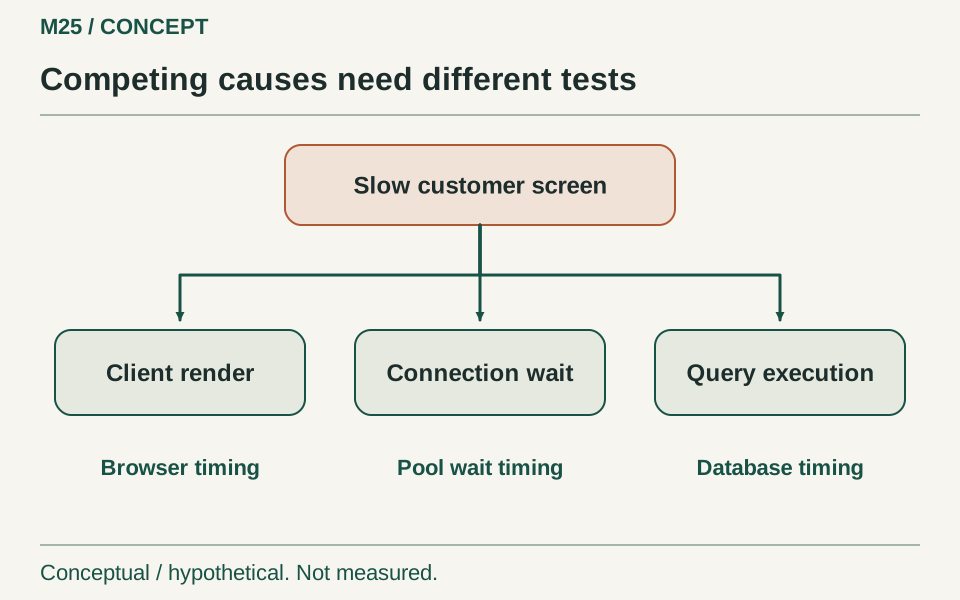
Imagine a slow customer screen whose database query itself is brief. Measuring connection wait and client rendering can discriminate between competing explanations that a single server-duration number leaves unresolved.
Interpretation and evidence
- Start at the user boundary.
- Predict an observation for each cause.
- Do not equate busyness with causality.
The first plausible explanation is dangerous because it determines where attention goes next. A high database duration may suggest a query problem. It could also include waiting for a connection, blocking caused by another workload or a data distribution that the investigator has not reproduced.
Write several hypotheses and the observation that would separate them. If client rendering dominates, changing the database should have limited effect on the chosen interval. If connection-pool waiting dominates, the query's execution plan may look satisfactory while the request still waits. If one unusually large response is responsible, average request size may conceal the relevant case.
This does not require a long academic document. A short hypothesis table can prevent hours of tool-driven wandering. Each entry should contain the proposed mechanism, its predicted symptom and the smallest useful observation. A hypothesis without a discriminating observation is a story, not yet an investigation step.
Keep confidence separate from consequence. A low-confidence explanation with a potentially severe consequence may deserve a focused check. A high-confidence explanation for a trivial portion of the delay may not deserve immediate repair. The diagnostic should help the team spend its next unit of effort where it can change the decision.
Use a reproducible slice of the workload
Reproducing the entire production environment may be impractical. A useful diagnostic often starts with a smaller slice that preserves the mechanism under examination: the relevant query shape, object graph, concurrency pattern or input distribution.
The slice must be described honestly. A synthetic dataset with uniform records may reproduce serialization work but fail to reproduce the skew that drives a database plan. A single-user script may expose a slow query while hiding contention. A local database may eliminate the network boundary that matters most to a remote user.
Record what the slice preserves and what it omits. If the suspected mechanism disappears, do not immediately conclude that production is inexplicably broken. Ask whether the fixture removed an essential condition. Reproduction is itself a hypothesis about which parts of the environment are causally relevant.
The opposite mistake is to demand perfect reproduction before learning anything. A carefully bounded test can rule out a mechanism or quantify a component without reproducing the full system. Its value comes from the precision of the question, provided the final report does not promote a component result into a system-wide claim.
Make the proposed change discriminate between explanations
02 / A concrete example
An improvement can challenge the cause
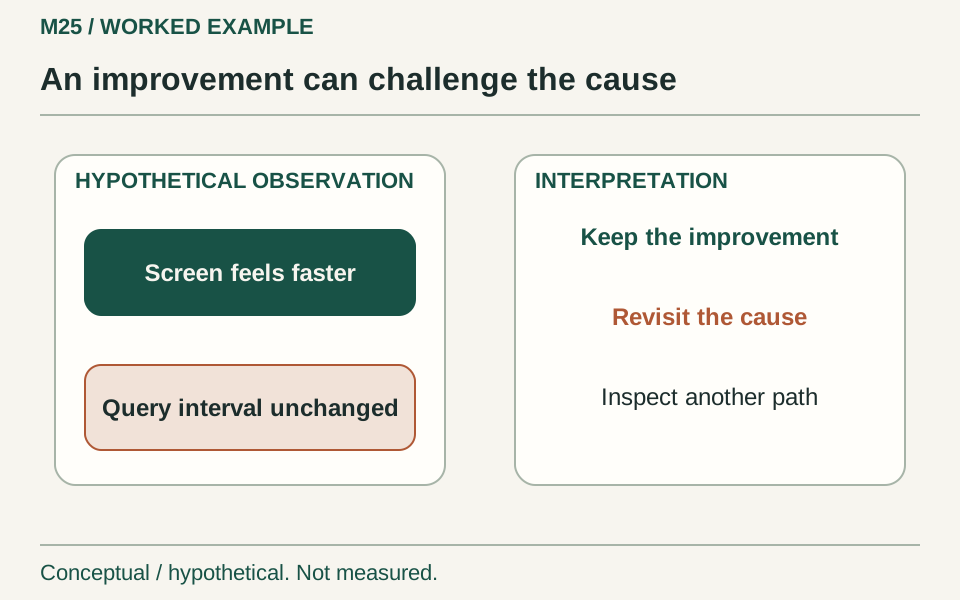
Suppose a reference intervention makes a screen faster but leaves the suspected query interval unchanged. The improvement may be real, yet the evidence does not support claiming that the database change caused it.
Interpretation and evidence
- Separate improvement from explanation.
- Retain a comparable baseline.
- Revise the causal claim when predictions fail.
Changing several settings at once can improve the system while weakening the diagnostic. The team may be pleased with the result and still unable to explain which change mattered or which one created a hidden regression.
Where practical, make one coherent intervention and retain a comparable baseline. If the hypothesis concerns an unnecessary round trip, remove that round trip while keeping the data and workload stable. If it concerns a memory allocation path, measure that path separately before claiming a change to end-to-end latency.
A successful intervention should move the observation predicted by the hypothesis. If the customer screen becomes faster but the suspected database interval remains unchanged, another mechanism may have contributed. That can still be a useful improvement, but the explanation needs revision.
The report should include alternatives that were considered and why they were not selected. A cache can hide an expensive operation while introducing invalidation and freshness questions. More concurrency can reduce waiting at one boundary while increasing contention at another. A new service tier can provide headroom without explaining why the workload consumes it. Each can be appropriate, but the diagnostic should show what responsibility comes with the choice.
Present the finding as a chain of evidence
A useful finding has a structure: a declared symptom, an observation, an interpretation, a competing explanation and the effect of a controlled change. Readers should be able to see which parts are measured and which parts are inferred.
For example, a hypothetical report might state that requests for customers with a large order history issue a repeated set of database calls; that those calls occupy a substantial portion of the chosen request boundary; and that a reference change reducing the calls also reduces that interval under the same workload. It should then state which production conditions have not been reproduced.
Do not insert invented measurements into such a narrative. The actual report would need request samples, query records, configuration manifests and repeated observations. Until those exist, the paragraph is a reporting template, not a case study.
A negative finding should be equally explicit. If a proposed runtime upgrade does not improve the relevant symptom in the tested slice, record that result rather than burying it among successful changes. Negative evidence can save the team from investing in an attractive but unrelated project.
The counterargument: sometimes the fastest answer is more capacity
There are situations in which a detailed investigation costs more than adding capacity. A temporary workload spike, a low-cost service tier change or an urgent customer deadline may make an immediate operational intervention reasonable. Insisting on a complete causal account before acting can be the wrong decision.
The diagnostic should accommodate that reality. Distinguish mitigation from explanation. Add capacity if the accountable team chooses it, record what changed and preserve enough evidence to revisit the mechanism later. Do not describe the mitigation as proof that the original architecture was sound or that a particular code path was the cause.
There is also a legitimate stopping point. If the observed performance meets the agreed requirement with acceptable cost and risk, further optimization may have little value. The investigator should not manufacture a new objective simply because more interesting work remains possible.
This makes a performance engagement different from a general code review. Its scope is an observable problem and a decision. Improvements unrelated to that problem can be noted separately, but they should not expand acceptance indefinitely. A team should be able to recognise when the diagnostic has delivered what it was commissioned to establish.
Leave the team able to repeat the reasoning
03 / Watch the mechanism
Hand over a repeatable decision
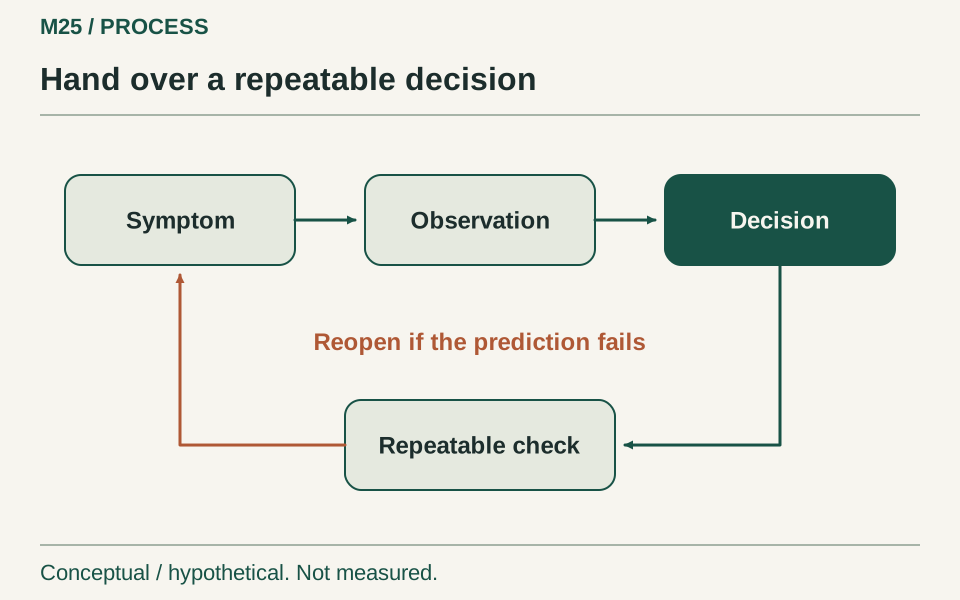
Static view. Play to see how the mechanism unfolds.
Imagine a handoff recommending removal of a redundant round trip. The receiving team needs the same workload and predicted interval, plus a rollback condition, so it can test the recommendation without reconstructing the investigation.
Interpretation and evidence
- Keep workload and configuration.
- Link the finding to its observation.
- Name acceptance and rollback conditions.
The handoff should contain more than recommendations. It should include the workload description, the measurement boundary, exact configuration, raw observations and instructions for reproducing the discriminating checks. The next engineer should not need to reconstruct the investigation from screenshots.
Include a short decision record. What should change, who owns it, how will the effect be checked and what result would cause a rollback or a different choice? If the evidence is insufficient, specify the missing observation and why it matters. “Investigate further” is not an adequate deliverable unless the investigation path is concrete.
Version the evidence. A later deployment can invalidate a query plan or remove the original symptom. That does not make the earlier finding useless; it makes its scope historical. The record should allow the team to determine whether a new incident resembles the old mechanism or merely produces a similar-looking graph.
This is particularly important when working across application and database teams. SQL Server's 2022 release announcement describes engine-level performance capabilities, but the existence of those capabilities does not establish their effect on a particular query. The diagnostic still needs the actual workload and evidence from the examined configuration.
Measure the engagement by the decision it enables
A good diagnostic may produce a small patch, an architectural change, a capacity adjustment or a decision to leave the system alone. It may also expose that the original complaint combines several unrelated experiences. The deliverable should explain the result without overstating what was learned.
For a buyer of technical advisory work, the useful questions are therefore concrete. Will the scope define the symptom? Will the investigation retain competing explanations? Will findings include reproducible evidence? Will the handoff identify what remains uncertain and who decides the next step? These questions are more informative than asking how many dashboards or profiling tools will be used.
For the engineer, the discipline is similar. Every additional observation should have a purpose. Once the evidence supports a safe correction and an integrated acceptance check, perform that check. Do not let curiosity turn a bounded diagnostic into an indefinite tour of the system.
The strongest performance report is one the receiving team can use, challenge and eventually supersede. It improves more than a number. It improves the organisation's ability to connect a symptom to evidence, evidence to a choice, and a choice to a result whose limits remain visible.
A later diagnostic packet makes the handoff inspectable
Implementation note, prepared 12 November 2026. The original May 2026 article describes the desired shape of a diagnostic engagement. The packet below uses later first-party laboratory evidence, not a customer delivery or a newly measured production system.
The packet contains ten preserved artifacts and a small executable reporter. It checks the identity of the inputs, evaluates a few explicit predicates and emits five findings. Each finding names a claim, its evidence boundary and the decision that follows.
The artifacts come from the publication's own measurement, telemetry, runtime and retrieval work. They do not describe one customer's application. Combining them into a single fictional engagement would hide their different workloads and conditions, so the packet keeps their source identities visible.
This is a concrete example of the deliverable proposed earlier: something a receiving engineer can inspect, challenge and rerun at the level of its stated checks. The reporter does not diagnose arbitrary systems. It verifies selected conclusions about known evidence and demonstrates how to keep those conclusions attached to their scope.
The source package includes the snapshots and their hashes. It needs only Python's standard library and does not start a service, call a model or repeat the underlying benchmarks. Reproducing the report is distinct from reproducing the original performance experiments.
Write the finding before decorating the report
01 / See the idea
A diagnostic finding keeps four links
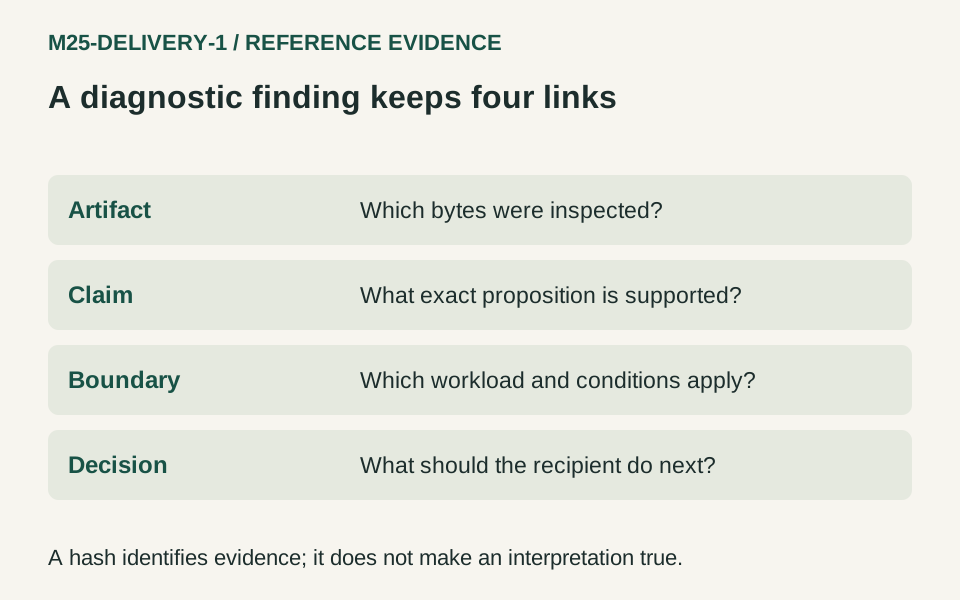
The reporter connects a preserved artifact with a bounded claim and an actionable next decision. It does not diagnose an unrelated customer system from a local laboratory result.
Interpretation and evidence
- Name the boundary beside the finding.
- Keep interpretation separate from identity.
- State what evidence would reopen the decision.
A finding should make the next decision easier. The packet therefore avoids a generic score and uses four fields: artifact references, claim, boundary and decision.
For the measurement-contract laboratory, the finding records that correctness and timing evidence exist for the declared projection workload. Its boundary is local projection, not a user's complete request. The decision is to use the result only for a projection-level comparison unless another experiment establishes the wider effect.
For the telemetry laboratory, the record accepts that the transport fixture was acknowledged. It does not extend that observation into a claim about durable production storage or queryability. The next decision is to request the missing downstream evidence before promising those properties.
The point is not that these findings are surprising. It is that their wording prevents the evidence from growing in scope as it moves between people. A chart copied into a presentation can lose its workload description. A short finding with an explicit boundary is harder to reuse carelessly.
This structure also gives the recipient something to dispute. They can argue that the evidence is insufficient, that the boundary is too narrow for their question, or that the proposed next decision does not follow. That is a useful technical conversation, unlike a vague disagreement over whether the report looks thorough.
A negative recommendation can be the correct deliverable
02 / See the idea
A negative recommendation can be useful
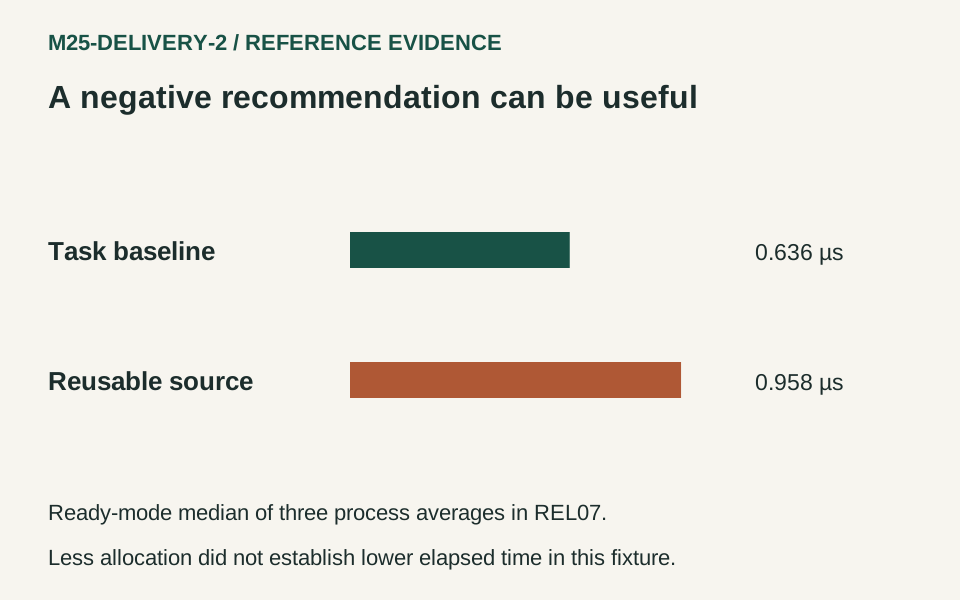
The saved ready-mode source median is higher than the task baseline median. The diagnostic therefore does not recommend this source as a time improvement from these data alone.
Interpretation and evidence
- Do not promote allocation savings into a speed claim.
- Retain the simpler baseline.
- Keep the recommendation within the tested workload.
The reusable-source laboratory provides an example of evidence that resists an attractive optimization story. In its recorded ready-mode comparison, the reusable source's median elapsed time was higher than the task baseline's, despite lower managed allocation.
The packet checks that relationship directly from the saved samples. Its finding does not recommend the specialized source as an elapsed-time improvement on the basis of those data alone.
That is a positive diagnostic contribution. It can prevent a team from paying the maintenance cost of a more complicated abstraction for a benefit not established at the relevant boundary. The finding remains open to a different workload or a different objective, such as allocation pressure, but those conditions require their own argument.
Similarly, the buffer-pooling laboratory records warm heap observations without claiming to measure the pool's total retained capacity. Its warm baseline already includes storage retained during preparation. The packet therefore identifies a separate heap investigation as necessary if retained memory is the decision's central concern.
Neither conclusion says that reusable sources or pooling are bad. Both say what the evidence does and does not justify. A diagnostic that always recommends a change may be optimizing for visible activity rather than for a defensible decision.
The report must preserve the distinction between mechanism and environment
The packet includes the telemetry-contract laboratory as another scope example. Its recorded checks concern normalization under a declared local execution boundary. That does not demonstrate an entire distributed telemetry platform under real operating conditions.
A receiving team might still use the fixtures to define a shared naming or propagation contract. The next test would then concern the actual transports and components that carry those signals. The local result is reusable evidence for one layer, not a certificate for every layer above it.
This distinction is especially useful during modernization. A component can behave correctly in isolation while a changed deployment introduces different scheduling, network, data or identity conditions. The diagnostic should help the team identify which evidence remains valid and which boundary has changed.
The source hash in the packet contributes to that task by identifying the exact input examined. It does not prove that the input is representative of a customer's environment. That requires a separate account of the workload and operating conditions.
A report becomes stronger when it states these limits clearly. The recipient can then decide whether to reuse the finding, run a narrower confirmation or gather a different observation, rather than treating every earlier result as either universally valid or entirely irrelevant.
An executable reporter is not an automated consultant
Running the packet checks artifact hashes, verifies known relationships in the saved results and writes structured findings. The code is useful because it makes those relationships repeatable and exposes accidental changes in the evidence.
It does not decide whether a customer should buy more capacity, redesign a workflow or accept a risk. The finding's decision field is an authored technical recommendation tied to the known scope. A person remains responsible for judging whether that scope matches the current problem.
The reporter also cannot authenticate the original source merely by recomputing a hash stored beside it. The manifest preserves identity within the packet; trust in the collection process remains a separate question. This is why the packet records original artifact paths and describes the laboratories as first-party evidence.
There is a useful middle ground between an uncheckable consulting narrative and a promise that software can automate all diagnosis. A small tool can verify arithmetic, identity and declared predicates while leaving uncertain interpretation visible.
That middle ground is the purpose of this implementation. It reduces avoidable reporting mistakes without hiding the professional judgment that connects evidence to action.
Make the smallest useful output reproducible
The packet's workflow.py check command validates ten artifact snapshots, generates five diagnostic findings and exercises the accompanying recorded-output contract fixture. Its output is structured JSON rather than a screenshot of a terminal. The report includes the identifiers needed to locate each input and the boundary that limits the resulting advice.
One finding can be read without knowing the whole investigation: the reusable-source ready-mode median was not lower than the task baseline in the saved samples; the scope is that declared local fixture; the decision is not to recommend the source as an elapsed-time improvement from those data alone. That is a compact technical conclusion with a clear route back to evidence.
The reporter does not silently refresh the artifacts. If the current source changes, the preserved packet still identifies the bytes used for this conclusion. A new investigation should create a new snapshot and explain whether the result changed because the workload, implementation, environment or interpretation changed.
This is also why the source package includes the manifest and not only the final report. A recipient can verify that the expected files are present, check their hashes and reproduce the selected arithmetic or comparisons. They can then challenge whether those comparisons answer their own question.
The distinction between reproducibility and applicability remains important. Reproducing a finding does not establish that it applies to a different customer's system. The packet makes the original reasoning inspectable; the receiving team still needs to connect the mechanism to its own symptom before acting on it.
Hand over the next experiment, not a permanent conclusion
The packet's findings point toward bounded follow-up work. Confirm the larger request boundary before claiming a user-visible speedup. Examine storage behavior before promising telemetry retention. Measure object retention before attributing heap capacity to a pool. Preserve the normalization fixtures when introducing another transport.
These are directions for further work, not requests to run every possible check immediately. The receiving team should select the one that matters to its current decision and stop when enough evidence exists for that decision.
The strongest counterargument remains practical: a team under pressure may need a mitigation before it can complete an investigation. The packet structure accommodates that choice. It can record the mitigation, the evidence supporting it and the uncertainty left unresolved. It should not reclassify a successful mitigation as a complete causal explanation.
A useful handoff therefore includes the current conclusion and the condition that would reopen it. If the workload changes, the runtime changes or the observed symptom no longer fits the explanation, the team knows where to resume.
That is a more durable result than a list of optimizations. It leaves the organization with an inspectable decision process and a clear account of where its knowledge ends, while making no claim that this reference packet was delivered to a real client.