One AI Decision, Three Perspectives: Engineer, Founder and User
One hypothetical work-order assistant exposes three distinct kinds of evidence: mechanism, value and a usable commitment. Actual laboratories inform the technical claims without becoming a market or investment verdict.
Explore the mechanism ↓
Reading tools Listen or translate
Read aloud
Uses an installed voice on your device.
Translate article
Machine translation. Code and evidence notes stay in English.
Original English text.
START WITH THE MECHANISM
Interactive companion and laboratory update: 12 November 2026. The editorial date places the topic on the timeline; this current explanation and its measured evidence retain their actual preparation and execution dates.
THE FULL INVESTIGATION
One AI Decision, Three Perspectives: Engineer, Founder and User
Dates and technology context
This is a retrospective editorial timeline. Topic context: 27 November 2025. First publicly available: 12 November 2026. Current text, visuals and laboratory revisions were prepared on 12 November 2026.
Links to AI01/AI13 and contemporary accepted-work/Blazor references are later additions. Preserve hypothetical framing, no interviews or investment outcomes.
An AI feature can be technically impressive, commercially attractive and difficult to rely on at the same time. Those descriptions are not necessarily contradictory. They can be answers to three different questions about the same product.
The engineer asks whether the mechanism behaves correctly under its declared conditions. The founder asks whether solving that problem creates a useful, sustainable business. The user asks whether the result can be trusted enough to act on, and what happens when it cannot. None of these questions is a substitute for the others.
This article examines one hypothetical product decision through those three perspectives. It is not a transcript of interviews, a customer case or a report of an investment decision. The perspectives are analytical lenses. Where the argument refers to a laboratory, it identifies the actual evidence and keeps its technical limits separate from claims about market demand or human experience.
The product is an assistant that helps a service team turn a request into an actionable work order. It can read supporting information, propose the next action and, within a defined scope, call a tool. The interesting question is not whether it can produce a convincing demonstration. It is what must be true before the organization lets someone depend on its promise.
Start with one commitment rather than a list of capabilities
01 / See the idea
One commitment, three distinct questions
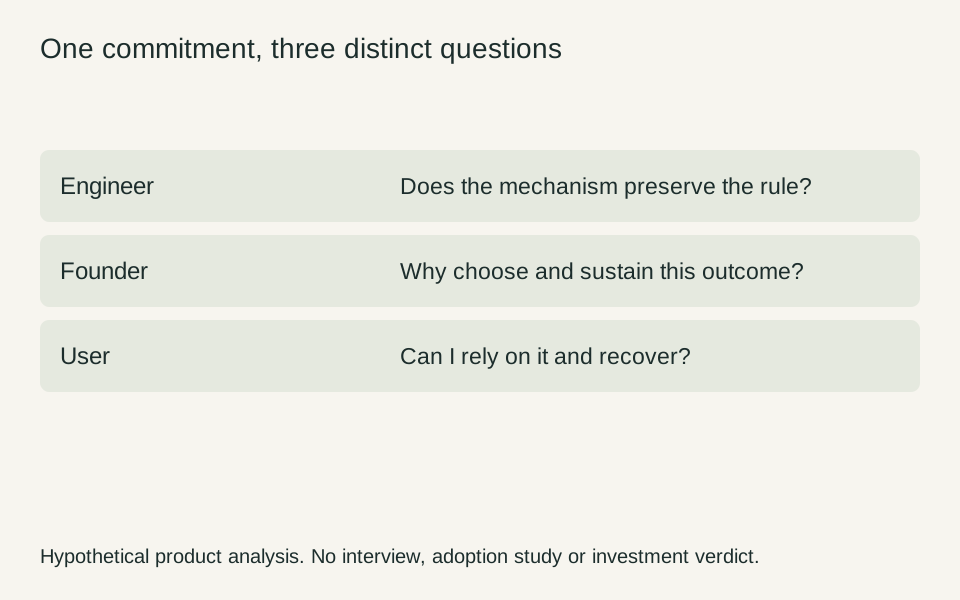
The same work-order promise needs technical, commercial and user evidence; none of the three establishes the others.
Interpretation and evidence
- Name one bounded promise.
- Keep different evidence types separate.
- Make uncertainty actionable.
A feature list might say that the assistant understands requests, searches documents, plans steps and integrates with business systems. Those descriptions are too broad to decide what should be released. They do not identify the result the user is buying or the conditions under which the organization accepts responsibility for it.
A narrower commitment might be: for the selected request types, the system creates a reviewable work-order proposal from authorized evidence, shows unresolved information and executes an approved action only when its preconditions still hold. That statement can be challenged. It names a population, an intermediate artifact, uncertainty, authority and a moment when the state may have changed.
The engineer can translate parts of that commitment into executable checks. The founder can ask whether the bounded result matters enough to support adoption. The user can ask whether the proposal and its limitations are understandable in the actual workflow.
This does not require the first release to solve every exception. It requires an honest boundary around what it does solve. A product can be useful because it handles a narrow class of work reliably, provided its refusal and escalation paths do not leave people guessing.
A broad promise can make a demo easier to narrate because it hides distinctions. A bounded promise makes implementation and evaluation harder in a productive way: it forces the team to decide what acceptance actually means.
The engineer sees a chain of contracts
02 / Watch the mechanism
Responsibility crosses more than a model call
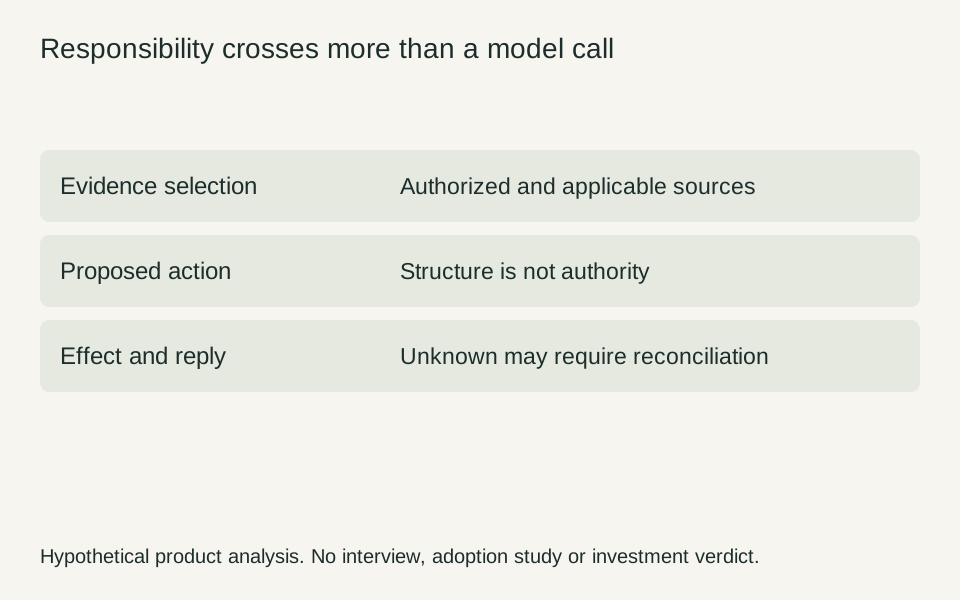
Static view. Play to see how the mechanism unfolds.
A valid proposal still needs trusted authority checks and an explicit policy for uncertain external outcomes.
Interpretation and evidence
- Validate scope outside the model.
- Bind approval to the action.
- Do not equate a timeout with no effect.
From the engineering perspective, the work order crosses several boundaries. A request arrives under an identity. The system selects evidence the actor may access. A planner proposes a structured action. Application code checks the action against policy and current resource state. An external component may perform the effect, perhaps before a reply is received.
Each boundary can fail differently. Retrieval can select an outdated source. A valid JSON proposal can describe an unauthorized operation. An approval can refer to an earlier amount or resource revision. A timeout can leave the outcome unknown instead of proving that nothing happened.
The engineering task is to preserve those distinctions in code and state. A single status called failed may be insufficient if some cases are safe to retry and others require reconciliation. A single log message called completed may be insufficient if it means only that the model stopped generating text.
The agent-authority laboratory implements a narrow version of this problem with synthetic units and a local SQLite-backed receiver. It verifies approval scope and an uncertain reply after a committed effect. That is actual technical evidence, but it does not establish that a full work-order product has been deployed or accepted by users.
The distinction protects the engineer from two opposite mistakes. One is to dismiss the laboratory because it is not the whole product. The other is to sell the laboratory's success as proof of the whole product. Its proper role is to support a specific part of the commitment and identify the next unverified boundary.
The founder sees a reason to choose and remain
A founder evaluating the same feature needs to ask why the customer would choose it over the current process and continue using it after the novelty fades. A technically sound action ledger may be necessary, but the customer is unlikely to buy a ledger in isolation. They are buying a better way to complete work they care about.
The question therefore moves from capability to consequence. Does the proposal reduce a costly delay? Does it make an exception easier to resolve? Does it let a team handle work that was previously uneconomical? Does it create another review queue that is more difficult to manage than the original task?
These questions require evidence from the intended setting. The current laboratories do not answer them. A founder can use the technical findings to define a pilot, but cannot infer willingness to adopt or pay from the fact that a test suite passes.
A useful commercial argument also needs to survive substitution. If another team can reproduce the visible answer with a different model, what remains valuable? It may be the integration with the customer's actual workflow, the quality and rights of the evidence, the ability to recover an uncertain effect, or the accumulated understanding of exceptions. Those are hypotheses to examine, not automatic moats.
The founder's perspective is not less rigorous because some questions are difficult to measure. It becomes rigorous when assumptions are named and when the next commitment is proportional to the evidence. A small pilot can answer a local adoption question without pretending to establish the long-term value of the company.
The user sees an action and its consequences
The user is not choosing between architecture diagrams. They are trying to complete a task under practical constraints. They may have limited time, incomplete information and a responsibility to explain their decision to someone else.
A proposal that looks authoritative can be inconvenient if its evidence is difficult to inspect. A technically correct refusal can be unusable if it gives no path forward. A fast answer can be worse than a slower one if it encourages the user to commit before noticing a missing condition.
The product should therefore make its state legible. Is it gathering information, waiting on an external system, requesting approval or reconciling an uncertain result? These states need different language and different controls. A spinner cannot explain all of them, and a fabricated percentage does not become honest progress because it makes the interface feel responsive.
The executed Blazor laboratory demonstrates a narrow UI contract: a late response from an earlier operation must not replace the result of a newer one, cancellation must be represented honestly, and status announcements remain outside the busy region. It does not claim that the interface has passed a user study or a complete accessibility audit.
That technical behavior matters because it protects the user's understanding of which operation they are looking at. But the user perspective remains larger than state correctness. A team must still find out whether the controls and explanations help the intended people do the actual work.
A shared artifact does not guarantee a shared interpretation
Suppose the team presents a successful trace from the work-order fixture. The engineer sees that the effect was committed once and later reconciled. The founder sees a demonstration that the product can recover from an important uncertainty. The user may see only that the interface remained in an unfamiliar pending state longer than expected.
All three observations can be relevant. The mistake is to let one interpretation silently stand for the others. A recovered effect is not by itself an understandable experience, and an understandable experience is not proof that the underlying effect was correct.
The team needs a shared evidence packet that preserves the distinction. It might contain the request and expected outcome, the observed state transitions, the reason for refusal or delay, the user-visible explanation, and the unresolved adoption assumption. Each item should say what it establishes and what it leaves open.
The evidence-pack article applies this discipline to saved laboratory artifacts. It labels supported, contradicted and unknown claims and checks the bytes used by the packet. It is not an automated investment recommendation or a substitute for commercial diligence.
A packet is useful when it makes disagreement specific. Instead of saying that the demo is convincing or unconvincing, a reviewer can say that the policy invariant is supported but the user's ability to recover from a refusal is still unknown. That leads to a concrete next test.
The same success can conceal a transferred cost
03 / See the idea
A benefit can transfer work to another person
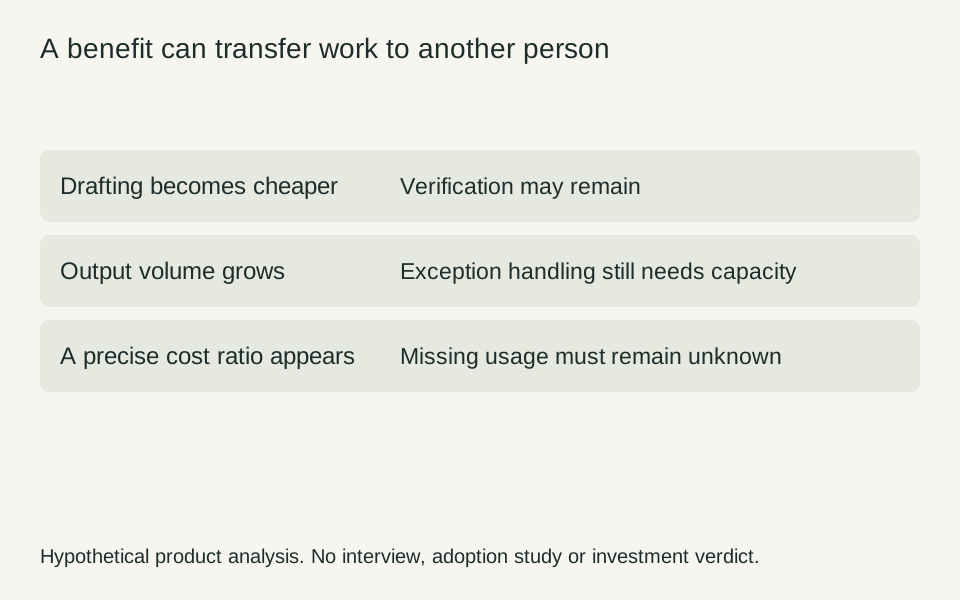
The analytical link to the actual cost ledger does not supply missing human-effort or market evidence.
Interpretation and evidence
- Follow the transferred work.
- Avoid invented planning constants.
- Measure the uncertainty that changes a decision.
Consider a proposal that saves time during initial drafting but requires a specialist to verify every source. From the engineer's perspective, the retrieval and citation code may be behaving as designed. From the founder's perspective, the specialist cost may determine whether the product can operate at a useful price. From the user's perspective, the workflow may feel slower because verification has moved closer to the moment of action.
The right response is not to choose one perspective as the real result. It is to follow the transferred work. What was removed? What was added? Who performs it, and when? A local improvement can be genuine while the overall arrangement fails to improve the outcome that matters.
The cost-ledger laboratory demonstrates how attempts, duplicate observations and incomplete usage can be represented without fabricating a precise ratio. Its rates are synthetic. It does not measure a person's verification effort or a real provider invoice.
For a product pilot, those missing observations should become explicit work. If review effort is the uncertain term, observe the review process under an appropriate protocol. If an external dependency dominates, retain its actual failure and retry behavior. Do not insert an invented constant merely because the spreadsheet needs a value.
This is where technical and commercial judgment can reinforce each other. A precise implementation can reveal which quantity is unknown. A good product question can then direct the next technical experiment toward the uncertainty that would change the decision.
Refusal is part of the product, not a leftover error state
A trustworthy system sometimes declines to proceed. The source version may be unknown, the requested action may exceed the actor's authority, or the resource may have changed after approval. Those refusals can be evidence that a control is functioning, not simply failures to hide from a success metric.
The user still needs to know what can happen next. Can they provide missing evidence, refresh the proposal, ask for another approval or escalate to a person? If every refusal produces an opaque message, the product can be technically cautious and operationally frustrating.
The engineer needs stable refusal categories and an explicit state machine. The founder needs to understand how often refusal affects the target workflow and what support burden it creates. The user needs a meaningful explanation and a way to continue without bypassing the protection.
These concerns should shape a pilot's acceptance criteria. Counting only successful responses can make a system with excessive refusals look excellent. Counting every refusal as a defect can pressure the team to weaken valid controls. The measurement needs to distinguish appropriate refusal, unnecessary refusal and unhandled uncertainty.
The existing laboratories provide examples of mechanical refusal, such as a mismatched source version or a changed action digest. They do not establish a rate of appropriate refusal in a real organization. That judgment requires the intended cases and an independent understanding of which actions should be permitted.
Reversibility changes what an early experiment can justify
An early pilot can be valuable even when much remains uncertain, provided the commitment is bounded and the learning is real. A read-only proposal system can answer different questions from a system allowed to perform external effects. Both may be useful stages, but their risks and acceptance evidence differ.
The engineer can design boundaries that make reversal possible: feature flags, stable data export, a preserved manual path, scoped permissions and recorded decisions. The founder can choose a pilot whose cost and dependency do not assume the final business model is already correct. The user can retain a clear way to recover when the new workflow is unsuitable.
Reversibility is not a claim that every consequence can be undone. An email sent to a customer, a disclosed document or a decision acted upon may have lasting effects. The pilot must identify which commitments are genuinely reversible and which merely have a compensating action.
That distinction prevents an attractive but weak argument: it is only a pilot, therefore ordinary evidence and authority rules can be relaxed. A pilot is still an intervention in a workflow. Its smaller scope should make the commitments easier to inspect, not invisible.
The reversible-pilot essay develops this reasoning further. Here it serves as a connection between the three perspectives: a bounded technical design makes a bounded business experiment possible, while the user's path through uncertainty remains part of the design.
The difficult conversation is about the next commitment
A useful review meeting should end with a decision that is more precise than build more or wait. The team can identify the next commitment, the evidence that supports it and the uncertainty that could still invalidate it.
For the hypothetical work-order assistant, the next step might be a read-only trial on selected request types, with independently reviewed proposals and no automated effects. Or the technical controls may be mature enough for a tightly scoped action in a synthetic or otherwise authorized environment. The choice depends on evidence that this article does not invent on behalf of the team.
The engineer should be able to say which guarantees are implemented and tested. The founder should be able to say which adoption or value hypothesis the next step examines. The user representative should be able to say what the participant is being asked to understand, approve or recover from.
If those statements conflict, the conflict is useful. It reveals that the team has not yet agreed on the promise. A larger model, another dashboard or a more polished pitch does not resolve that disagreement automatically.
The most productive outcome may be a smaller scope. It may also be a more ambitious experiment because the missing condition can now be tested safely. The shared discipline is to make the commitment proportionate to what is known rather than to the enthusiasm of the demonstration.
Separate facts, hypotheses and decisions in the review
04 / See the idea
Fact, hypothesis and decision are different records
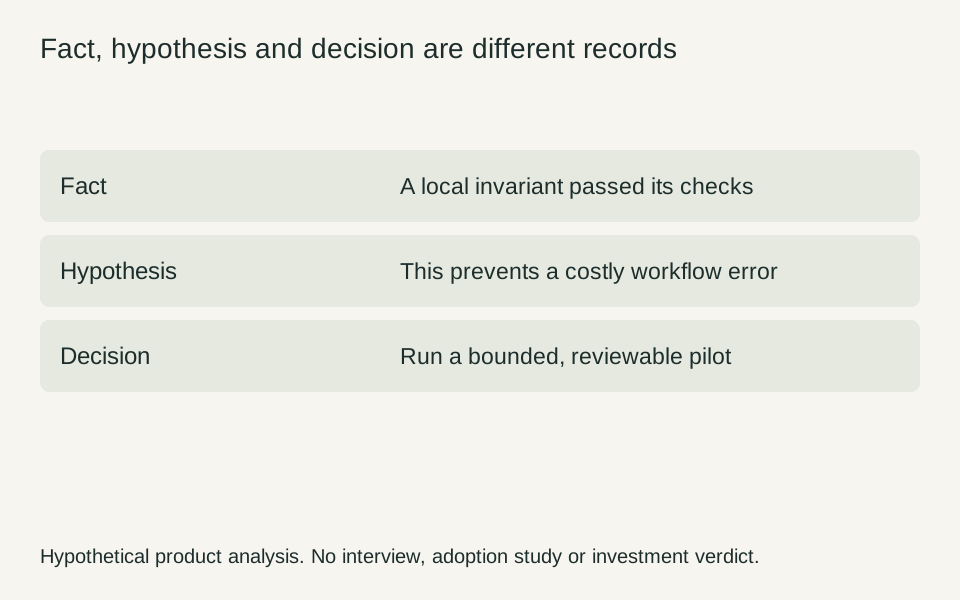
A technical test can support a mechanism while an organizational hypothesis still requires investigation.
Interpretation and evidence
- Preserve the exact claim boundary.
- A good hypothesis can still be unproven.
- Choose the next commitment explicitly.
A fact in the packet might be that a particular local fixture rejected a changed approval and preserved one receiver effect after reconciliation. A hypothesis might be that this mechanism will reduce costly duplicate work in the target process. A decision might be to pilot the feature on a limited set of cases with an agreed escalation path.
Those statements are connected, but they have different evidence requirements. The local test does not prove the organizational hypothesis. The hypothesis can still be worth testing. The decision can be reasonable without pretending that uncertainty has disappeared.
Keeping the categories separate also improves communication after a disappointing result. If users reject the workflow, the team can ask which adoption premise failed without rewriting the technical test as though it had never passed. If an integration breaks the invariant, the team can repair that boundary without claiming the whole product idea is disproved.
The reverse error is equally important. A promising interview or a strong expression of interest does not verify an implementation. A founder should not be asked to choose between customer evidence and technical evidence as though one makes the other unnecessary. The product depends on both, joined by an explicit account of the proposed workflow.
A useful review artifact therefore records the claim, its evidence, its limits, the owner of the next observation and the decision it can inform. That format keeps the discussion concrete while allowing uncertainty and disagreement to remain visible.
One product needs three kinds of credibility
The engineer, founder and user are not fixed personality types. One person may occupy several of these perspectives at different moments. The value of separating them is to prevent one familiar way of thinking from answering every question by default.
Technical credibility comes from mechanisms that behave as claimed and evidence that another engineer can inspect. Commercial credibility comes from a justified account of why the bounded result matters and how the organization can sustain it. User credibility comes from a workflow that people can understand, challenge and recover within when conditions are imperfect.
None can be manufactured by borrowing the appearance of another. A trace screenshot does not prove demand. A persuasive pitch does not prove authority checks. A friendly interface does not prove that a lost acknowledgement will not duplicate an effect.
The work-order assistant becomes a more serious proposition when those distinctions guide what is built and tested. Its scope can remain small. Its diagrams can remain simple. What matters is whether the team can explain the promise from the user's task through the implementation to the consequences of operating it.
That is the conversation I would want around an AI product: not three groups defending separate scorecards, but three ways of testing the same commitment. The next useful step is the one that closes a real gap in that commitment, with enough evidence to know what changed.
For a practical first review, take one proposed action and write three sentences before opening the demo. State the observable condition that the implementation must preserve, the reason this outcome matters to the intended customer, and what the user must be able to understand or contest. Then attach the evidence already available to each sentence. Leave the missing evidence blank rather than filling it with enthusiasm. That small exercise often exposes whether the team is discussing the same product or three different promises that happen to share an interface.
Sources and editorial evidence
Download the source notes and visual explanations. This essay contains no new workplace measurements.