The Evidence Pack Behind an AI Investment Thesis
An engineering evidence pack can clarify uncertainty without pretending to decide the financial merits of an investment.
Explore the mechanism ↓
Reading tools Listen or translate
Read aloud
Uses an installed voice on your device.
Translate article
Machine translation. Code and evidence notes stay in English.
Original English text.
START WITH THE MECHANISM
Interactive companion and laboratory update: 12 November 2026. The editorial date places the topic on the timeline; this current explanation and its measured evidence retain their actual preparation and execution dates.
THE FULL INVESTIGATION
The Evidence Pack Behind an AI Investment Thesis
Dates and technology context
This is a retrospective editorial timeline. Topic context: 10 November 2026. First publicly available: 12 November 2026. Current text, visuals and laboratory revisions were prepared on 12 November 2026.
The evidence pack was assembled from laboratories executed on November12, two days after the original November10 editorial context. Artifact identity is not proof of the full investment thesis.
An investment thesis often contains a technical sentence that carries more weight than the rest of the evidence can support. The product learns from proprietary data. The agent reduces operational work. The architecture scales efficiently. The model is replaceable. Each statement may be reasonable, but each describes a different proposition that should be examined in a different way.
A technical evidence pack makes those propositions inspectable. Its purpose is to help a founder, advisor or investment team understand which parts of the product story have support, which depend on assumptions and which remain unresolved. It does not calculate the financial merits of an investment or transform an engineering review into certainty about a market.
The distinction matters because technical detail can create an illusion of precision. A repository, an architecture diagram and a performance chart look substantial. They become useful evidence only when they are connected to the claim they are supposed to establish.
The original design below proposes the structure of such a pack. It uses a hypothetical product and makes no claim about the author's portfolio, fund role, transactions or client experience. Its product-level evidence remains proposed. The later implementation section adds a narrower executable packet of actual reference-laboratory evidence, without treating those separate laboratories as the hypothetical product.
Begin with a claim ledger
Consider a hypothetical product that helps small service businesses turn incoming requests into reviewed work orders. It reads messages and attached documents, proposes a classification, requests missing information and prepares a draft for a human to approve.
The product's thesis might contain several claims: it reduces manual preparation, handles varied documents, improves consistency and can serve more customers without proportionate support effort. Those claims should not be bundled into a single assertion that the product “works.”
Create a ledger with one row per material claim. State the claim, its role in the business thesis, the evidence available, the boundary of that evidence and the observation that would weaken it. Give each row a stable identifier so an evaluation, trace or customer study can refer to the same proposition.
A claim such as “the model understands service requests” is too broad. A more useful version is: on the declared task set, the examined system produces a draft with the required fields and identifies the cases that need human clarification. That statement has an observable outcome. It also leaves room for a disappointing result without turning the entire review into a dispute over the meaning of intelligence.
Pack one: the product boundary
The first pack should describe the workflow before it describes the architecture. Who initiates a request? Which information is available? What action can the system take? Who accepts the result? What happens when the system cannot proceed?
Include the work that remains outside the product. If a customer must clean documents, maintain categories or verify every proposed field, that effort belongs in the workflow model. It may be entirely reasonable. It should not disappear because it occurs before ingestion or after the assistant returns a response.
For the hypothetical work-order product, distinguish drafting from dispatch. Preparing a suggestion for review and sending instructions to a field technician have different consequences. Evidence supporting the first should not silently be reused to justify the second.
The workflow description should also identify its exclusions. A narrowly useful product can be more credible than one with a broad promise and poorly understood exceptions. The evidence pack should make the boundary of value visible, including the tasks that the product deliberately leaves to another person or system.
Pack two: data provenance and permission assumptions
01 / See the idea
A source has more than one copy
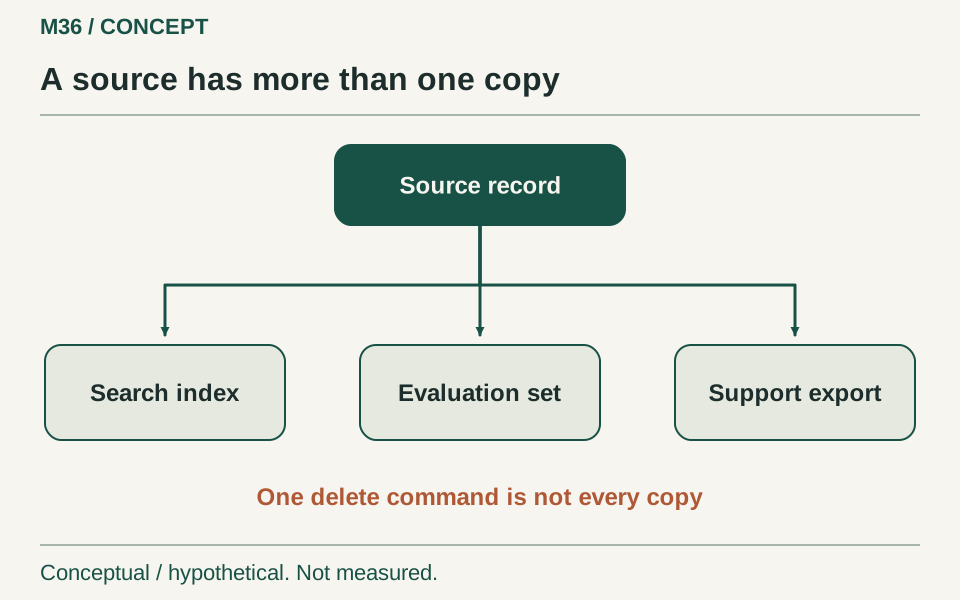
Imagine deleting a source record while its text remains in a search index and an evaluation fixture. A provenance pack must identify those copies and the owners of their correction or deletion process, without claiming that technical inventory settles legal rights.
Interpretation and evidence
- Map derived copies.
- Name correction and deletion owners.
- Keep rights decisions with qualified owners.
Document where the system's information comes from, how it changes and what the organisation believes it may do with it. The technical reviewer can inspect movement and access mechanisms. The appropriate legal and business owners must resolve rights and contractual interpretation.
For each source, record ownership, access path, update process and retention behaviour. Explain whether the product receives a copy, queries a source in place or relies on a person to curate an export. Those choices affect freshness, permissions and the effort required to serve another customer.
Include evidence of deletion and correction behaviour where those operations are part of the promise. A source record can be removed from the operational system while remaining in an index, evaluation set or support export. The evidence pack should show which copies exist and which processes govern them, rather than treating “delete” as one universal operation.
NIST's 2024 generative AI profile provides a primary reference for organising lifecycle risks. NIST AI 600-1. In this pack, it supports asking systematic questions about information and system behaviour. It does not establish that any particular dataset is lawful to use or that the proposed controls are sufficient for every jurisdiction.
Pack three: evaluation that measures a customer outcome
The evaluation pack should contain the task set, its selection method, the expected outcomes and the judgement procedure. Separate cases used during development from cases held out for the final comparison. Keep disagreements between reviewers visible.
A product may report high classification accuracy while still failing the workflow. Perhaps the rare misclassification sends a request to the wrong business unit, or perhaps a technically correct draft requires more review than the existing manual process. The acceptance criteria should reflect the consequences of the output, not only its similarity to a label.
Report abstentions and escalations separately from incorrect answers. A correct refusal can protect the workflow while leaving work for a person. That remaining work matters to the operating model. Conversely, a confident answer that happens to match the expected label may still be unsupported if it cites the wrong source or invents a required detail.
Attach every reported result to a product version, corpus version and actual execution date. If those identities are missing, a later model or prompt change can make the number impossible to interpret. The evidence should tell the reader what was tested, not merely provide a figure that can be reused in a presentation.
Pack four: the economics of completing the task
02 / A concrete example
Keep the status of each number visible
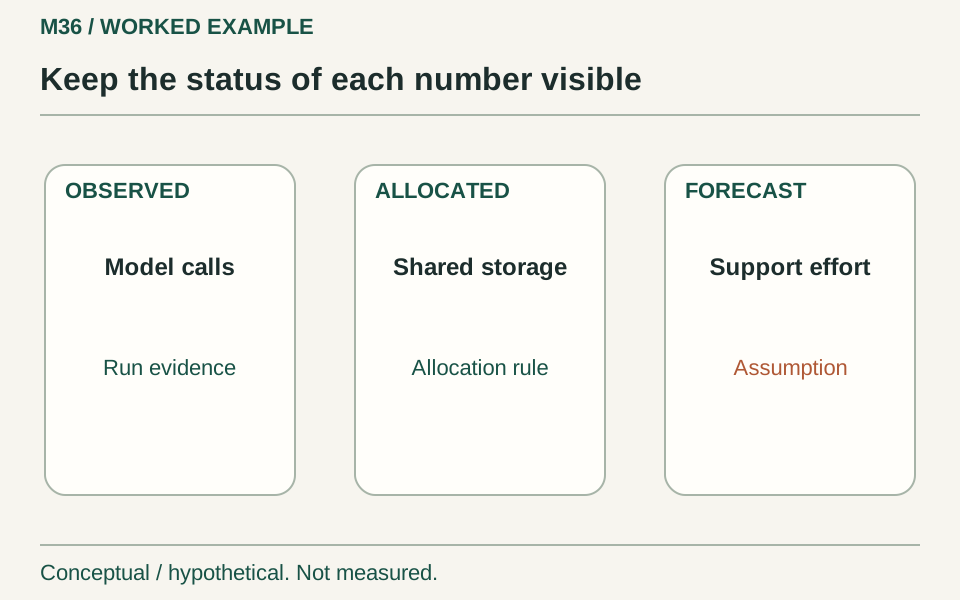
Suppose a work-order product records model-call usage but estimates future support effort. Both may matter to a planning model, yet the observed call and support forecast must retain different evidence labels and sensitivity assumptions.
Interpretation and evidence
- Label direct observations.
- Declare shared-cost allocation rules.
- Expose assumptions in forecasts.
The engineering contribution to operating economics is to identify and measure the work required to produce an accepted outcome. That includes retrieval, model calls, retries, storage, processing, review and support where those activities belong to the chosen boundary.
Separate measured observations from allocated shared costs and forecasts. The cost of an observed model call is different from an estimate of future customer-support effort. Both may belong in a planning model, but they should not have the same evidential status.
For the hypothetical product, compare scenarios with different document quality, request complexity and escalation rates. A product that is economical on clean requests may need a different scope for poorly structured documents. This does not mean the product lacks value. It means the addressable workflow should be described more precisely.
Ask which assumption most affects the result. If human review dominates, a small reduction in model price may contribute little. If document onboarding dominates, a repeatable ingestion process may matter more than a more impressive demo. The pack should identify the next measurement that could change the operating decision, rather than disguise sensitivity behind one average cost.
Pack five: failure, recovery and operational ownership
A credible product story includes what happens when an operation is uncertain. A downstream write may succeed while its acknowledgement is lost. A model call may finish after the user's deadline. A document update may arrive halfway through a task. The system needs a declared response to each relevant condition.
The evidence pack should include a small set of controlled failure scenarios and their actual outcomes when executed. Before execution, it should contain only the protocol and expected invariant. Keep those states separate. A planned recovery test is not evidence that recovery works.
The most important artifact may be the handoff to a human. Can the operator identify what was attempted, what definitely changed and what remains unknown? Can they resolve the state without improvising against a production database? Who is authorised to make that decision?
Microsoft's compensating-transaction pattern describes why recovery across independent effects can require application-specific actions rather than a simple rollback. In this pack, that is a prompt to inspect the product's actual recovery mechanism. Naming a pattern is not evidence that the implementation preserves its intended properties.
Pack six: dependencies and substitution
List dependencies that materially shape quality, cost or operability. A model provider is one. So are a data source, a distribution channel, a specialised employee and a customer integration that requires manual maintenance.
For each dependency, distinguish replacement in principle from replacement in practice. An interface can make model calls look interchangeable while prompts, output assumptions and evaluations remain tightly coupled to one model. A data export may be portable while the permission model is not.
A bounded substitution experiment can establish how much of the product survives a change. Hold the task set and acceptance criteria constant, replace one dependency and record the engineering work and outcome differences. The result should not be reduced to a universal portability score. It should explain which coupling is intentional, which is avoidable and which has not been examined.
The commercial interpretation remains a separate judgement. A strong dependency can be a source of capability as well as risk. The technical pack should describe the consequences clearly enough that the decision-maker can include them in a wider thesis without pretending they have disappeared.
Pack seven: an accountable technical opinion
03 / Watch the mechanism
Let evidence change the thesis
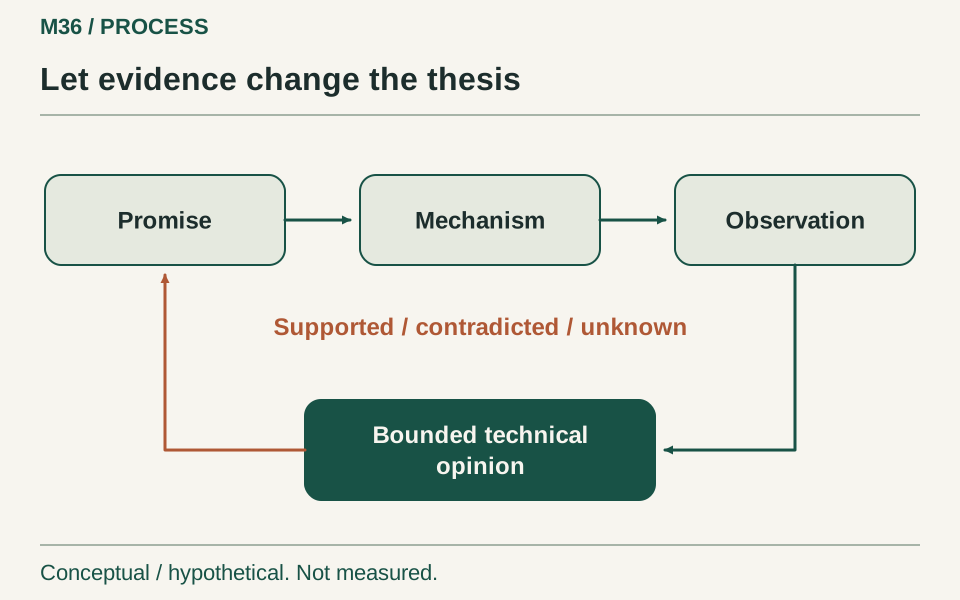
Static view. Play to see how the mechanism unfolds.
Imagine that a work-order assistant drafts correctly but requires more review than expected. The evidence can narrow the thesis to a useful drafting workflow while withholding support for autonomous dispatch; this is a technical conclusion, not an investment verdict.
Interpretation and evidence
- Connect each opinion to evidence IDs.
- Keep unknowns visible.
- Separate technical scope from investment judgment.
The concluding opinion should connect the packs rather than repeat them. Identify the claims that are supported, those contradicted by evidence and those still unknown. State how the unresolved items affect the next technical commitment.
An opinion might support a limited read-only deployment while withholding support for autonomous writes. It might find that the product's evaluation is coherent but its onboarding process is too informal to support the claimed growth model. It might conclude that a particular performance result is reproducible while its relevance to the expected customer workload remains uncertain.
Each conclusion should include the examined version and the relevant evidence identifiers. A reader should be able to move from the conclusion to the observation without asking the author to reconstruct their reasoning. Where the conclusion depends on expert judgement, name the assumption and the alternative interpretation.
Disclose conflicts and access limitations. A review based only on supplier-selected demonstrations should say so. A reviewer who may later sell implementation work should make that relationship visible. The point is not to imply that any relationship makes the work invalid. It is to let the reader understand how the evidence and incentives were produced.
The counterargument: a young company cannot carry seven packs
The objection is reasonable. An early product may not have a dedicated evaluation team, formal operations function or a long record of customer deployments. Demanding a large dossier before a small experiment can waste the very capacity needed to generate useful evidence.
The answer is proportionality and structure, not paperwork. Each pack can initially be a short section with a link to an artifact, an explicit unknown and an owner. A missing result should remain missing. The next experiment should target the uncertainty that matters most to the next commitment.
For an early prototype, the entire pack may fit into a concise document and a small repository. For a product seeking responsibility for consequential actions across many customers, the evidence burden grows. The structure remains the same while the depth changes.
There is also a cost to overconfidence. Without an explicit pack, the same unanswered questions recur in sales, engineering, support and fundraising conversations. People supply slightly different answers, and the organisation gradually loses track of which claims were demonstrated. A modest shared record can reduce that confusion before a larger governance process becomes necessary.
Use evidence to improve the thesis
The best outcome is not necessarily a reassuring report. Evidence may reveal that the product is valuable for a narrower task than its original pitch. It may show that an integration, rather than a model trick, creates the most useful advantage. It may demonstrate that an ambitious autonomous workflow should begin as a reliable drafting and review tool.
Those are strategic discoveries. They can help a founder choose what to build and help an advisor explain what remains uncertain. They do not determine the price of a company or the outcome of an investment. The technical contribution is to make the underlying propositions harder to misunderstand.
A good evidence pack leaves the next reader with a clear distinction between a promise, a mechanism and an observation. It shows how the mechanism is supposed to fulfil the promise and whether the observation supports that explanation. That is the foundation for a serious conversation about an AI product, especially when the demonstration is persuasive and the consequences of believing it extend far beyond the room.
A later executable pack makes the claim ledger concrete
Contemporary laboratory note, prepared 12 November 2026. The original 10 November context describes the structure of an evidence pack. The following packet was assembled later from executed first-party laboratories and does not imply a prior investment review.
The packet contains 11 frozen artifact snapshots, a manifest of their hashes and original paths, a small Python validation program and the resulting claim register. It is shared with the cost and technical-diligence articles so that the same observation is not silently reinterpreted in three different copies of the story.
The artifacts cover local retrieval, a synthetic cost ledger, a controlled action-reservation scenario, runtime measurements and telemetry evidence. They do not form a complete agentic product. Each was produced under its own declared conditions. The packet's job is to preserve those boundaries while making selected claims easy to inspect.
Running check.py performs exact arithmetic and checks selected properties of the saved records. It does not rerun the model, reopen the experimental databases, perform another benchmark or call any paid service. A successful packet validation means that the expected snapshots and stated predicates are present, not that every possible conclusion about the underlying systems has become true.
This is a small but important shift from a folder of impressive material to a reviewable argument. The reader can see which artifact supports which proposition and which propositions remain without the required evidence.
Accepted, rejected and unknown are judgments about exact claims
The register uses three states. Accepted means the declared evidence supports the exact bounded proposition. Rejected means a specific observation contradicts it. Unknown means the necessary evidence is absent or does not reach the claimed boundary.
Those meanings depend on wording. C02 accepts that the selected rankings respected the synthetic tenant filter in the local retrieval fixture. It does not accept that a deployed multitenant application is secure. There was no production identity provider or private-corpus authorization service in that experiment.
C03 rejects the statement that every first-ranked document was relevant. The saved rankings contain counterexamples. C04 leaves generated-answer correctness unknown because the experiment never generated an answer. Rejecting C03 and leaving C04 unknown are different responses to different evidence situations.
C07 accepts a controlled lost-response and reconciliation sequence in the reservation laboratory. C08 leaves arbitrary power-loss recovery unknown. A database reopen test is useful, but it does not represent every operating-system, storage or process-failure condition.
The register also leaves the attractiveness of an investment unknown. No combination of these local engineering artifacts supplies a market study, valuation argument, customer outcome or forecast of returns.
This discipline makes the states more useful than a generic red, amber or green assessment of the whole project. A reader can challenge the claim wording or the supporting observation without turning the discussion into a disagreement about whether the product is generally good.
A hash connects the review to bytes, not to truth
02 / See the idea
A reproducible chain still needs judgment
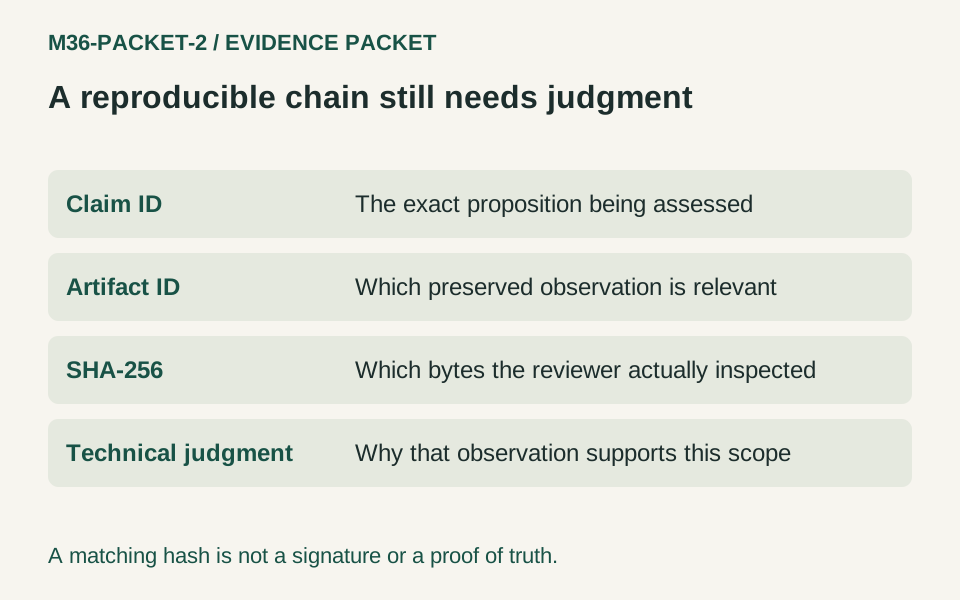
The manifest preserves real artifact hashes and the claim register points to stable artifact IDs. Reproducing those checks does not automate the interpretation or validate a broader commercial conclusion.
Interpretation and evidence
- Check byte identity before interpreting a snapshot.
- Preserve the basis and limit of each status.
- Do not infer an integrated product from separate labs.
Every input snapshot has a SHA-256 recorded in the manifest. The validation program recomputes the digest before reading the artifact into the analysis. If the bytes change, the packet no longer silently treats them as the previously examined input.
This is a reproducibility mechanism. It is not a signature by the original author, proof of the artifact's truth or evidence that the reviewer interpreted it correctly. Someone who controls both the manifest and the snapshots can create a different packet with matching hashes. The reader still needs provenance and a reason to trust the process that produced the evidence.
The manifest therefore preserves an artifact identifier, its original path, the capture date and a statement of what the hash means. Claims refer to these identifiers rather than copying an isolated number into prose.
For a concrete example, the retrieval snapshot includes the actual ranked document IDs and the expected sets. A reader can inspect the counterexample behind C03 directly. The cost-ledger snapshot includes intermediate states, so the reader can see an unknown ratio before all information arrives and a later complete ratio after the missing observation is supplied.
The chain remains short enough to understand: claim, relevant predicate, artifact ID, preserved bytes. Adding more documents would not automatically strengthen it. A larger pack can obscure a weak connection just as easily as it can provide useful context.
The cost packet contains assumptions that must stay visible
The accompanying arithmetic uses observed retrieval outcomes with invented accounting rates. The lexical and dense methods had 15 and 16 relevant first results respectively across 18 queries. The packet charges every initial query, then adds a hypothetical follow-up amount for each first-result miss.
With one synthetic unit per lexical query, two per dense query and four per follow-up, the totals are 30 and 44 units. Changing only the follow-up assumption to 20 units produces totals of 78 and 76. The order changes because one method has fewer assumed follow-ups.
This is a sensitivity example, not a report of real pricing. It does not convert first-result relevance into answer correctness or claim that a follow-up was actually performed. The fields for monetary cost, accepted generated answers and human minutes remain null.
The cost article explains that denominator in detail. In the evidence pack, the important lesson is how the assumption travels. A decision-maker should be able to identify which inputs are observed and which were selected to explore a possible scenario.
If the commercial thesis depends on the synthetic assumption, the next task is to obtain the missing observation. It is not to hide the assumption behind additional decimal places or a chart that resembles a measured invoice.
An adverse result can narrow the promise without destroying it
The reusable-source experiment reduced allocation in its declared fixture but did not improve median elapsed time. The packet therefore rejects the claim that allocation reduction made the source faster in every measured mode.
That rejection does not erase the measured allocation difference. It changes what the result can support. A system constrained by managed allocation might still care about the technique, while a claim of universal speed would exceed the evidence.
The same reasoning applies to an AI product. A retrieval system may supply all required evidence within three results while failing to rank the correct scope first. The resulting product could still be useful when a person reviews sources or when a downstream component correctly distinguishes them. That usefulness would need its own evidence.
This is why an evidence pack should retain negative results rather than treat them as presentation defects. They help define the viable promise. Removing them may make the pack more persuasive briefly while making the eventual decision less informed.
An honest technical opinion can therefore say both that a mechanism works in a declared way and that a broader claim has been contradicted. The precision of those statements is more valuable than a single reassuring assessment of the entire project.
Component evidence does not establish a composed product
One of the register's unknowns is whether the separate laboratories have been tested as one end-to-end agent. They have not. A retrieval filter, an accounting ledger and an approval mechanism can each pass local checks while their composition loses an identifier or changes an assumption.
Imagine a hypothetical integration that retrieves evidence under one tenant scope but sends an action proposal with a different actor context. The component tests would not necessarily detect that mismatch. Or imagine that a retry creates a new task identifier, causing the accounting layer to count one user problem as two independent successes.
These are proposed failure scenarios, not findings about the existing code. Their function is to identify the missing integrated boundary. The next experiment should carry a stable task identity, source scope, proposal and terminal outcome through the components and verify the relationship among them.
The dossier should not respond by demanding every conceivable end-to-end test immediately. It should select the scenario that matters to the next promised use. A read-only assistant and an agent issuing consequential commands create different obligations.
This preserves proportionality. Component evidence is valuable and reusable, but it is not a transferable certificate that automatically covers any architecture assembled from those components.
Read the register as a map of the next investigation
01 / See the idea
A claim inventory is not an investment score
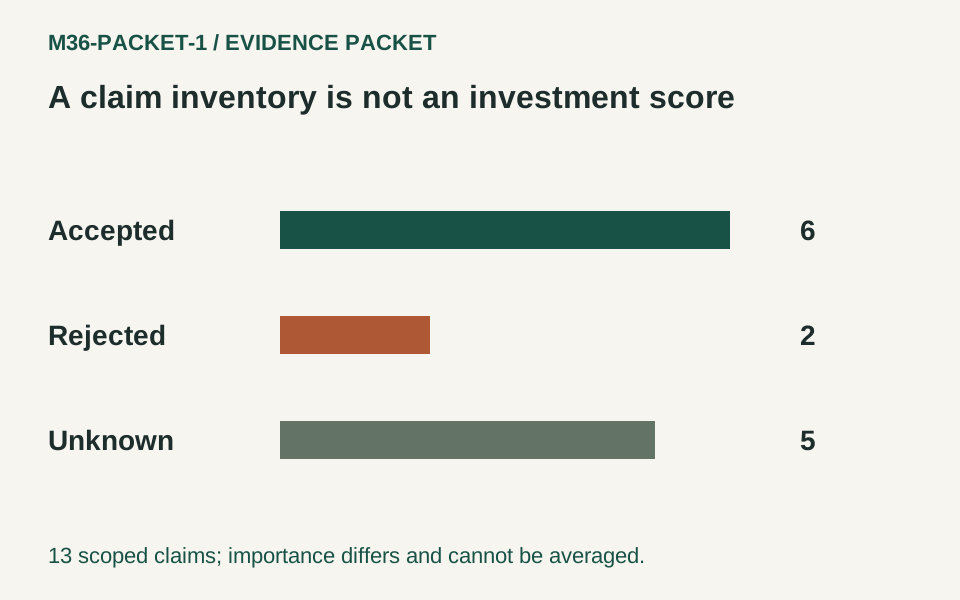
The packet has six accepted, two rejected and five unknown claims. These counts describe the review inventory; one consequential unknown may matter more than several accepted implementation facts.
Interpretation and evidence
- Interpret each claim inside its boundary.
- Keep unknown distinct from rejected.
- Choose the next investigation by consequence.
The packet's executed validation produced 13 claim records: six accepted, two rejected and five unknown. Those counts are not a score, a confidence percentage or a ranking of the project's investment quality. The claims have different consequences and cannot sensibly be averaged as though they were interchangeable questions.
An unknown about a nonessential future feature may not affect the next step. An unknown about whether the system can safely perform its central action may determine the whole scope of the next commitment. A rejected universal performance claim may require narrower wording rather than abandonment of the implementation.
The register is useful because it makes those distinctions discussable. Each entry names the claim, the artifact references, the basis for the status and the limit of the conclusion. The reader can ask for a missing test or dispute an interpretation at a precise point.
A small executable packet cannot replace technical judgment. It can make that judgment more accountable by keeping arithmetic, provenance and declared uncertainty visible. That is a worthwhile foundation for an investment conversation, while leaving the investment decision where it belongs: in a broader assessment that these engineering artifacts do not pretend to complete.