Early, but Reversible: What an AI Pilot Should Actually Teach
A useful AI pilot buys knowledge while keeping the consequences of a mistaken assumption manageable. Demonstration, learning and deployment are different commitments.
Explore the mechanism ↓
Reading tools Listen or translate
Read aloud
Uses an installed voice on your device.
Translate article
Machine translation. Code and evidence notes stay in English.
Original English text.
START WITH THE MECHANISM
Interactive companion and laboratory update: 12 November 2026. The editorial date places the topic on the timeline; this current explanation and its measured evidence retain their actual preparation and execution dates.
THE FULL INVESTIGATION
Early, but Reversible: What an AI Pilot Should Actually Teach
Dates and technology context
This is a retrospective editorial timeline. Topic context: 30 September 2025. First publicly available: 12 November 2026. Current text, visuals and laboratory revisions were prepared on 12 November 2026.
Links to the new RAG, ValueTask and spending-authority laboratories require12Nov2026 addition labels.
A team can finish an impressive AI pilot without becoming much wiser about whether it should build the product. The demonstration works, the audience is interested, and the prototype makes the proposal feel more concrete. Yet the questions that determine a durable commitment may remain almost untouched.
What did the team learn about the data it can use? Which failures did it observe? What work remains with people? Can the experiment be stopped without leaving a new dependency behind? What evidence would justify moving from a bounded trial to an operating promise?
My position is that a good pilot buys useful knowledge while keeping the consequences of a mistaken assumption manageable. It is not merely a smaller version of a deployment. It has a different purpose and therefore needs a different definition of success.
This does not mean that every early commitment should be easily reversible. Some worthwhile discoveries require real integration, meaningful effort or a relationship that cannot be treated as disposable. It means that the commitment should be chosen deliberately, with a clear account of what it is expected to teach.
The examples in this essay are hypothetical unless explicitly linked to a documented reference laboratory. They describe ways to reason about a pilot, not client engagements, investment recommendations or a prediction about which platform will win.
Choose the question before the demonstration
Consider a hypothetical company exploring an assistant for internal procedures. A simple pilot ingests a folder, answers questions and displays citations. The demonstration looks convincing because it uses familiar documents and asks questions the project team understands well.
What decision does that success support? It may establish that the selected components can be connected. It may show that an interaction is understandable. It may reveal that employees would like a quicker way to find a procedure. These are useful observations, but they do not establish the same thing.
If the next commitment concerns access to sensitive documents, the pilot needs evidence about permissions. If it concerns saving employees' time, the pilot needs a meaningful account of the work it replaces and the work it adds. If it concerns maintaining the system, the pilot needs to expose what happens when documents change.
A vague objective such as explore AI leaves too much room to redefine success afterward. Almost any attractive result can be presented as progress. A sharper question gives the team a way to choose the smallest experiment that can change a decision.
For the procedure assistant, a useful question might be whether a controlled set of version-sensitive requests can retrieve the applicable source without crossing access boundaries. That is narrower than building a company-wide knowledge assistant. It is also easier to test and harder to satisfy with a polished but irrelevant demonstration.
A pilot and a deployment make different promises
01 / See the idea
A demonstration and a commitment differ
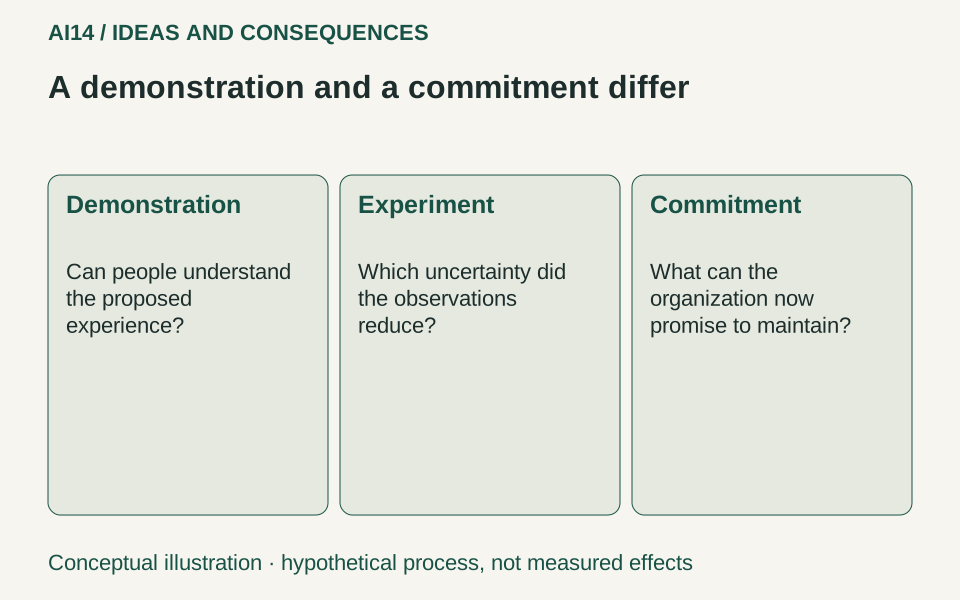
A hypothetical pilot can support a useful demonstration without answering the questions needed for deployment. The three outcomes should be assessed separately.
Interpretation and evidence
- Name the learning objective.
- Do not turn a demo into a deployment promise.
- Make the next commitment depend on relevant evidence.
A deployment promises a service that people can rely on. A pilot promises an opportunity to learn about a possible service. Confusing those promises creates trouble in both directions.
If a pilot is judged as though it were a finished service, the team may spend heavily on infrastructure before resolving whether the basic use case is worthwhile. If a pilot is treated as exempt from every operating obligation, people may begin depending on something whose limits nobody has accepted.
The boundary should therefore be explicit. Who may use the pilot? For what decisions? With which data? What happens when it fails? How long will the experiment remain available, and who decides whether it continues?
In the hypothetical procedure assistant, the team might allow a small group to explore a public internal handbook while prohibiting its use as the sole authority for consequential decisions. That limitation should appear in the workflow and the evaluation, not only in a disclaimer nobody reads.
The pilot can still be useful. It can expose confusing documents, missing version information or an interaction that users find awkward. Those findings may change the proposal before the organization commits to a broader service.
The critical distinction is that the experiment's usefulness comes from the information it produces. A prototype becoming popular does not automatically answer whether the organization is prepared to maintain the dependency it creates.
Reversibility has several layers
02 / See the idea
Stopping has several layers
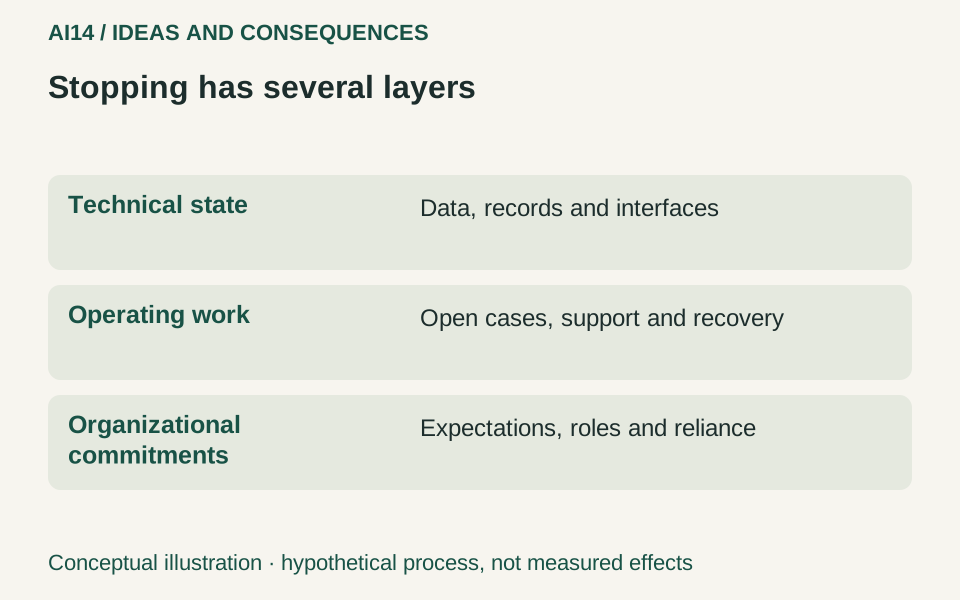
Turning off a process does not remove every obligation created by a pilot. This conceptual map shows the layers whose exit costs need to be understood.
Interpretation and evidence
- Identify the state that survives shutdown.
- Assign unfinished work to an owner.
- Include user expectations in the exit decision.
The ability to turn off a process is only one part of reversibility. A pilot can stop running while leaving behind copied data, changed workflows, expectations, integration code and knowledge that only one person possesses.
Technical reversibility concerns the system's state. Can created records be identified? Can a generated change be separated from the original? Can data be exported in a form another component can use? Is the previous path still available and understood?
Operational reversibility concerns the work around the system. Can the team return to the earlier process without losing track of cases? Does someone know how to handle work started by the pilot? Are users informed about what will happen to unfinished requests?
Organizational reversibility concerns the commitments people have made. A pilot may create an expectation of continued support or reshape how staff divide responsibilities. Those effects are not necessarily bad, but they should not be mistaken for cost-free experimentation.
The right question is not whether every effect can be erased. It is whether the organization understands the cost and consequences of stopping. A pilot can be rational even when exit is expensive, provided the expected learning justifies that commitment and the relevant owners accept it.
Calling an experiment reversible without examining these layers is a way of hiding its obligations inside an optimistic label.
The price of exit should influence the experiment's shape
Suppose two hypothetical pilots address the same question about document retrieval. One uses a copied, controlled corpus and exports all evaluation records. The other modifies the company's document repository, adds a proprietary workflow and trains users to depend on a new portal.
The second may reveal integration issues the first cannot. It also creates a different cost of exit. That does not make it wrong. It means the additional commitment should buy additional knowledge that matters to the decision.
If the immediate uncertainty concerns whether source versions are preserved in answers, deep integration may be premature. If the uncertainty concerns whether the existing access model can be respected in practice, some integration may be necessary.
The experiment should therefore earn its complexity. Each new dependency should answer a named question or make an essential observation possible. Otherwise, the pilot accumulates infrastructure because infrastructure feels like progress.
This approach also helps distinguish a useful prototype from an accidental foundation. A team can deliberately build disposable code when the artifact's purpose is to test an interaction. It can build production-shaped components when it needs evidence about operating behavior. The choice should be visible, because the standards and costs differ.
A prototype is not dishonest because it will be discarded. It becomes misleading when its temporary assumptions are used to justify a permanent commitment without being revisited.
Decide in advance what would change your mind
03 / Watch the mechanism
Evidence decides the next commitment
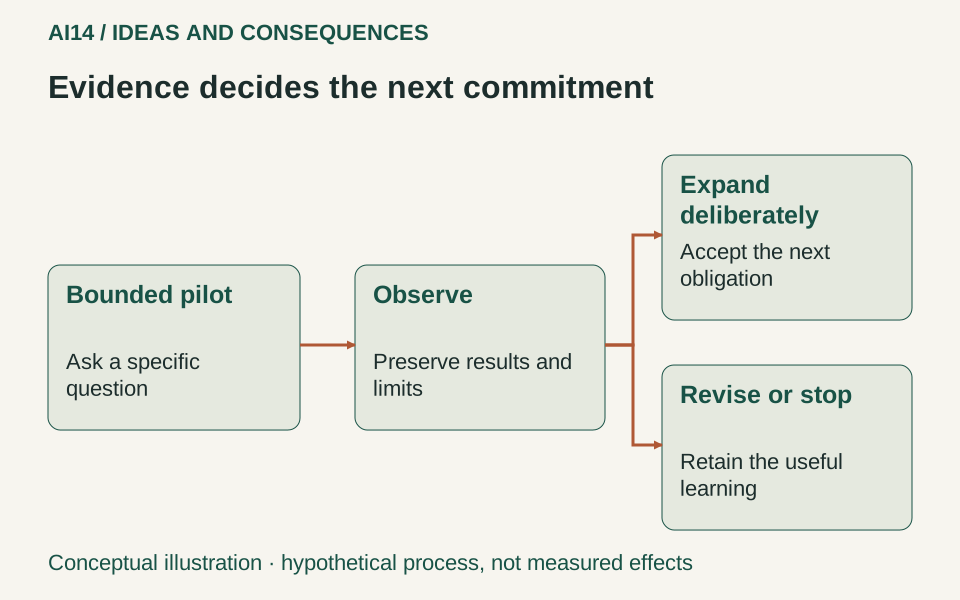
Static view. Play to see how the mechanism unfolds.
The animated paths represent alternative decisions after a hypothetical pilot. Evidence can justify expansion, a changed experiment or stopping; no path is a predetermined rollout.
Interpretation and evidence
- Define what would change the decision.
- Keep evidence separate from enthusiasm.
- Preserve learning when the pilot stops.
An experiment needs a relationship between possible observations and the next decision. If every outcome leads to the same larger rollout, the pilot is functioning as a rehearsal for approval rather than a test.
For the procedure assistant, consider several possible findings. Correct source retrieval may be strong for straightforward questions but weak when policies contain exceptions. Users may like the interface but spend substantial effort verifying answers. Access filtering may work on the controlled corpus while document updates create stale evidence.
Each result suggests a different next step. The team might narrow the use case, improve the source structure, change the interaction or stop the effort. It might also proceed because the useful cases justify the operating cost.
The decision rule need not be a single numerical threshold. Some requirements are hard boundaries, such as not retrieving a document outside the user's permitted scope. Others involve judgment, such as whether the verification effort is acceptable for a particular task. Both should be stated before the team becomes attached to its preferred story.
This does not prevent learning from unexpected observations. A pilot can discover a different valuable question. The team should record that change explicitly rather than pretend the new goal was the original success criterion all along.
An honest pivot preserves what was learned and why the next experiment differs. A moving definition of success preserves enthusiasm while making the evidence difficult to interpret.
A demonstration is useful evidence about a small boundary
There is no need to dismiss demonstrations. They can make an idea understandable, reveal an interaction problem and help people discuss a requirement they struggled to express abstractly.
The limitation is that a demonstration often removes inconvenient variation. It uses selected inputs, a prepared environment and a presenter who knows what should happen. That can be appropriate for communication, but it is a different setting from an evaluation designed to expose failure.
A good pilot can contain both. The demonstration explains the intended experience. The evaluation asks what happens when the assumptions change. Keeping those activities separate allows the team to communicate clearly without treating the presentation as its entire evidence base.
In the hypothetical assistant, the demonstration might show a well-supported answer to a simple policy question. The evaluation should also include an obsolete document, an ambiguous request, a missing permission and a question that the authorized corpus cannot answer.
The purpose is not to embarrass the prototype. It is to discover what kind of promise the prototype could support. A system that reliably helps with a narrow class of questions may be more valuable than a broader system whose failures are difficult to recognize.
The pilot should leave the organization better able to state that promise, even if the demonstration itself needs to become less ambitious.
An unwelcome result can be the most useful deliverable
The publication's local retrieval experiment offers a concrete example of bounded learning. Both compared methods retrieved the manually required evidence within their top three on a small synthetic set, yet their first-result behavior differed across question families. The result did not justify calling the entire problem solved.
The reusable-source laboratory supplies a different example. The specialized implementation reduced managed allocation in the tested fixture without improving median elapsed time. That finding narrows the reason for adopting it.
These are engineering laboratories, not studies of product adoption or customer value. Their relevance to a pilot is methodological: the evidence can be useful even when it weakens the original intuition.
If a pilot shows that document maintenance is the main obstacle, the next investment may belong in the information process rather than the model. If it shows that an apparently sophisticated component adds complexity without improving the relevant outcome, keeping the simpler approach is a legitimate result.
The organization must make room for this possibility. A team asked to prove that a predetermined technology is the future has little incentive to preserve a finding that supports a narrower conclusion. A team asked to reduce uncertainty can treat that same finding as successful work.
The difference lies in the pilot's mandate, not in the enthusiasm of the people building it.
Earlier platform changes are questions, not prophecy
It is natural to compare AI adoption with earlier changes in software platforms. Such comparisons can generate useful questions: which dependencies became difficult to replace, which skills transferred, and which early experiments clarified the real operating burden?
An analogy is not evidence that the same sequence will repeat. Different technologies, markets and organizations create different constraints. A story about an earlier platform cannot determine the right time for a particular company to adopt an AI capability.
The useful move is to translate the analogy into an inspectable question. If the concern is dependence on one provider, examine what must change to replace it. If the concern is losing time to learn, identify the capability the team can develop through a bounded experiment. If the concern is premature architecture, compare the knowledge gained with the commitments introduced.
This avoids two symmetrical mistakes. One says that every new wave must be adopted early because previous waves mattered. The other says that waiting is always wise because early technologies change. Both replace a local decision with a general story.
The decision should instead be grounded in the problem, the available options and the consequences of being wrong. Historical experience can help identify the relevant questions, but the pilot still has to produce evidence about the current situation.
Waiting has a cost too
04 / See the idea
Three legitimate choices, three questions
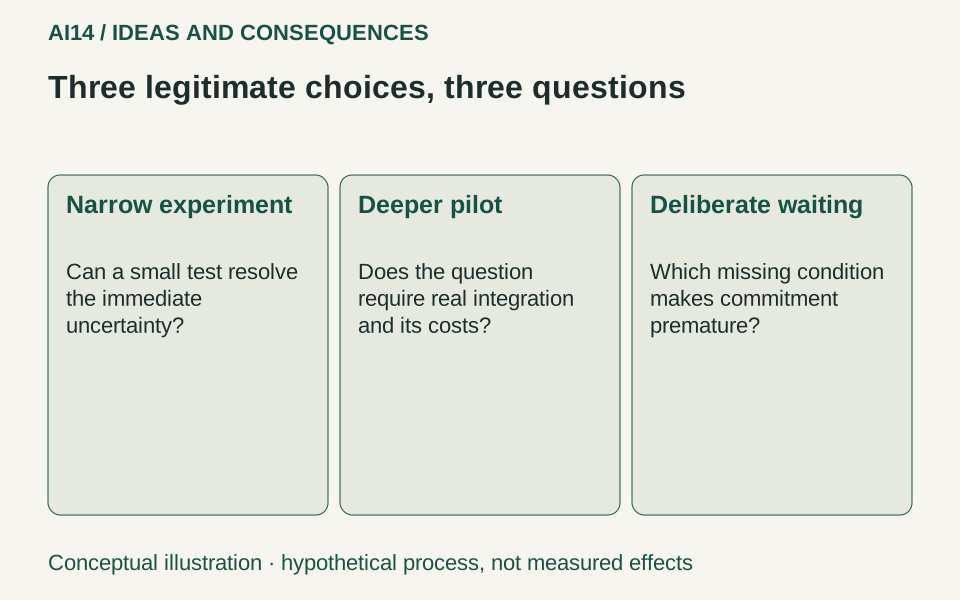
Reversibility should shape the commitment rather than make caution an automatic winner. The choice depends on what can be learned and which consequences the organization accepts.
Interpretation and evidence
- Compare the cost of waiting too.
- Make complexity earn its place.
- Do not confuse an open question with a reason never to act.
The strongest objection to emphasizing reversibility is that it can become a sophisticated way to avoid commitment. A team can keep designing safe experiments while competitors or internal needs move ahead. Some capabilities are learned only by doing work that matters.
That objection deserves a real answer. The alternative to a pilot is not always a cost-free continuation of the present. Waiting may preserve a manual burden, delay the discovery of a data problem or leave a team unfamiliar with a technology it will later need to use.
The relevant comparison includes those costs. A modest experiment can be justified by the value of learning even when immediate deployment is unlikely. A deeper pilot can be justified when the remaining uncertainty concerns integration that cannot be studied from the outside.
Reversibility should therefore influence the size and design of a commitment, not become a rule that commitments are bad. The team should know which uncertainty it is accepting and why the next step is proportionate.
Sometimes the right decision is to proceed with an acknowledged risk. Sometimes it is to run a smaller experiment. Sometimes it is to wait for a capability, requirement or contractual condition that does not yet exist. A useful framework leaves room for all three instead of rewarding caution automatically.
The question is whether the organization can explain its choice in terms of the knowledge it has and the consequences it is prepared to carry.
Rollback is incomplete without handling unfinished work
A shutdown switch can stop new activity while leaving the old activity unresolved. Requests may already be in progress, generated records may have been reviewed, and external effects may have occurred without confirmation.
For a hypothetical pilot that prepares service orders, rollback needs to identify which orders are drafts, which were approved and which were sent. Restoring an earlier interface does not undo a dispatched instruction. The organization needs a plan for reconciling the state it has created.
The action-reservation laboratory demonstrates a narrow version of that problem: a lost reply does not establish that the receiver did nothing. Its controlled example preserves an uncertain obligation until reconciliation. It is not evidence about a particular pilot's recovery plan, but it shows why stopping and undoing are different claims.
A pilot with consequential effects should make unfinished work visible before it starts. It should define who can resolve it, which records will survive shutdown and how users will be informed. For a low-risk read-only experiment, the requirements can be much simpler.
This is where proportionality becomes concrete. The more durable the effects, the less credible it is to call the experiment temporary merely because the project has an end date.
Preserve the learning in a form another team can use
A pilot can end successfully while its knowledge disappears with the people who ran it. A presentation may preserve the conclusion but omit the conditions that made it reasonable.
The handoff should therefore include the question, the important assumptions, the tested configuration, the observations and the decision those observations support. It should also identify what was not tested. This need not become a large report; it needs to be usable by someone who was not present during the demonstration.
For the procedure assistant, the useful package might include the controlled corpus, the query families, the failed distinctions and the unresolved access questions. A future team can then decide whether a changed model or document process justifies a new test.
The source-evidence API laboratory makes a related distinction between publication, applicability and observation. A record being checked today does not make its contents applicable to every historical or current situation. The same care should apply to pilot conclusions.
When the environment changes, the organization should know which part of the evidence needs renewal. Otherwise, a once-useful pilot can become a permanent citation for a decision whose assumptions no longer hold.
A small scope should make the conclusion sharper
A pilot does not become weak merely because its scope is small. It becomes weak when the conclusion is larger than the scope. A carefully chosen set of documents can reveal a version-handling defect. It cannot establish quality for every document collection the company may later connect.
The report should therefore state both the finding and the extension that remains untested. If the next phase adds another language, a different access model or longer documents, those are changes in the evidence boundary. They should not inherit confidence automatically from the earlier phase.
This makes staged work more useful. Each phase can preserve what remains valid, test what changed and avoid repeating checks without a reason. The organization can increase its commitment as the relevant uncertainty decreases, while retaining the ability to stop at a boundary it understands.
The resulting story may be less dramatic than a single announcement that AI is ready for the business. It is more actionable: this question has been answered under these conditions, and this is the next question worth paying to resolve.
Commit to the next question, not the inevitable rollout
The end of a pilot should produce a decision with a boundary. Continue because specified evidence supports the next commitment. Change direction because an assumption failed. Stop because the expected value no longer justifies the work. Defer because a necessary condition remains unavailable.
Each can be a responsible outcome. The common requirement is that the organization can explain what it learned and what that learning permits it to promise next.
Before beginning, ask what would make the pilot worth doing even if the final decision were not to deploy. If there is no answer, the project may be an approval exercise disguised as experimentation. If every useful answer requires a full rollout, the chosen question may be too broad for a pilot.
Then ask what would remain if the experiment stopped tomorrow: data, unfinished work, commitments, dependencies and knowledge. The answer reveals the real cost of being early.
AI creates new opportunities to build and explore quickly. The disciplined response is to make learning equally concrete. A good pilot leaves the organization with a clearer decision and an honest account of its obligations, rather than only a more persuasive demonstration of what it already hoped to believe.
Sources and editorial evidence
Download the source notes and visual explanations. This essay contains no new workplace measurements.