A Career Built on Judgment, Not Syntax Recall
Engineering judgment is built through specific decisions and feedback. A career strategy should develop that ability without treating technical fluency as disposable.
Explore the mechanism ↓
Reading tools Listen or translate
Read aloud
Uses an installed voice on your device.
Translate article
Machine translation. Code and evidence notes stay in English.
Original English text.
START WITH THE MECHANISM
Interactive companion and laboratory update: 12 November 2026. The editorial date places the topic on the timeline; this current explanation and its measured evidence retain their actual preparation and execution dates.
THE FULL INVESTIGATION
A Career Built on Judgment, Not Syntax Recall
Dates and technology context
This is a retrospective editorial timeline. Topic context: 12 May 2026. First publicly available: 12 November 2026. Current text, visuals and laboratory revisions were prepared on 12 November 2026.
The unwelcome-result examples use November2026 technical laboratories, not career or client observations made in May2026.
Prepared on 12 November 2026, this retrospective essay considers engineering careers through the lens of 12 May 2026; it does not claim publication on that earlier date.
The advice to focus on judgment can sound reassuring to an engineer watching more implementation work become assisted. It can also be almost useless. Judgment is easy to praise and difficult to develop unless we name the decisions it consists of.
An engineer exercises judgment when deciding whether a requirement is coherent, whether an observation supports a diagnosis, whether a dependency is worth its operating cost, or whether an apparently successful change is safe to release. These are concrete activities. They depend on technical knowledge, context, and feedback.
My argument is that a durable career should be organized around improving those activities. Syntax recall remains useful, but it should serve the ability to understand consequences rather than become the main evidence of professional value.
This is a proposed strategy, not a forecast that any particular role is safe from change. No essay can promise that a labor market will reward the right habits. It can, however, distinguish skills that make a person more useful in consequential work from signals that merely make expertise look familiar.
Judgment is visible at a choice
Imagine a hypothetical engineer asked to make an application faster. One response is to begin replacing code with patterns associated with performance. Another is to ask which user interaction is slow, under what workload, and what observation would establish the limiting factor.
The second response may initially produce less code. It can still be the more valuable contribution because it prevents work on the wrong problem.
The distinction is not between thinking and doing. Investigation is work, and an engineer who never reaches an implementation is not automatically exercising superior judgment. The value lies in connecting action to a defensible explanation of why the action should help.
The same pattern appears in design. Choosing a queue, a cache, or a different database is not meaningful expertise by itself. Explaining which constraint the choice addresses, what cost it introduces, and what would make it inappropriate is closer to the professional contribution that matters.
This is also something a colleague can inspect. A claim to have good judgment is difficult to evaluate. A decision with visible assumptions and evidence gives another person a basis for agreement or challenge.
For career development, that suggests a practical shift: collect examples of decisions you can explain, not merely technologies you have encountered.
Technical fluency still matters
01 / See the idea
Judgment connects knowledge to consequences
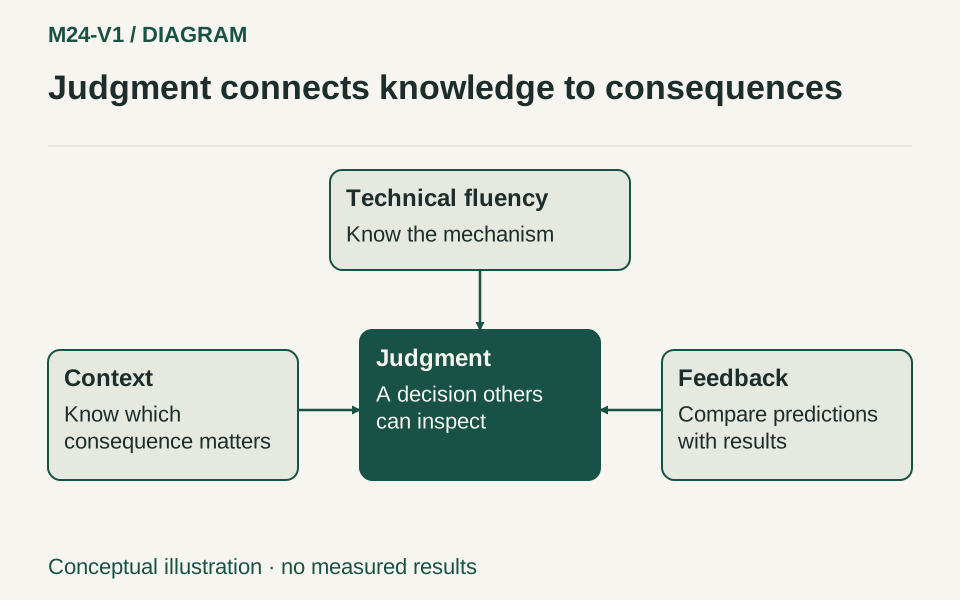
Technical knowledge, context and feedback support a consequential choice together. The map does not treat syntax as disposable or judgment as a title; it shows the ingredients an engineer needs to reason about an actual responsibility.
Interpretation and evidence
- Learn the mechanisms behind your decisions.
- Connect technical action to a relevant consequence.
- Use feedback to revise the mental model.
There is a tempting but mistaken conclusion that if tools can produce code, engineers can stop learning implementation details. Judgment without a working model of the system becomes a vocabulary of plausible concerns.
A person deciding whether a retry is safe needs to understand effects, state, and failure. A person reviewing a query needs enough knowledge to recognize how its shape relates to the data and workload. A person evaluating telemetry needs to know what the measurement includes and excludes.
Technical fluency reduces the effort required to reason about these questions. It also makes unusual behavior easier to notice. Someone who must ask an assistant to explain every basic mechanism may find it difficult to recognize when the assistant has omitted a crucial condition.
The goal is therefore selective depth, not the abandonment of detail. Learn the mechanisms that govern the systems you are responsible for. Use references and assistance for details that do not need to remain in memory. Be able to distinguish the two.
This distinction will differ by role. A database specialist and a product engineer need overlapping but different depths. There is no universal list of facts every engineer must recall without help.
The useful test is whether the person can reason about the consequences of the work they are authorized to do. Memory is one resource in that reasoning, not the entire profession.
Tools can move effort without removing it
A Microsoft Research survey published in April 2025 reported that AI-assisted knowledge work involved critical-thinking activities such as verification and task stewardship. The findings are self-reported and do not predict careers or establish causal skill changes. They nevertheless support examining where the human effort moves when producing an answer becomes easier. Microsoft Research, CHI 2025.
For an engineer, that movement may create both an opportunity and a trap. The opportunity is to spend less time on routine production and more time on the decisions surrounding it. The trap is to accept the produced answer so quickly that the remaining judgment never occurs.
An assisted workflow should therefore make room for questions that output alone cannot answer. What requirement is being assumed? Which failure matters? How would we know that the proposed explanation is wrong? Who will operate the result?
These questions are not a ritual to perform on every trivial task. They are habits to apply where the consequences justify them.
The career value comes from becoming consistently useful at locating those boundaries, then helping the team act on them.
Build a record of changed minds
02 / A concrete example
Two starts to a slow-application task
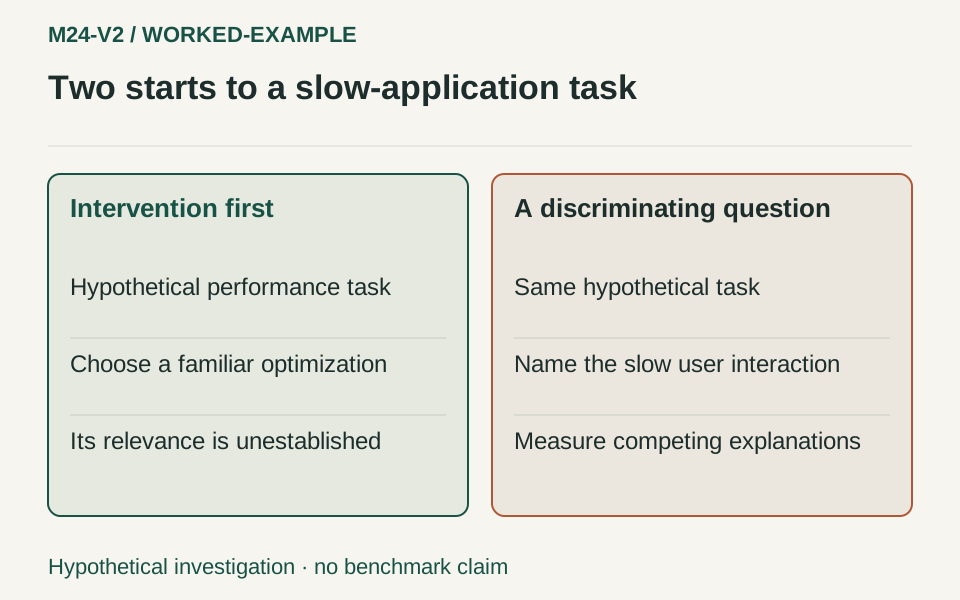
The hypothetical engineer who starts with a measurement may initially produce less code. The point is to establish which intervention has a defensible reason to help, not to celebrate investigation that never leads to action.
Interpretation and evidence
- Less early code can still be useful work.
- Connect the measurement to a user boundary.
- Publish genuine changed conclusions, not invented successes.
A portfolio often presents finished work as a sequence of successes. That is understandable, but it can hide the reasoning that would help a collaborator assess the author.
A more revealing portfolio can show how a conclusion changed. A performance investigation might begin with one hypothesis and end with another because a measurement discriminated between them. A design note might explain why a simpler approach became preferable after the actual requirement was clarified.
These examples should be real when presented as experience. If no investigation has been performed, publish a labelled proposal or laboratory plan instead of inventing a result.
The point is not to advertise mistakes. It is to show that evidence has authority over preference. A person who can explain why they revised a decision demonstrates something more useful than a claim that their original instincts were always correct.
This can be done without exposing private client information. A public reference implementation, a carefully bounded experiment, or an analysis of an open technical question can make reasoning inspectable. The work should identify its limits rather than imply a production history it does not have.
For someone beginning to publish, this is an attainable standard. The first useful article does not need a dramatic career story. It needs a question, a transparent method of thinking about it, and an honest account of what the work establishes.
Do not turn judgment into status
There is a social risk in this argument. Senior engineers can use the language of judgment to protect authority while junior engineers are expected to perform the implementation. If judgment cannot be questioned, it becomes a title rather than a capability.
Good judgment should make its reasons available. A senior person's experience can generate valuable hypotheses, but experience does not remove the need to connect a recommendation to the present system.
Likewise, a junior engineer may notice a contradiction that others missed. Their contribution should be evaluated by its reasoning and evidence, not discounted because they lack a long history with the organization.
A career strategy centered on judgment should therefore include the ability to explain decisions at a level other people can engage with. It should include listening when someone identifies a missing condition. It should include recognizing when another person has the relevant domain knowledge.
These behaviors can look slower than issuing a confident answer. They can also prevent a team from committing to a mistake that confidence made difficult to challenge.
The practical standard is demanding but fair: if a recommendation is consequential, its authority should not depend entirely on the identity of the person making it.
A practice plan with observable feedback
03 / Watch the mechanism
Practice judgment with observable feedback
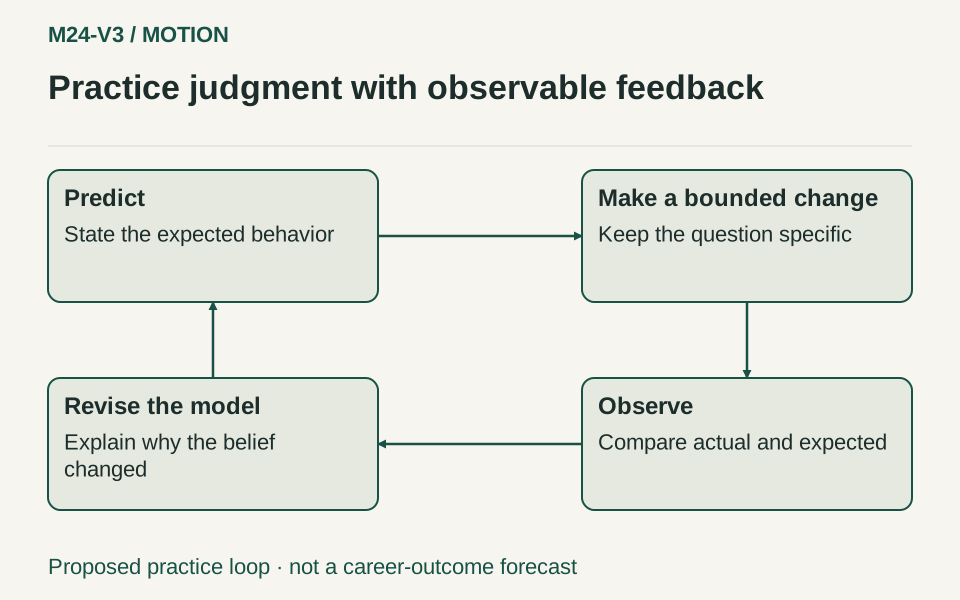
Static view. Play to see how the mechanism unfolds.
An engineer could practice with one query, workload or dependency decision whose feedback arrives soon enough to be useful. The record preserves whether the model, the assumptions or the measurement boundary needed correction.
Interpretation and evidence
- Choose a responsibility with observable feedback.
- Use AI for hypotheses, not invented observations.
- Keep the practice small enough to continue.
An engineer can develop judgment deliberately by choosing a small area of responsibility and keeping a record of predictions. Before a change, state what you expect to happen and why. Afterward, compare the expectation with the observation.
This could concern a query plan, a service's behavior under a particular workload, or the operating consequences of a dependency. The topic should be narrow enough that feedback arrives in a useful time frame.
When the prediction is wrong, distinguish an incorrect model from an incomplete observation. Perhaps the mechanism was misunderstood. Perhaps the workload differed from the assumption. Perhaps the measurement did not represent the boundary you thought it did.
Ask a colleague to challenge one consequential decision periodically. The purpose is not to collect approval. It is to discover an assumption you have stopped noticing.
Use AI as another source of hypotheses, explanations, and counterexamples, while preserving the distinction between a suggestion and an observation. An assistant can help enumerate possibilities; the environment must still tell you which ones apply.
Keep the practice small enough to continue. A brief decision note with a later correction can teach more than an elaborate learning system abandoned after a week. The unit of progress is an improved ability to predict and explain consequences, not the volume of notes produced.
The market objection
A reasonable objection is that employers and customers do not always reward careful reasoning. They may prefer speed, recognizable technologies, or a persuasive presentation. A person can develop excellent judgment and still struggle to communicate its value.
That is why the work must become legible. Explain the decision the evidence helps someone make. Connect a technical investigation to a practical consequence such as avoiding unnecessary complexity, locating a bottleneck, or clarifying an operating risk.
Do not claim a financial saving without evidence. Do not convert a laboratory result into a customer outcome. The goal is to show how you reason about value, not to inflate the scale of what you have done.
Technical depth and communication should reinforce one another. A clear explanation makes careful work usable. Careful work gives the explanation something worth communicating.
This still offers no guarantee of employment. It offers a more defensible basis for professional positioning than trying to remember more syntax than an increasingly capable tool can retrieve.
Judgment needs a technical object
01 / See the idea
Judgment needs something that can disagree
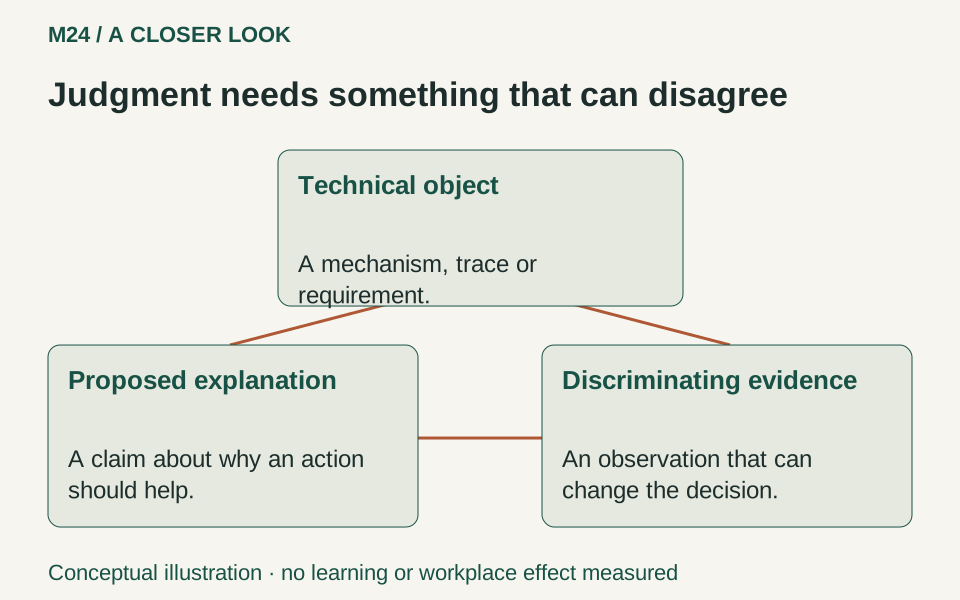
In a hypothetical performance investigation, the explanation must meet a measurement capable of challenging it. Judgment becomes inspectable when the engineer connects a decision to the technical object and its evidence.
Interpretation and evidence
- Build depth around the decisions you carry.
- Treat an unwelcome result as useful information.
- Distinguish an analytical example from personal history.
It is tempting to describe judgment as what remains after routine technical work has been automated. That formulation can make judgment sound detached from implementation, as though it were a general talent for making sensible decisions above the details.
In engineering, the details often determine whether the decision is sensible. A recommendation about cancellation depends on what can still be running. A recommendation about performance depends on what was measured. A recommendation about reuse depends on which obligations remain attached to the object being reused.
The technical object gives judgment resistance. It is something that can disagree with the explanation. A test can expose an assumption. A trace can show that work occurs at a different boundary. A user requirement can reveal that an apparently elegant optimization changes the promise the system makes.
Without that resistance, judgment risks becoming a style of speech. The person learns to name tradeoffs without demonstrating that they understand the mechanism producing them. AI can help produce such language, but the problem does not originate with AI. Humans can also sound thoughtful while avoiding the part of the question that would make their answer testable.
A useful career strategy therefore connects each desired responsibility to a technical object the person must learn to reason about. If you want to make performance decisions, learn to construct and challenge measurements. If you want to design reliable workflows, learn to trace effects across failures. If you want to advise on AI systems, learn where uncertain interpretation meets deterministic authority.
That is a more concrete ambition than becoming the person who supplies the final opinion. It means becoming useful where an opinion must survive contact with the system.
A decision record is not an autobiography of success
A professional body of work can show how a person thinks without turning every article into a story about an important client or a dramatic incident. A small, honest investigation can be more revealing than a large claim whose evidence cannot be inspected.
This essay is a professional argument, not an account of three unreported turning points in my career. The examples here are hypothetical unless identified as a documented laboratory. Personal experience can add value when its details are available and appropriate to share. It should not be invented to give an argument emotional weight.
For a hypothetical engineer building a portfolio, consider the difference between claiming expertise in asynchronous systems and explaining a narrow lifetime bug. The second contribution can state the contract, show the failing assumption, describe the correction and identify what the example does not establish. It gives another person something specific to assess.
The record should include decisions that became less attractive after investigation. If a specialized implementation reduces allocations but complicates ownership without improving the relevant outcome, choosing the simpler implementation may be the strongest conclusion.
That result should not be hidden because it looks less impressive than a new abstraction. The ability to abandon an unnecessary technique is part of engineering competence. It shows that the method serves the problem rather than the author's desire to demonstrate sophistication.
A portfolio built this way can grow through modest, verifiable work. It does not require a fictional history of exceptional projects. It requires care in making the reasoning visible and restraint in describing the result.
When assistance makes technical depth more important
An assistant can make it easier to reach unfamiliar code. That increases the opportunity to learn, but it can also create the impression that familiarity with the explanation is equivalent to understanding the mechanism.
Suppose a hypothetical developer receives a plausible reusable asynchronous component. They can read the method names and explain the intended flow. The harder questions concern ordering: can the previous result still be consumed, can a callback run during completion, and what prevents an old operation from being confused with a new one?
These questions require a model of time and ownership, not merely recognition of syntax. Assistance can help build that model by generating examples or explaining documentation. It cannot remove the need to compare the explanation with behavior.
The practical response is to choose depth deliberately. It is unreasonable to expect every engineer to understand every layer equally. It is equally unreasonable to accept responsibility for a critical boundary while treating its mechanism as an interchangeable generated detail.
A person should know where they can reason confidently, where they need a reference, and where they need another specialist. That calibration is more useful than either heroic self-sufficiency or complete dependence on a fluent assistant.
The learning question becomes: which mechanism would most improve my ability to assess the decisions I am already making? Answering that question can produce a focused study plan. Chasing every new framework often produces broader vocabulary without the same improvement in judgment.
Later laboratories show the value of an unwelcome result
Contemporary laboratory note, prepared 12 November 2026. These examples postdate the essay's May 2026 context and are included as later demonstrations of the professional argument.
The reusable-source laboratory reduced managed allocation in its measured fixture without improving median elapsed time. That outcome matters because it resists the attractive story that a more specialized implementation must be a faster one.
The segmented-parser laboratory likewise separates avoiding unnecessary copies from claiming a universal speed advantage. Its interpretation depends on the declared inputs and measured boundary, while its correctness checks concern message handling under different storage layouts.
The runtime-async laboratory compares representations and execution under an explicitly identified later runtime. It is useful here because a change in artifacts or allocation is kept distinct from a blanket claim about speed. None of these experiments establishes a career outcome or a general result for every application.
The professional lesson is that a result can improve judgment while disappointing the original expectation. Preserving that result lets another engineer understand the tradeoff and decide whether it applies to their work.
It also changes what counts as an impressive portfolio. The important evidence is not how often the author finds a dramatic improvement. It is whether the author can define a meaningful question, execute a defensible check and accept the answer the evidence supports.
Responsibility grows through calibrated commitments
Career development is often described as taking on more responsibility. More is not automatically better if the person has no way to assess the commitments being accepted.
A calibrated commitment names what the engineer can establish, what depends on others and what uncertainty remains. It may involve a narrow component at first. Over time, the person can connect more components, understand more consequences and coordinate with more roles.
This growth should not require pretending to know everything. An engineer who can identify the point where another person's knowledge becomes necessary is exercising judgment, not surrendering it. The key is to make that dependency useful: ask a precise question, preserve the answer's conditions, and integrate it into the decision.
The same principle applies to AI assistance. A generated proposal can be one input among several. Its value depends on whether the engineer can determine what still requires checking and what would make the proposal inappropriate.
For a personal practice plan, choose one current responsibility and describe the evidence you would need to carry it well. Then identify the smallest missing skill or observation. That may lead to studying a runtime mechanism, learning to design an experiment, improving a decision note, or understanding the user's actual constraint.
The plan remains connected to work rather than becoming an endless accumulation of credentials. Its progress can be observed in decisions that become clearer, assumptions that become visible and commitments that become easier for other people to trust.
Choose the responsibility you want to earn
A career develops around the kinds of decisions other people become willing to trust you with. That trust should have a basis: understanding, evidence, candor about limits, and a record of following through when consequences arrive.
The useful question is therefore not which technical facts will remain impossible to automate. It is which responsibilities you want to become capable of carrying, and what knowledge and practice those responsibilities require.
Look at your current work. Where do you make a consequential choice? What feedback tells you whether the choice was good? Which mechanism do you need to understand more deeply to improve it?
Those questions do not replace technical learning. They give it direction. Syntax remains part of the craft, while judgment becomes the discipline of using the craft well enough that someone else can depend on the result.