Your Data Does Not Become Knowledge by Entering a Prompt
Retrieval supplies material for reasoning. Knowledge requires context, provenance and a defensible connection between evidence and decision.
Explore the mechanism ↓
Reading tools Listen or translate
Read aloud
Uses an installed voice on your device.
Translate article
Machine translation. Code and evidence notes stay in English.
Original English text.
START WITH THE MECHANISM
Interactive companion and laboratory update: 12 November 2026. The editorial date places the topic on the timeline; this current explanation and its measured evidence retain their actual preparation and execution dates.
THE FULL INVESTIGATION
Your Data Does Not Become Knowledge by Entering a Prompt
Dates and technology context
This is a retrospective editorial timeline. Topic context: 10 February 2026. First publicly available: 12 November 2026. Current text, visuals and laboratory revisions were prepared on 12 November 2026.
The later retrieval/interpretation examples were developed in November2026 and do not establish facts or observations available in February2026.
Prepared on 12 November 2026, this retrospective essay uses 10 February 2026 as its historical lens; it was not published on that date.
A company can possess the correct document and still make the wrong decision from it. The document may describe an old policy, use a different definition, apply to another customer, or omit an exception that the people doing the work consider obvious.
Putting that document into an AI system improves access to its contents. It does not automatically resolve those conditions.
This matters because the phrase connect the model to our data can sound like the final step in making an assistant knowledgeable. In reality, it is the beginning of a more specific design problem: how will the system distinguish material that is merely relevant from evidence that justifies a particular answer?
My argument is that organizational knowledge is partly a relationship between information and permitted action. A useful assistant must preserve that relationship, or clearly admit when it cannot establish it.
The engineering challenge is therefore larger than retrieval quality. It includes meaning, time, authority, and the ability to show how an answer depends on its sources.
A document can be relevant and still mislead
Consider a hypothetical support assistant asked whether a customer can cancel a contract without a fee. It retrieves a policy document containing the phrase cancellation fee and a section that appears to answer the question.
The document is relevant. But suppose it applies only to contracts signed after a particular date. The customer's contract is older. Another retrieved document describes a regional exception. A third is an internal draft that was never approved.
A fluent answer can be assembled from this material while remaining wrong for the actual case. The failure is not necessarily that the model invented a sentence. It may have combined genuine statements without preserving the conditions under which each statement is valid.
This is a hypothetical example, not legal guidance or a customer case. Its purpose is to show why factual fragments do not automatically form a warranted conclusion.
The system needs to know which contract is being discussed, which policy version applies, and which source has authority. If those facts are unavailable, the useful answer may be a precise request for missing information or a referral to the responsible person.
That response can look less impressive than an immediate conclusion. It is often more useful because it keeps uncertainty attached to the decision that depends on it.
Retrieval solves a real problem
01 / See the idea
Relevant text is only one ingredient
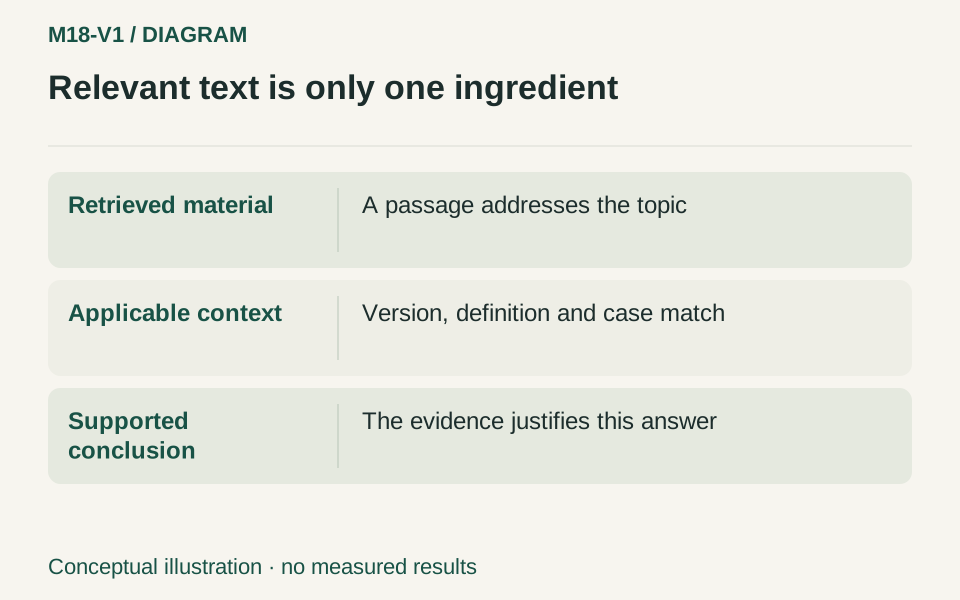
A retrieved policy can be relevant while applying to a different version or case. The figure separates access to text from the conditions that make a conclusion warranted.
Interpretation and evidence
- Relevance does not establish applicability.
- Preserve definitions and effective versions.
- State which inference connects evidence to action.
Retrieval-augmented generation is not an empty promise. The original RAG research combined model generation with retrieved external material and reported improvements on knowledge-intensive tasks. It also treated provenance and updating knowledge as important problems. Those results support retrieval as a useful mechanism; they do not establish the correctness of every enterprise decision made from retrieved documents. Lewis and colleagues, primary paper and version history.
The distinction is between a capability and a complete application contract. A retrieval system can find useful passages. An application must decide whether those passages are enough to answer the user's question in the relevant setting.
That decision may require information outside the document collection: the user's role, the date of the transaction, the status of a record, or the meaning of a business term. It may also require a rule for what to do when authoritative sources disagree.
These requirements should be visible in the design. Otherwise, the assistant can appear to possess organizational understanding when it actually possesses a collection of searchable text.
Searchable text is valuable. It becomes dangerous only when its availability is mistaken for a guarantee about the conclusions drawn from it.
The definition is part of the data
Imagine a hypothetical management question: did customer retention improve last quarter? The assistant finds several reports containing retention percentages. One counts active accounts, another counts paying organizations, and a third excludes customers acquired during the quarter.
The numbers may all be accurate within their definitions. Comparing them without preserving those definitions creates a new error.
The same issue appears in engineering telemetry. A metric called request duration might include time spent waiting at a gateway in one system and begin only when application code starts in another. A chart can look precise while comparing different boundaries.
This is why metadata should not be treated as optional decoration. Definitions, units, populations, time windows, and collection methods can determine whether a value is meaningful for a question.
An assistant that returns a number should be able to identify the boundary represented by that number. If the boundary is uncertain, that uncertainty belongs beside the answer rather than in a distant technical note.
The practical consequence is that data preparation cannot focus exclusively on extracting text. It must preserve the relationships that make the text interpretable. A table separated from its heading, a policy separated from its effective date, or a metric separated from its definition may retain words while losing the information that matters.
A citation is an invitation to inspect
02 / A concrete example
Three documents can disagree about one case
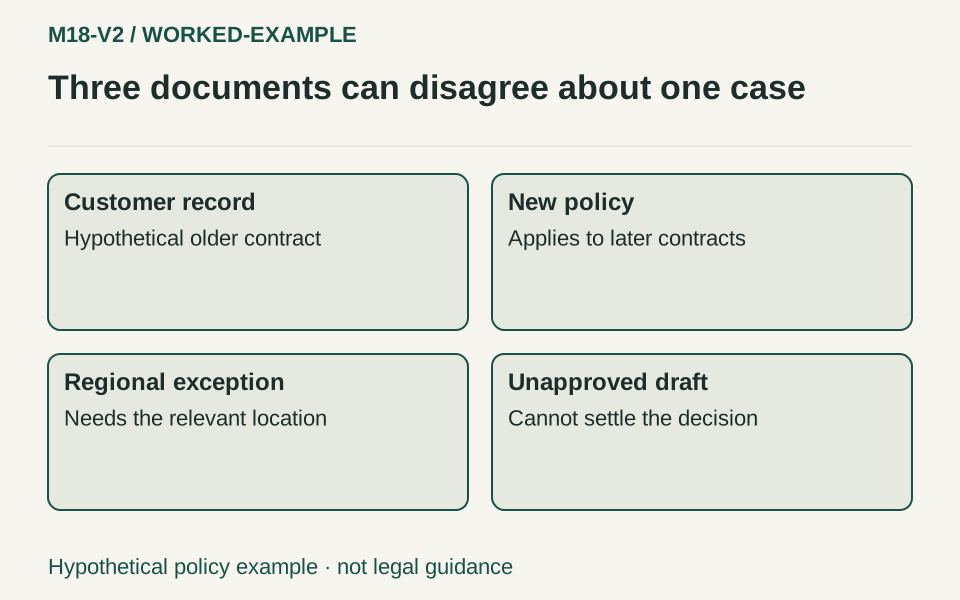
In this hypothetical cancellation question, genuine documents can still produce an unsupported answer if their scope is lost. The assistant needs the applicable contract and policy conditions before treating a passage as authority for the case.
Interpretation and evidence
- Do not combine true fragments without their scope.
- A citation must support the exact conclusion.
- Ask for the missing case information when it matters.
Adding a source link improves an answer only if the link supports the relevant claim. A citation can point to a real document that does not establish the conclusion, or to a passage whose exception was omitted.
The reader should therefore be able to inspect the connection between the answer and the evidence. Which passage supports this statement? Does the passage apply to the current case? Is the conclusion directly stated or inferred from several pieces of information?
These are different kinds of support. A direct quotation, a summary, and an inference should not be presented as though they carry the same certainty.
Consider a hypothetical answer that recommends increasing database capacity because latency rose during a busy period. A cited dashboard may establish the correlation. It does not, by itself, establish the cause or prove that additional capacity is the best response.
A useful assistant can say what the observation suggests and what further evidence would distinguish competing explanations. That is more informative than attaching the dashboard to a confident recommendation and allowing the citation to do rhetorical work it cannot perform logically.
Provenance should make an answer easier to challenge. When it functions only as a badge of authority, the system has missed much of its value.
Absence needs a vocabulary
An assistant connected to a document collection will often fail to find something. The meaning of that failure depends on the collection and the search process.
Not finding a policy is different from establishing that no policy exists. Not retrieving an exception is different from proving that there are no exceptions. A missing record may reflect an access restriction, an indexing delay, a naming difference, or an actual absence.
These distinctions can change the action a user should take. If a source is inaccessible, a responsible owner may need to inspect it. If the collection is known to be incomplete, the assistant should avoid a universal conclusion. If a search was narrowly scoped, the answer should preserve that scope.
A practical application can define a small set of useful states: supported by an applicable source, supported only under a stated assumption, conflicting evidence, missing required context, or insufficient accessible evidence. The exact labels matter less than their effect on the workflow.
The user should know whether to act, provide more information, or seek a different kind of review. A generic confidence score often fails to explain that next step because it compresses different reasons for uncertainty into a single number.
Do not turn every answer into a committee
03 / Watch the mechanism
Missing context changes the answer route
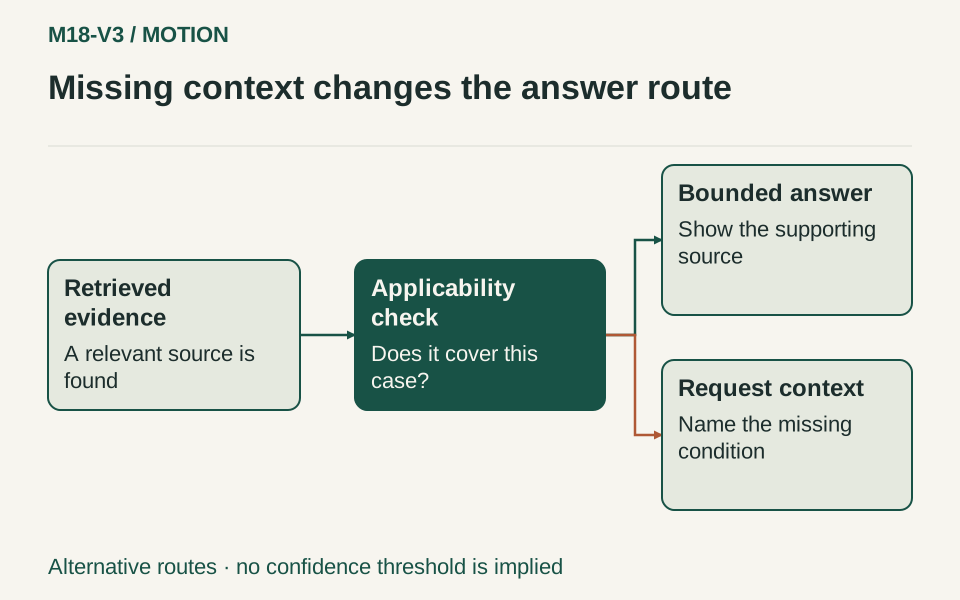
Static view. Play to see how the mechanism unfolds.
A hypothetical assistant can answer a low-consequence question when the applicable source is sufficient. When a necessary condition is missing, the useful output is a specific request for context rather than a confident conclusion.
Interpretation and evidence
- Match the evidence burden to the decision.
- Make uncertainty lead to a useful next action.
- Test inapplicable and conflicting-source cases.
There is a strong objection to this cautious approach. Most workplace questions are ordinary. If every answer requires a provenance investigation and an escalation path, the assistant may become slower than searching manually.
The answer is to match the evidence burden to the decision. Finding the location of a template is different from deciding whether a customer is entitled to a payment. Summarizing a meeting is different from authorizing a production change.
For low-consequence questions, a concise answer with a source may be sufficient. For a consequential decision, the assistant should expose the applicable conditions and identify missing evidence. The system should not impose the same ceremony everywhere.
This requires understanding the task, not merely classifying the document. The same policy can support a harmless explanation in one interaction and a consequential authorization in another. The requested action determines how much confidence is enough.
Nor does every uncertainty require a human. Some can be resolved by obtaining the correct version, checking a structured record, or asking the user a targeted question. Human review should be reserved for the judgment or authority that the system genuinely lacks.
The goal is useful discrimination: knowing when the available material is enough and when pretending it is enough would mislead the user.
What retrieval leaves undecided
01 / See the idea
Relevant is only the first boundary
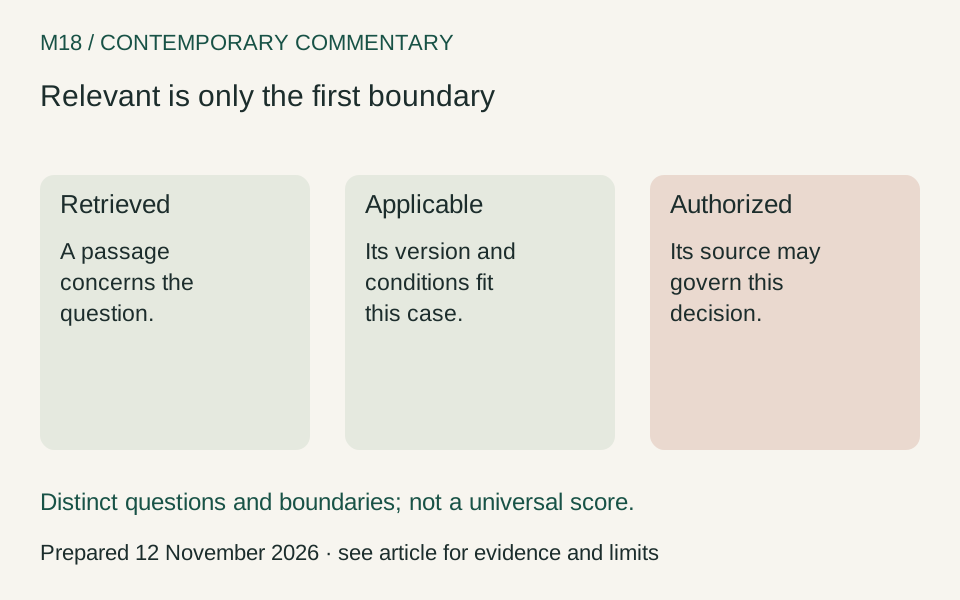
A retrieved passage can be relevant while its version or authority is wrong for the case. The three questions are distinct, not a universal automated knowledge pipeline.
Interpretation and evidence
- Test applicability as well as retrieval.
- Preserve version and scope.
- Do not infer authority from availability.
Contemporary laboratory note, prepared 12 November 2026. This section and the next three connect the earlier argument to subsequently executed reference laboratories; their results were not available at the February context date.
The most revealing result of a retrieval experiment is sometimes the question it cannot answer. Our typed RAG oracle laboratory reuses recorded retrieval outcomes and checks structured propositions against hand-authored expected facts. Its executed checks reject deliberately altered quantities, scopes, versions and conditions. They do not establish that a language model understands those distinctions in arbitrary prose. No generated answer is evaluated by that packet.
That boundary is useful because it separates two kinds of competence often merged in a demonstration. One system finds a passage. Another checks whether a proposed statement preserves the passage's relevant conditions. A search result can help the second system without completing its job. A correct structured comparison can reject an invalid proposition without explaining how to extract every proposition from natural language.
Consider a hypothetical storage policy saying that one file may contain at most a stated number of bytes. An answer about the total capacity of an account is not justified merely because it repeats that number. The value may match exactly while the object to which it applies has changed. A typed record can preserve both the value and the object, making that particular mistake visible. The remaining challenge is whether the record accurately represents the source and the user's question.
This is not an argument that all organizational knowledge should be forced into a rigid schema. Some questions require interpretation, conflicting values or an explanation of exceptions that no compact record captures adequately. It is an argument for using structure where a distinction determines the action. Units, effective versions and permission conditions are often such distinctions. A system should not repeatedly rediscover them through free-form persuasion when an explicit representation can preserve them.
The adverse finding is that successful retrieval and successful field checks still leave a gap before a warranted answer. Filling the prompt with more passages does not remove that gap automatically. It can add conflicting versions or more opportunities to combine compatible words with incompatible meanings. The useful question is which missing relationship would change the conclusion, and whether the application can establish that relationship rather than merely mention it.
A source identifier is not a theory of authority
02 / See the idea
What each evidence field can establish
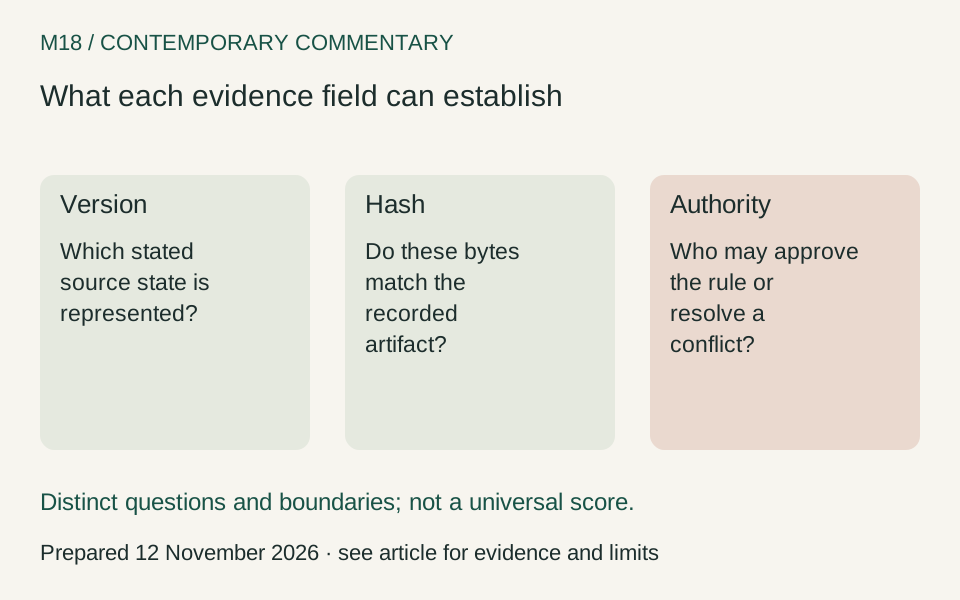
A version identifies a state and a hash supports integrity checking. Neither field decides whether a source has the institutional authority required by a consequential action.
Interpretation and evidence
- Identity is not truth.
- Integrity is not applicability.
- Authority needs an explicit rule.
The source-evidence API laboratory adds a different piece of the problem. It exposes source identity, version, hash and dates through an actual read-only HTTP application. Claims refer to evidence records, and requests that omit the required version are refused. The laboratory distinguishes a source's publication date from the date when a stated rule becomes effective. Its executed routes and refusal checks provide evidence about that application contract, not about the truth of every possible source.
The distinction between dates matters because publication and applicability answer different questions. A hypothetical policy can be published before it takes effect. Another document can describe an earlier event long after that event occurred. Selecting the latest published document may therefore be wrong when the user asks which rule governed a past transaction. A temporal filter is useful only when the field being filtered has the meaning the question requires.
A hash contributes another narrow assurance. It can show that a retained artifact matches a recorded byte sequence. It cannot establish that the original author was authorized, that the policy was approved or that the statement applies to the present case. Treating the hash as a badge of truth would merely replace one kind of misplaced confidence with another. Identity and integrity support examination; they do not complete interpretation.
Imagine a hypothetical assistant that retrieves an approved policy and an internal draft. Both have stable identifiers, complete timestamps and correct hashes. The technical metadata is impeccable. The answer is still unsafe if the draft is treated as equally authoritative. The application needs an explicit source-role distinction or an escalation path when authority is unknown. More precise storage cannot compensate for an absent rule about which source may govern the decision.
This is where institutional knowledge becomes visible as more than information possession. Someone must be entitled to approve a rule, define an exception or resolve a contradiction. An assistant can preserve the record of that authority and route a question to it. It should not manufacture authority from the fact that a document was easy to retrieve. A reliable evidence chain tells us where the answer came from and also where the chain stops.
The strongest objection is that people work with imperfect knowledge
An insistence on conditions and provenance can sound detached from ordinary work. People answer questions from memory, use incomplete documents and proceed without formal proof. If an assistant must meet a much higher standard, it may be excluded from tasks where it could help. That objection deserves more than the reply that safety is important.
The comparison should concern the entire workflow, including the cues a person ordinarily uses to interpret an answer. A colleague may know that a question concerns an older contract, remember that a policy owner is away, or say that their recollection is uncertain. A document assistant may lack those cues while producing a polished response that conceals their absence. Matching human usefulness may require recovering the context that the interface removed, not demanding mathematical certainty from every sentence.
At the same time, a human answer can be wrong in precisely the same way. Familiarity should not exempt it from a proportionate evidence burden. If an organization tolerates undocumented decisions from people but rejects the same uncertainty in software, the inconsistency is worth examining. The aim is a better decision process for both, not a ceremonial disadvantage for the machine.
A hypothetical team could use three response modes. For locating a document, the assistant provides the best available link. For explaining a general rule, it names the source and relevant exception. For authorizing a consequential action, it requires the applicable record and the responsible authority. These modes would not be ranked by how intelligent the assistant appears. They would reflect what the requested action puts at risk.
The boundary should also remain contestable. A user may know that a missing field is irrelevant to the current question, or that a supposedly authoritative document is obsolete. The workflow needs a way to challenge the system's interpretation without silently bypassing the rule. Otherwise provenance becomes bureaucracy: an impressive chain of identifiers that prevents correction rather than making correction possible. Knowledge is not merely a preserved answer. It includes a disciplined way to discover that the answer no longer applies.
Design the response around the next justified action
A useful answer does not have to resolve every uncertainty. It has to leave the reader better able to choose the next justified action. Sometimes that means a conclusion. Sometimes it means identifying the one missing fact that prevents a conclusion. Sometimes it means refusing to combine incompatible sources and showing the disagreement clearly.
Return to the hypothetical cancellation question. “I cannot answer” is less useful than “The retrieved policy applies to contracts signed after this effective date; the contract date is missing.” The second response describes a dependency the user may be able to resolve. It also makes a bounded promise: supplying the missing date may determine applicability, but it does not automatically settle every regional exception or approval condition.
This suggests a different evaluation unit. Instead of scoring only whether the final sentence resembles an expected answer, examine whether the response moves the case into a justified state. Did it preserve the relevant version? Did it distinguish a missing record from a negative fact? Did it identify a contradiction instead of averaging it away? Did it ask for context that could actually change the decision? These are proposed application checks, not newly measured outcomes in this essay.
The typed oracle and source API demonstrate that some parts of this contract can become executable. They also show why an engineering team should resist inflating the result. Passing a schema check does not establish arbitrary textual entailment. Serving versioned evidence over HTTP does not prove organizational authority. Their value lies in making specific failure modes harder to conceal, while leaving the remaining uncertainty named.
For an expert building such a system, that is a demanding form of ambition. It asks for more than a fluent interface, but less than the impossible promise that every question can be answered. It asks us to decide which conclusions the available evidence permits, make the decision inspectable and preserve the reader's ability to disagree. The result may occasionally say less. When it does speak, the reader should know more about why the statement deserves to guide action.
Test the interpretation, not only the search
A meaningful evaluation should include cases where the relevant document is easy to find but easy to misuse. Conflicting versions, similar names, conditional rules, and missing definitions can reveal failures that a collection of straightforward factual questions would miss.
For the hypothetical cancellation assistant, evaluation could include an older contract, a regional exception, and an unapproved draft. The desired behavior would specify whether the assistant should answer, ask for context, or stop short of a conclusion.
The evaluation should also check whether the cited source supports the exact claim. An answer can sound reasonable and contain a legitimate link while still making an unsupported inference.
These proposed checks do not prove that the system will handle every future case. They make the application contract visible and provide a way to improve it when new failures appear.
The most useful question is not whether the assistant can speak about the documents. It is whether the assistant helps a person make a decision that the documents actually justify.
Before adding more data, ask what meaning the current data loses on its way to the answer. Before increasing the model's confidence, ask which missing condition would make that confidence deserved.
The documents are raw material. Knowledge begins when the system preserves enough context for a conclusion to remain valid outside the prompt that produced it.