Why Publish When AI Can Already Explain the API?
A technical publication earns its place by exposing judgment, assumptions and the evidence that could change a recommendation.
Explore the mechanism ↓
Reading tools Listen or translate
Read aloud
Uses an installed voice on your device.
Translate article
Machine translation. Code and evidence notes stay in English.
Original English text.
START WITH THE MECHANISM
Interactive companion and laboratory update: 12 November 2026. The editorial date places the topic on the timeline; this current explanation and its measured evidence retain their actual preparation and execution dates.
THE FULL INVESTIGATION
Why Publish When AI Can Already Explain the API?
Dates and technology context
This is a retrospective editorial timeline. Topic context: 20 May 2025. First publicly available: 12 November 2026. Current text, visuals and laboratory revisions were prepared on 12 November 2026.
November laboratory examples of measurement boundaries and evidence-based editorial revision are later commentary, not evidence available in May 2025.
Prepared on 12 November 2026, this retrospective essay considers the question from 20 May 2025; it was not published on that earlier date.
An explanation used to be a relatively convincing demonstration of expertise. Someone who could explain a difficult API clearly had probably spent time with it. They had encountered its terminology, understood its examples, and arranged what they learned into a path another person could follow. The explanation was useful, and the effort behind it was at least partly visible.
Generative AI weakens that connection. A readable explanation can now appear before its publisher has developed the judgment the explanation seems to imply. This does not make explanations worthless. It makes the act of producing one a less reliable signal of understanding.
That is an uncomfortable starting point for a new technical blog. Why add another article when a reader can ask a machine for a tailored explanation? Why spend an evening editing paragraphs that can be generated in seconds?
My answer is that an expert should publish to make judgment available for inspection. Syntax explanations can support that purpose, but they cannot carry it alone. The reader should leave with a better understanding of what to believe, what to investigate, and where an apparently sensible recommendation stops being sensible.
That is a more demanding editorial ambition. It is also a more interesting one.
The missing decision
Consider a hypothetical developer building an application that imports customer records. An AI assistant explains asynchronous programming, shows how to start several operations, and produces a neat example. The explanation is accurate within its small boundary. The code may even compile.
The developer's actual problem is larger. The database has limited capacity. Imported records can refer to one another. Some failures should be retried, while others indicate invalid input. A user may cancel the import and expect it to stop promptly. The team needs to explain which records were accepted after an interrupted run.
An article that merely reproduces the API explanation leaves all those decisions untouched. An article that identifies them has already done something more useful, even before it proposes an implementation.
The difference lies in selecting the consequential question. Should this work run concurrently? Under which constraints? What does cancellation mean after a record has been committed? Which failure must become visible to an operator rather than disappear inside a retry?
These questions do not require an author to pretend that every topic demands a novel invention. They require the author to take responsibility for the boundary of the advice. A familiar technique becomes valuable when a reader can understand why it applies here and why it may fail elsewhere.
That boundary is often the part most easily lost when knowledge becomes a stream of polished answers.
An article should expose its conditions
01 / See the idea
What an expert article makes visible
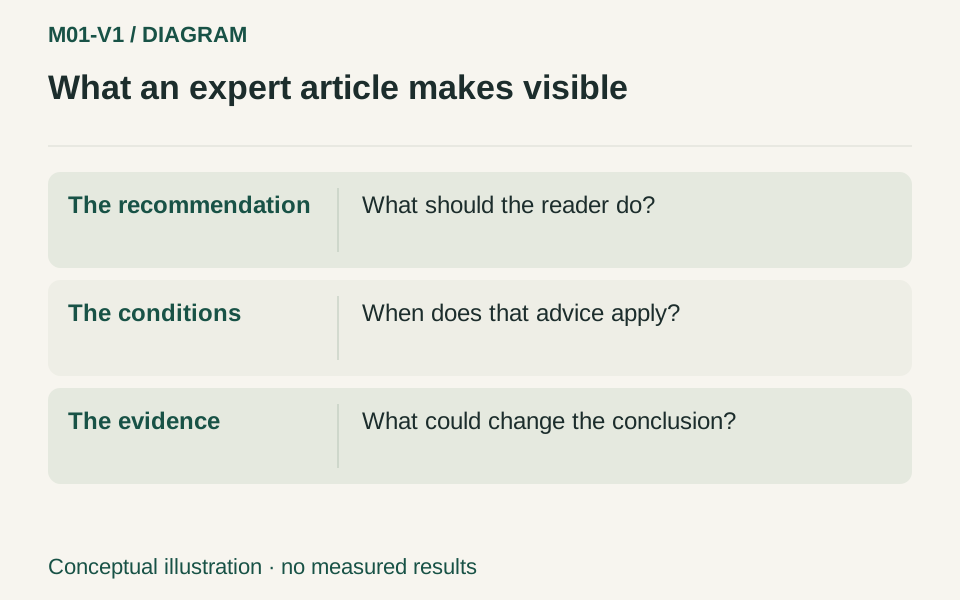
A recommendation to cache a value becomes useful when the article states which staleness is acceptable. Showing the conditions and a possible falsifying observation gives the reader a decision they can inspect.
Interpretation and evidence
- Attach conditions to recommendations.
- Separate explanation from justification.
- Name evidence that could change the advice.
A useful technical claim has conditions attached. A statement that one implementation is faster should identify the workload and the measured boundary. A recommendation to introduce a queue should explain which form of delay is acceptable. A proposal to simplify a system should acknowledge who will absorb the work that the removed component previously performed.
The conditions are not decorative disclaimers at the bottom. They are part of the claim.
Imagine two hypothetical articles about caching. The first presents caching as a broadly effective performance improvement and ends with a working example. The second begins with a specific constraint: readers can tolerate a short period of stale product descriptions, but cannot tolerate stale authorization decisions. It explains why the same mechanism should be treated differently across those boundaries.
The second author may write less code. The article may attract fewer searches for an exact method name. Yet it offers something a reader can carry into another system: a way to reason about the cost of being wrong.
That is the kind of contribution I want an expert publication to make. Its value should survive the replacement of the particular library used in the example.
This does not excuse vague abstraction. Conditions need concrete consequences. If a recommendation depends on bounded input size, say what happens when that assumption fails. If a tradeoff moves work into operations, describe the operator's new task. The reader should be able to challenge the recommendation without first reconstructing the author's hidden model of the world.
Verification belongs in the argument
02 / A concrete example
One cache, two different consequences
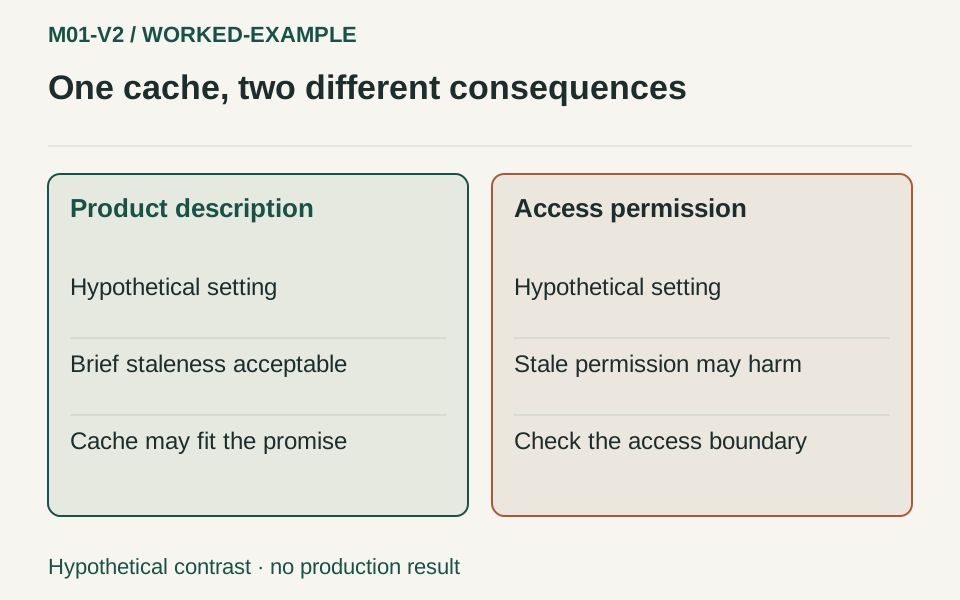
In this hypothetical comparison, both features could use the same caching mechanism. The acceptable consequence of stale information differs, so the implementation pattern alone cannot decide the policy.
Interpretation and evidence
- A shared mechanism need not imply a shared rule.
- Ask what stale information would permit.
- Explain the consequence before choosing a duration.
There is a relevant distinction between obtaining an answer and taking responsibility for it. A Microsoft Research study published in April 2025 surveyed knowledge workers about AI use and reported a shift in critical-thinking activities toward verification, integration, and task stewardship. It was a self-report study, not proof that AI causes skill loss or that expert blogging creates trust. It nevertheless provides a useful empirical prompt for thinking about the work an author should make visible. Microsoft Research, CHI 2025.
For a technical publication, verification can become part of the narrative rather than a private ceremony performed before writing. The author can show which observation would undermine the proposed explanation, which alternative was considered, and what remains unresolved.
Suppose a hypothetical investigation finds that an endpoint becomes slower as concurrency increases. A superficial article might attribute the slowdown to allocations because the profiler displays many allocations. A more useful article asks whether reducing those allocations changes latency under the same workload. If it does not, the original explanation needs revision.
The educational moment is the revision. It teaches the reader that a plausible mechanism must survive contact with a discriminating observation.
There is no obligation to stage a dramatic failure in every post. Inventing a wrong turn would be as misleading as inventing a successful benchmark. The obligation is simpler: describe the actual reasoning honestly, including the degree of uncertainty that remains. When no experiment has been run, write a proposal or thought experiment and label it accordingly.
An unfinished investigation can still teach. An invented conclusion cannot become evidence merely because it makes a satisfying ending.
The strongest objection is accessibility
There is a danger in making this argument too grand. Beginners still need explanations. Experienced developers still need a concise example when they encounter an unfamiliar API. A blog that refuses to explain anything because explanation has become cheap would misunderstand its audience.
Moreover, a readable article has advantages that a private generated answer may not have. A fixed version can be linked, discussed, corrected, and reviewed by several people. A carefully chosen sequence can save the reader from discovering every prerequisite independently. Good teaching is more than the availability of sentences about a topic.
So the response should not be to abandon tutorials. It should be to make their promises precise.
A short tutorial can honestly promise to help a reader understand one mechanism. It need not pretend to establish a production architecture. A reference example can demonstrate a call without claiming that the surrounding system is complete. An introductory explanation can explicitly identify the next question that becomes important outside the example.
That modesty improves teaching because it gives the learner a map of what has and has not been learned. It also leaves room for different kinds of articles. A practical explanation, a measured investigation, and an essay about the consequences of a technology should not be judged by exactly the same contract.
The common requirement is that the author understands the promise being made.
Authorship after assistance
03 / Watch the mechanism
A published claim stays open to evidence
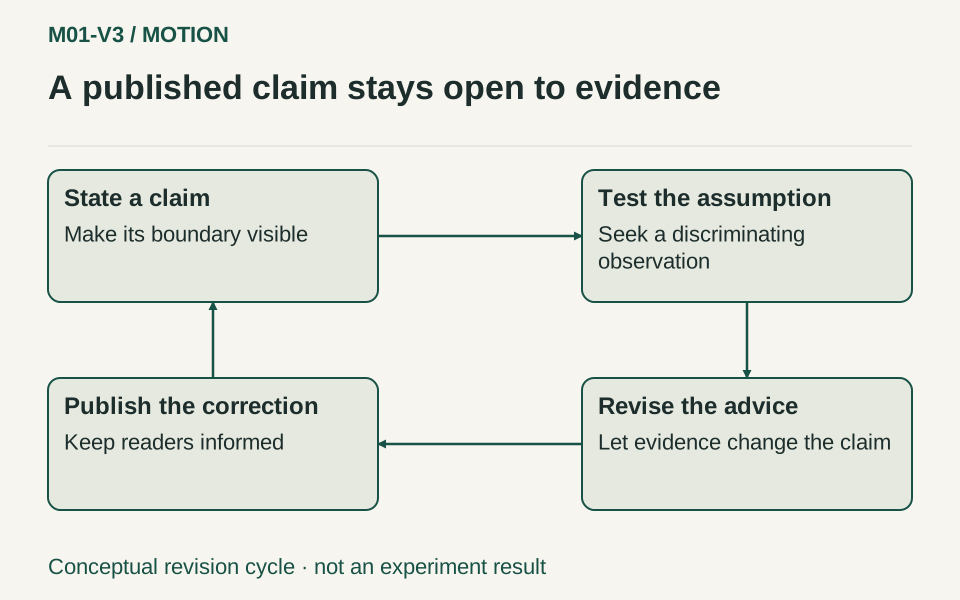
Static view. Play to see how the mechanism unfolds.
A hypothetical optimization article may begin with an allocation hypothesis and later find that changing allocations does not improve the measured latency. The useful publication preserves the changed conclusion instead of hiding the failed explanation.
Interpretation and evidence
- A claim needs an observable challenge.
- A failed hypothesis can still teach.
- Consequential corrections should remain visible.
Using AI to help write creates another decision about responsibility. The important question is not whether a machine touched the draft. The important question is which claims the named author is prepared to defend, correct, or withdraw.
A publication policy can make that responsibility concrete. Code examples should indicate whether they were executed. Measurements should identify their environment and date. Hypothetical scenarios should be distinguishable from experience. Sources should support the claim beside them, rather than lend general authority to the entire article.
Corrections deserve a policy too. If an error changes a recommendation, silently repairing a paragraph can leave earlier readers with an obsolete conclusion. A dated correction can explain what changed and why it matters. Small wording fixes do not need a ceremony, but consequential changes should preserve enough history to make the publication trustworthy over time.
These commitments cost something. They slow publication. They constrain the temptation to turn every interesting conversation into a confident essay. They may require an author to publish fewer pieces than an automated content pipeline could produce.
That cost is part of the point. Accountability means accepting work that cannot be delegated away by asking for a more polished answer.
For someone building a professional reputation, this is also a useful filter. A prospective collaborator does not only need evidence that the author can speak fluently about a stack. They need some basis for judging how the author handles ambiguity, disagreement, and incomplete information. A publication can reveal those habits without inventing a client story or claiming a result that has never been achieved.
Make the reader's decision the unit of value
01 / See the idea
Publish a decision the reader can inspect
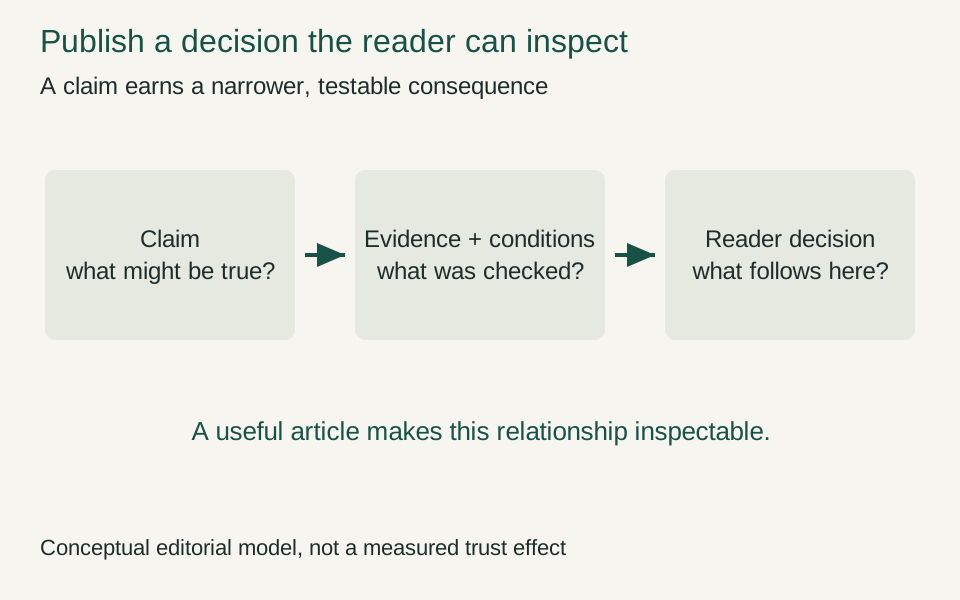
An article can explain one mechanism without claiming a complete deployment recommendation. The reader should see which conditions control the next decision.
Interpretation and evidence
- State the promise.
- Attach material conditions.
- Name the decision the evidence supports.
A useful way to edit an expert article is to imagine the decision immediately after the reader closes it. Perhaps the reader must choose whether to add concurrency, trust a benchmark, retain a cache entry or approve a proposed architecture. The publication earns its place when it improves that decision under identifiable conditions.
Consider a hypothetical author preparing a post about a faster database query. The first draft contains an elegant rewrite and a striking timing table. The intended reader, however, operates a system where the same table receives frequent updates. A more decision-focused article would ask what the new access structure costs to maintain, whether the result remains equivalent and which workloads would make the change unattractive.
That does not require the author to answer every possible question in one post. It requires choosing the promise. A query-mechanism tutorial can explain one access path. A deployment recommendation needs evidence about the surrounding workload. Confusing those promises makes a narrow demonstration sound like a general decision that it cannot support.
The same standard applies to an essay. An argument about AI and professional work should help the reader distinguish claims, responsibilities or incentives. It need not contain executable code to be useful. But it should expose enough reasoning that a reader can identify the premise on which the conclusion depends.
This gives different formats a common editorial test without forcing them into one template. What can the reader now decide more carefully? Which condition would change that decision? Which part remains a hypothesis? The answers can be short, but they should be present somewhere in the work.
An article can also make a valuable decision smaller. Instead of telling a team to adopt a technology, it might identify the one experiment that would determine whether adoption is worth considering. That is a legitimate contribution, especially when the alternative is a confident recommendation built on missing context.
Contemporary evidence can make an inconvenient result useful
The following is a contemporary note from laboratories executed on 12 November 2026. It is not evidence that these experiments existed at the essay's May 2025 context date, and it is not a client case history.
In the executed retention laboratory, a publisher retained a delegate, the delegate retained a payload owner and that owner retained a sixteen-mebibyte array. After the subscription was removed, the selected owner and array disappeared from the managed heap evidence. The process working set nevertheless increased between the recorded observations.
That result supports a more useful article than a simple memory-goes-down story. It shows why allocation history, object reachability and process residency must not be treated as interchangeable measurements. It does not establish why every additional resident page appeared, and the laboratory explicitly avoids that causal claim.
Another executed investigation compared an agent's fixed SQL tool with a direct adapter. The provider was scripted, so there was no remote language-model latency. The small timing ranges overlapped, and the direct adapter's median was slightly above one agent mode. Treating that ordering as evidence that the framework made SQL faster would have been an attractive but unsupported conclusion.
The stronger evidence came from the actual query plans. Two plans both used an Index Seek, yet one read one thousand rows and the other five thousand while returning the same aggregate. The mechanism was clearer than any universal overhead percentage the timing table could support.
These observations do not prove that detailed blogging creates trust or that every reader will value cautious interpretation. They illustrate the editorial judgment this essay proposes: preserve the inconvenient result, identify the narrower supported conclusion and let the reader inspect the boundary between them.
The author's value is visible in what the article refuses to infer. That restraint is not a ritual warning attached to a finished story. It changes the story itself. A reader learns how to distinguish a real mechanism from a satisfying explanation that the measurements did not establish.
Give simplification a visible boundary
02 / See the idea
Make simplicity accountable
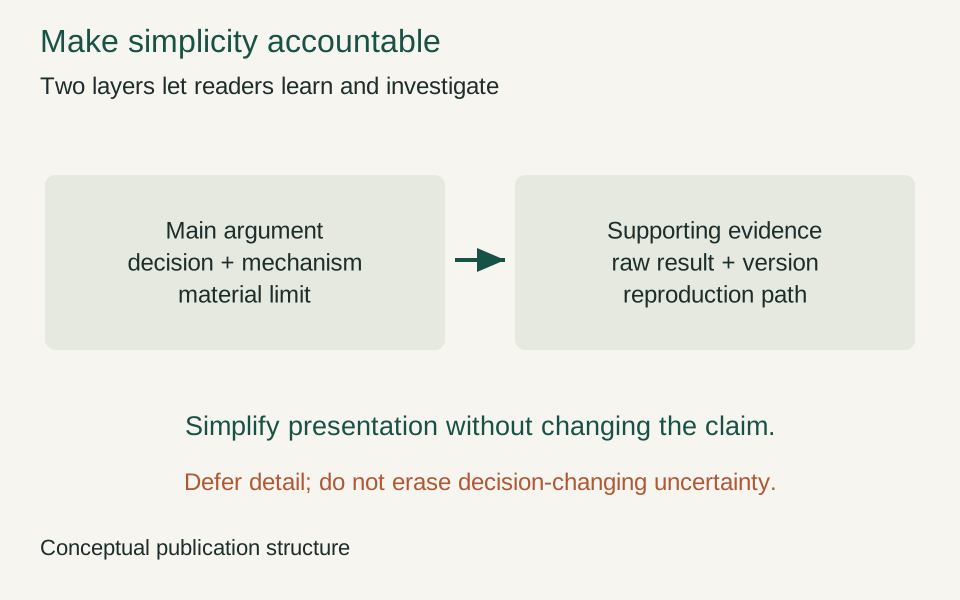
The raw artifact need not occupy the main page. Its absence from the prose must not turn a bounded result into a universal claim.
Interpretation and evidence
- Keep the main lesson clear.
- Retain a path to verification.
- Preserve limits that could change action.
There is a strong objection to all this evidentiary detail. Readers have limited attention. A tutorial that reproduces every artifact, exception and uncertainty can become harder to use than a concise explanation. Expert writing should reduce cognitive work, not transfer the author's entire investigation into the reader's lap.
The answer is layered explanation. The main argument should identify the decision, mechanism and material limitation. Supporting artifacts should make deeper inspection possible without becoming mandatory for understanding the first page. A reader should be able to learn the core distinction quickly and still find the evidence when a deployment decision requires it.
For the retention example, the main lesson might be a small ownership graph and the contrasting memory observations. The raw dump commands and object addresses belong in an accompanying artifact. Omitting those addresses from the main prose simplifies the presentation without removing the path by which the claim can be checked.
Simplification becomes misleading when it changes the claim. Replacing a noisy local timing result with a universal speedup is not clearer communication. Removing the unresolved part of a root path and inventing a name for it is not better teaching. Those edits reduce visible uncertainty by manufacturing information.
A useful editorial question is therefore what was removed and whether its absence could change a reader's decision. If not, the detail may be safely deferred. If it could, it belongs near the claim, even when the sentence becomes less dramatic.
This approach leaves room for short posts. A small article can establish one distinction and link to the next question. It need not become a research monograph. The obligation is proportionality between the promise and the evidence, not maximum length or maximum ceremony.
Build an editorial practice that can revise its own conclusions
A publication becomes more useful over time when its claims can be revised without erasing their provenance. The practical unit is not a permanent declaration of expertise. It is a versioned argument whose relevant evidence and assumptions remain recoverable.
Imagine a hypothetical post recommending a bounded batch size for a particular workload. Later, the workload changes and the recommendation no longer holds. A meaningful revision would state which input changed, which earlier result remains valid and which new observation supports the revised advice. It would not imply that the old experiment was fraudulent merely because its conditions stopped applying.
The opposite mistake is to defend the original advice as part of the author's identity. If being an expert requires never changing a conclusion, the publication becomes less informative precisely when new evidence arrives. A visible correction can demonstrate a better habit: the conclusion serves the decision, and the evidence can change both.
This does not mean every punctuation change needs a correction notice. The threshold is whether a reader could reasonably act differently after the change. A corrected unit, omitted condition or invalid benchmark can cross that threshold. A clearer transition between paragraphs usually does not.
For someone developing a body of work, this suggests a practical portfolio structure. Keep introductory explanations, bounded investigations and broader essays distinct enough that their promises are recognizable. Connect them through the decisions they help readers make. An introductory post can lead to an executed laboratory; the laboratory can inform an essay without pretending to prove every social conclusion in it.
The resulting reputation is an invitation to inspect a way of working. It is not a claim that published volume, a professional title or a polished voice establishes competence by itself. The reader can see how the author selects a problem, tests a belief, handles an inconvenient observation and changes the advice when the boundary changes.
Publish something a reader can challenge
Before publishing, I would ask a question more demanding than whether the article sounds authoritative: what could a careful reader disagree with here, and what would help us resolve that disagreement?
If the answer is nothing, the piece may contain only agreeable generalities. If the disagreement cannot be resolved because the relevant assumptions are hidden, the article needs more work. If the author would resist changing the conclusion regardless of evidence, the publication is acting as a performance of certainty.
A better article leaves the reader with a usable decision, a visible limit, or a question they had not known to ask. Sometimes that will require a repository and measurements. Sometimes it will require a carefully reasoned distinction. Sometimes a small example will be enough.
The opportunity for a new technical blog is therefore quite specific. It can become a place where claims have boundaries, investigations have observable steps, and the author remains answerable for the result.
AI can make explanation easier to obtain. The harder work is deciding which explanation deserves to influence a real decision. That is work worth publishing, provided the publication gives the reader enough evidence to decide whether the author has done it well.
What would you remove from your next article if your only goal were to sound knowledgeable? What would you add if your goal were to help someone make a better decision after you have left the conversation?