What Survives When the Model Becomes a Commodity?
Differentiation should be tested against substitution in models, distribution, data access and workflow ownership.
Explore the mechanism ↓
Reading tools Listen or translate
Read aloud
Uses an installed voice on your device.
Translate article
Machine translation. Code and evidence notes stay in English.
Original English text.
START WITH THE MECHANISM
Interactive companion and laboratory update: 12 November 2026. The editorial date places the topic on the timeline; this current explanation and its measured evidence retain their actual preparation and execution dates.
THE FULL INVESTIGATION
What Survives When the Model Becomes a Commodity?
Dates and technology context
This is a retrospective editorial timeline. Topic context: 25 August 2026. First publicly available: 12 November 2026. Current text, visuals and laboratory revisions were prepared on 12 November 2026.
The substitution fixture was assembled in November2026 from first-party artifacts; it does not establish an August2026 product moat or integrated commercial system.
Imagine that the model behind an AI product becomes available to every serious competitor at a comparable price. Nothing else changes overnight. Customers still have their workflows, integrations still break in ordinary ways, and someone still has to decide whether an answer is good enough to act on. What, exactly, has the product lost?
The question is deliberately conditional. It does not claim that models are interchangeable or that their capabilities will converge on a predictable schedule. It asks where the product's value would remain if an important input became easier to obtain.
That thought experiment is useful because “we use a powerful model” describes access to a capability, not necessarily a durable reason for a customer to choose one product. Sometimes the capability itself is scarce enough to matter. Sometimes the hard work is everything required to turn it into a reliable part of someone's day.
This article proposes a way to examine that distinction. It offers no account of the author's investments, no valuation conclusion and no prediction that a category of businesses must succeed or fail. The examples are hypothetical. The aim is to make a claim of differentiation precise enough that evidence could weaken it.
Name the advantage before defending it
A product team may describe its advantage as better answers, unique data, workflow knowledge, distribution or trust. Those labels are a starting point. Each needs a mechanism.
“Better answers” might mean fewer factual errors on a particular task, better handling of ambiguous inputs or a more useful response format. “Unique data” might mean exclusive rights, a difficult curation process or merely a collection that competitors have not yet assembled. “Trust” might mean a recognised brand, a dependable support process or evidence that the product behaves predictably under failure.
Without that decomposition, almost any product can claim the same advantages. The claims become useful when they identify what another team would have to build, learn, obtain or sustain to provide an equivalent outcome.
Write the claim as a relationship between the product and a customer task. For example: the product helps a service coordinator resolve a request using the correct version of several internal policies, with less manual searching and an inspectable escalation route. The model may contribute heavily, but the statement leaves room to identify the other mechanisms that make the outcome possible.
Separate access to intelligence from the work of integration
01 / See the idea
A shared input is not the whole product
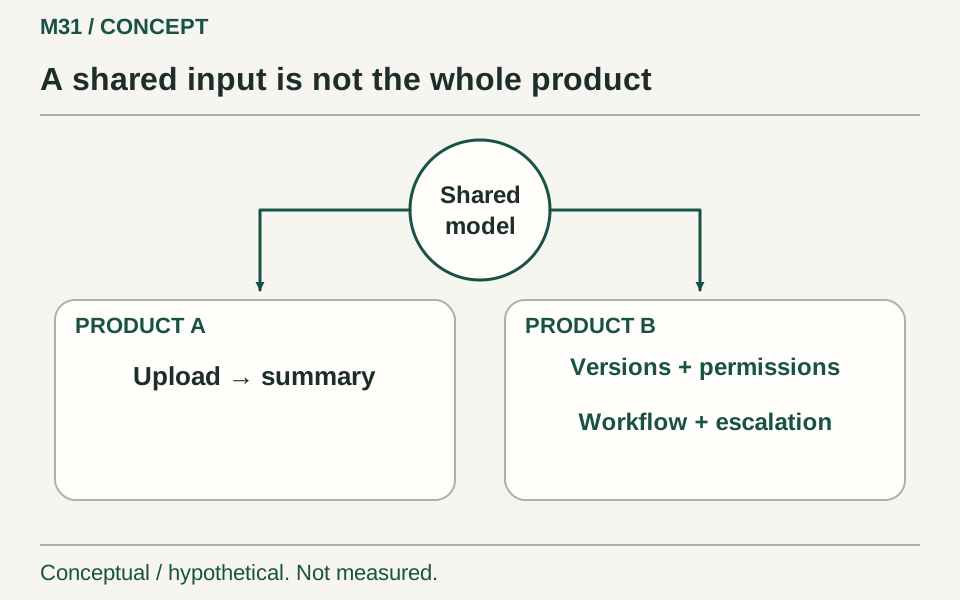
Imagine two assistants using the same model. One supplies a summary, while the other preserves document versions, permissions and an escalation route; the potential advantage lies in useful maintained work, not the box count.
Interpretation and evidence
- Separate shared input from customer work.
- Ask whether the extra work matters.
- Count the maintenance burden too.
The public availability of a model changes what developers can attempt. It does not automatically settle how a system obtains current information, preserves permissions, handles failures or fits into an existing workflow.
OpenAI's API changelog records the release of GPT-4.1 in April 2025 and the GPT-5 family in August 2025. Those milestones establish that new capabilities can become available as shared inputs. They do not demonstrate that every product built on those inputs becomes equivalent, or that access alone creates a defensible business.
Consider two hypothetical document assistants using the same model. One accepts uploaded files and produces a summary. The other maintains document versions, preserves user-specific access, identifies unresolved conflicts and attaches an answer to the operational record where a decision is made. The second has more components, but complexity by itself is not its advantage. Its potential advantage is the work the customer no longer has to reconstruct around the answer.
That work can still be replicated. The relevant question is how difficult it is to reproduce and keep correct, and whether customers care enough to pay for it. A component diagram should not be mistaken for a defence. It is an invitation to examine which components carry value and which merely carry maintenance cost.
Run the substitution experiment at the task boundary
Replacing a model in a benchmark is not the same as replacing it in a product. A benchmark may hold the prompt and input constant. A product also depends on response formats, latency expectations, tool behaviour and the handling of unusual cases.
A useful substitution exercise starts with a frozen task set and acceptance rubric. Keep the corpus and workflow stable. Record the engineering changes required to support the substitute, then compare accepted outcomes and operational behaviour. The effort needed to make the replacement work is part of the finding.
If substitution is easy and the outcomes remain comparable, the product's value may reside outside the model. That is not necessarily bad news. It can mean the team has designed a useful system that can benefit from competition among providers. If substitution is difficult, inspect why. The reason might be a genuinely distinctive capability or avoidable coupling to an unstable interface.
The exercise should include failure, not only successful answers. A substitute that performs well on routine questions but behaves differently when a tool is unavailable can change the product's operating responsibility. The team needs to understand that difference before calling the models equivalent.
Data becomes an advantage only through a usable right and a maintained process
Data is frequently presented as a durable asset without enough attention to its condition. A large archive can be stale, contradictory or inaccessible for the intended use. A smaller, well-maintained collection may support a more reliable product.
Ask what the product team can legitimately obtain and what a competitor could obtain under similar conditions. Then ask how the data changes. Who repairs labels, resolves conflicting records and decides which source is authoritative? If the answer is an experienced employee, that person's process is part of the capability. It should not disappear into a vague claim about proprietary data.
Feedback can strengthen the product, but only if it contains useful information. A thumbs-up is not always a reliable measure of correctness. A user may approve a plausible answer they cannot verify, or reject a correct answer that is inconvenient. The product needs a theory of what feedback means and a method for checking that theory.
Data rights and governance also constrain how feedback can be reused. The NIST generative AI profile is a useful reference for considering lifecycle risks, including the treatment of information. It does not establish a particular organisation's rights. A technical strategy should identify those dependencies rather than assume that possession implies permission.
Workflow ownership is more than a place on the screen
02 / A concrete example
More authority brings more responsibility
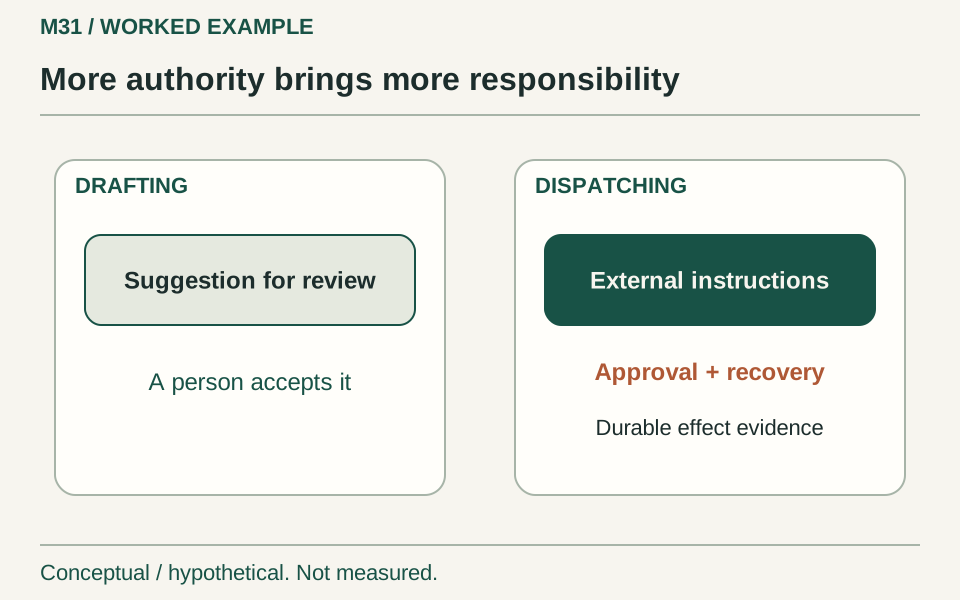
Suppose an intake product moves from preparing a draft to sending work instructions. That expansion may create value, but it also changes approval, uncertain-outcome handling and the evidence needed to operate it.
Interpretation and evidence
- Distinguish drafting from effect.
- Follow the task past generated text.
- Price the new operating obligation.
A product can occupy a prominent interface and still have a shallow role in the work. If users copy its output into another system, repair it there and resolve every exception elsewhere, much of the real workflow remains outside the product.
That may be a sensible scope. A drafting tool does not need to own every downstream decision to be useful. But a claim of deep workflow integration should be tested by following a task through completion. Where is its state recorded? Who handles an exception? How does another person continue the work? What happens when the original user is unavailable?
In a hypothetical accounting intake process, the valuable boundary might be the handoff from a received document to a reviewed, traceable draft entry. Automatically generating a draft is one step. Establishing which document version produced it, which assumptions were made and who accepted it can be the difference between a useful workflow and a pile of text waiting for reconciliation.
Owning more of that workflow also means accepting more responsibility. A product that can change records needs stronger recovery and accountability than one that suggests a sentence. The potential value and the operating burden grow together. Treating additional permissions as a simple feature expansion understates the change.
Distribution can be durable without being mysterious
An excellent product does not reach users merely because its implementation is difficult. Customers need to discover it, understand its role and trust the organisation behind it enough to try it.
Distribution can come from an existing customer relationship, a community, a partner integration or a useful public body of work. These routes are not automatically defensible, but they can be hard to reproduce because they depend on accumulated attention and demonstrated reliability.
The distinction between attention and trust matters. A provocative demo can attract attention quickly. Trust usually depends on what happens after the demo: clear claims, reliable behaviour, support and visible correction when something is wrong. A product's public technical writing can contribute by making its judgement inspectable, rather than merely restating its marketing promise.
There is a limit to this argument. Distribution should not be used to excuse an inadequate product. An established channel may help a team obtain a trial, but repeated disappointment can consume the trust that made the trial possible. The evaluation should examine both the route to the customer and the experience the customer receives once they arrive.
The strongest objection: the model may remain the product
Some products depend on a capability that alternatives do not provide adequately. A model might handle a particular modality, language or reasoning task well enough to make an otherwise impossible workflow viable. In that case, treating the model as a commodity would erase the central technical fact.
The thought experiment should therefore be used as a stress test, not a forecast. Ask how much of the value depends on the current capability gap and what evidence suggests that gap matters to the customer. Then consider what the product can learn or build while the gap exists.
There is also nothing inherently illegitimate about a business with a temporary advantage. A useful product can create value during a limited period. The problem is presenting a temporary dependency as a permanent defence without examining the possibility of substitution.
An honest product strategy can contain several horizons. Today, the system may depend on a distinctive model. Over time, it may develop workflow knowledge, evaluation assets, integrations and customer relationships. Those future capabilities remain hypotheses until they exist. A roadmap should not be counted as an accomplished advantage.
Watch for dependencies disguised as strengths
03 / Watch the mechanism
Stress-test the dependency
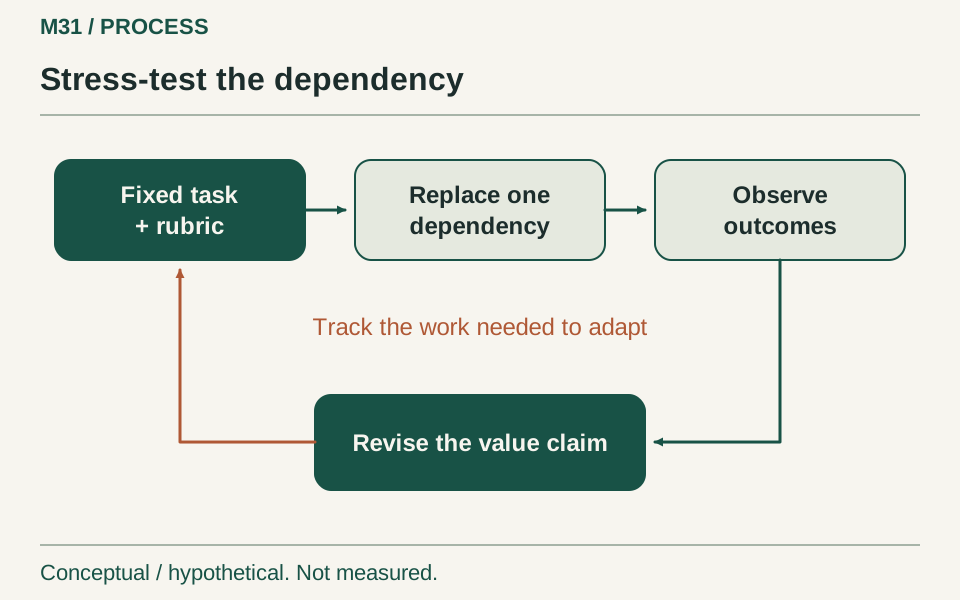
Static view. Play to see how the mechanism unfolds.
Imagine replacing the model while holding the task and acceptance rubric steady. Easy substitution may reveal a strong workflow advantage; difficult substitution may reveal a distinctive capability or merely avoidable coupling, so inspect the mechanism.
Interpretation and evidence
- Freeze the customer task.
- Record adaptation work.
- Revise the value claim from evidence.
An exclusive integration can create value while also concentrating risk. A highly specialised evaluation process can improve quality while depending on one expert. A carefully curated corpus can support better answers while requiring more maintenance than the business model includes.
The useful question is not whether a capability has a cost. Every capability does. It is whether the team understands that cost and can sustain the mechanism that creates the advantage.
Make the dependencies visible in the evidence pack. Identify the provider, the interface, the person or the source that would be difficult to replace. Describe the consequence of losing it and the options available. A dependency becomes easier to manage when its failure is a scenario the team can discuss concretely.
Do the same for customer dependence. If the product requires users to supply unusually clean data or perform extensive verification, its apparent quality may rely on work outside the product boundary. That work may be acceptable, but it should be part of the value proposition and operating economics. Hiding it does not make it disappear.
Ask what evidence would weaken the thesis
A differentiation claim becomes more credible when its author can describe how it could fail. If a model swap preserves quality with little effort, the claim of model-specific advantage weakens. If a competitor can reproduce the workflow from public documentation, the claimed integration barrier may be smaller than expected. If users do not value the added traceability, the product may be solving a problem that matters more to its engineers than to its buyers.
Those observations do not necessarily destroy the product. They change the account of why it is valuable. The team may discover that convenience, service or a narrow domain focus matters more than its original technical story.
Use that discovery to choose the next experiment. Test the part of the proposition that remains consequential and uncertain. Avoid responding to every challenge by adding more features. Additional functionality can make a product harder to understand without strengthening the mechanism that customers actually value.
A model becoming easier to obtain does not settle the future of the surrounding business. It changes the conditions under which that business must explain itself. The product that survives the thought experiment has a clear answer to a practical question: after access to the model is no longer special, what useful work does this organisation still do that its customers would otherwise have to do for themselves?
A later fixture separates a replaceable component from a stable promise
01 / See the idea
Substitute the output, preserve the boundary
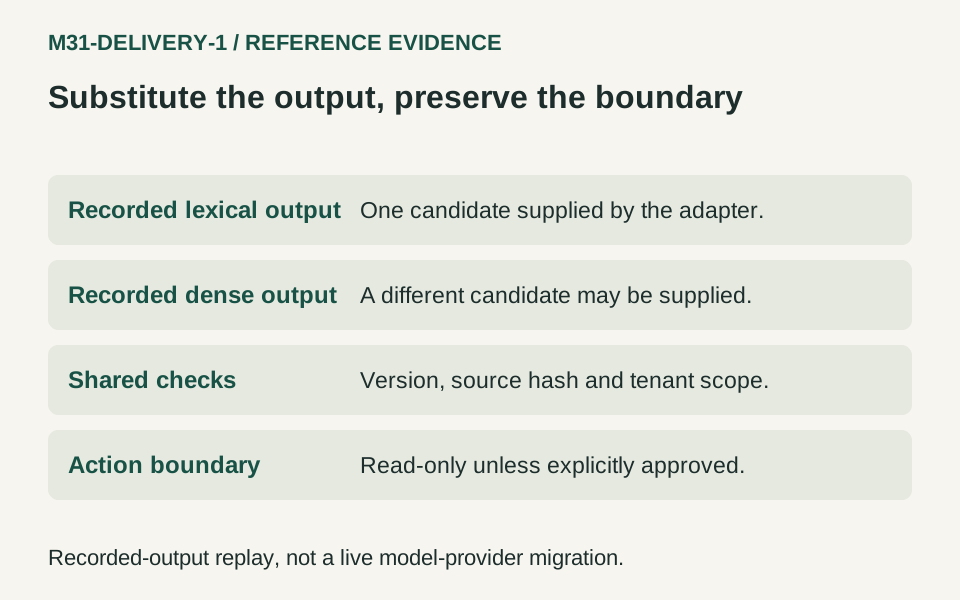
The fixture replays two strategies through one small downstream contract. Keeping that contract stable does not prove the providers are equivalent or the resulting workflow is production ready.
Interpretation and evidence
- Name what is actually being substituted.
- Check the surrounding invariant independently.
- Do not transfer component evidence to an untested product.
Implementation note, prepared 12 November 2026. The original August 2026 argument is a conditional examination of product value. The following fixture uses later first-party laboratory artifacts; it is not a market study or a live substitution of commercial model providers.
The executable fixture replays two recorded retrieval strategies through the same small downstream contract. One strategy is lexical, the other uses the locally executed embedding model from the retrieval laboratory. The new fixture does not run either retriever again. It reads their saved outputs and examines what the surrounding workflow can keep stable when the first-ranked document changes.
The distinction matters. A replay can test how a consumer handles a known result. It cannot establish live provider compatibility, latency, availability or behavior on unseen inputs. Those would require separate execution at the relevant boundary.
The stable promise here is deliberately modest: the candidate must identify an existing source in the permitted fixture scope, carry the expected version label and match the source representation hash. Passing those checks produces a read-only state unless an explicit synthetic approval is supplied.
This is not a production authorization implementation. It is a small, executable way to show that the model or ranking component should not define the entire workflow contract merely by producing a plausible output.
A different first result does not erase the need for evidence
The saved retrieval experiment contains 18 evaluation queries for each strategy. Both methods found all manually required evidence within the top three on that small synthetic set, but their first results differed in meaningful ways.
For questions about a per-file upload limit, a document describing total organization storage sometimes ranked first. The necessary evidence was still available lower in the list. A downstream system that treats the first result as unquestionable truth would therefore make a stronger assumption than the retrieval evidence supports.
The replay fixture preserves that difference. It validates the representation and scope of the selected document while retaining the recorded flag indicating whether the first result was relevant. A document can be mechanically valid and still be the wrong evidence for the question.
That separation is part of the potential workflow capability. The product can maintain source identity, ask for a different candidate, expose several sources or require clarification. None of those capabilities becomes unnecessary merely because a more capable model is available.
They are not automatically a commercial advantage either. Customers must care about the problem they solve, and the implementation must solve it well enough. The technical fixture establishes a boundary that can be tested; it does not establish willingness to pay for that boundary.
Test the contract with deliberately invalid inputs
02 / See the idea
Passing the gate is not proving relevance
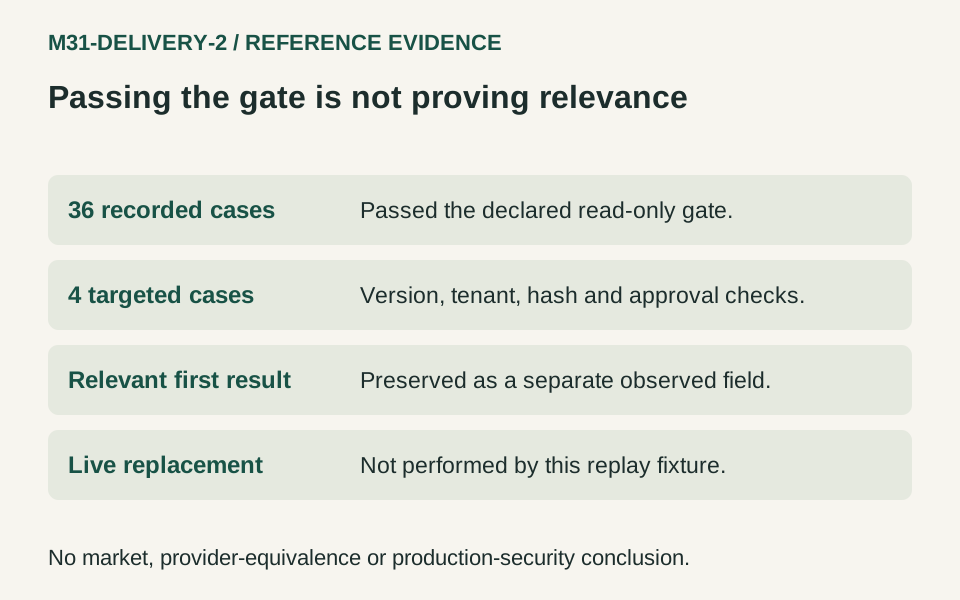
The valid recorded candidates remain read-only, and the targeted cases exercise their expected boundary outcomes. A mechanically valid source can still be the wrong evidence for the user question.
Interpretation and evidence
- Separate representation checks from answer quality.
- Keep negative-case expectations explicit.
- Describe the remaining integration work.
The fixture includes 36 valid recorded cases, one for each query and strategy. It then exercises targeted negative and approval cases: a wrong version, an unauthorized fixture tenant, an incorrect source hash and an explicit synthetic approval.
The expected outcomes are defined before these checks run. A changed version is rejected as a version problem. A candidate outside the permitted scope is rejected as a scope problem. A mismatched hash is rejected as a representation problem. A valid read-only candidate does not become permission to perform an action simply because its text is persuasive.
This is a better description of the test than saying that the product is provider independent. The fixture demonstrates a few invariants around saved results. It does not verify every possible adapter, every model output or a production identity system.
The source-evidence API supplies a related but separate implemented boundary: exact source versions and distinct publication and effective dates. Its real HTTP checks do not run inside this replay fixture. The packet retains that evidence to show how a fuller workflow could obtain stronger source resolution than the small local gate alone provides.
Similarly, the action-reservation laboratory establishes selected local authority and reconciliation behavior. Its executed results do not magically transfer to a new composition. A real integrated product must connect these boundaries and test the connection.
Preserve the difference between a capability and its evidence
A product may claim that it preserves source versions, controls actions and handles uncertain outcomes. Those are capability claims. The evidence consists of particular tests, traces and observations under stated conditions.
The distinction prevents a common inflation of technical value. A component diagram can describe an intended capability even when the important connection has not been implemented. A passing local test can establish a narrow behavior while leaving the complete workflow untested.
The packet therefore preserves the original artifact hashes and reports what was replayed. The gate's version label is a synthetic contract identifier, not an assertion that a real provider's API is compatible. The approval case is a controlled boolean input, not an authentication service or a payment authorization.
These limitations do not make the exercise trivial. They make it honest enough to be useful. The team can now name the next integration check: whether a real source resolver supplies the same identity the action controller later relies on, or whether a retried operation retains the correct task and approval references.
That is technical work that remains when access to a model becomes easier. Its value lies in maintaining an understandable promise across changing components. The existence of the work does not guarantee a moat, but ignoring it produces an incomplete account of what the product actually does.
Portability can strengthen a product without being its main advantage
Easy replacement of a model can be valuable to a product team. It may provide an option when quality, price or operating conditions change. But portability is not the same as differentiation, and a difficult migration is not proof of a defensible business.
A team may be tightly coupled to one provider because it uses a genuinely important capability. It may also be coupled because it has not separated output interpretation from business rules. The same visible difficulty can arise from different mechanisms.
The substitution question should therefore ask what changes and why. Does the model produce a different representation? Does the new adapter preserve source identity? Does the evaluation still measure the same user need? Does a different failure mode change the operating promise?
The recorded-strategy fixture is a small example of keeping some requirements stable while observing a changed component output. A real model substitution would add further concerns: request and response contracts, streaming, cancellation, tool invocation and the distribution of results across representative tasks.
The commercial conclusion remains conditional. If customers value dependable source handling and action control, a team that maintains those capabilities may have useful work to sell even when the model is widely available. If customers do not value them, technical elegance alone will not create demand.
Do not call a collection of controls an integrated product
The reference materials show several real pieces of engineering: local embeddings, source resolution and a reservation ledger. They are still separate implementations with separate evidence boundaries.
Before combining them into a product claim, the team would need to demonstrate that the identities and assumptions survive the handoffs. A source selected under one scope must not become evidence for an action under another. A changed source version must not silently retain an old approval. A retry must not turn one user task into several unrelated cost records.
Those are proposed integrated scenarios, not observed defects in the separate laboratories. They identify where composition creates obligations beyond the parts.
This is also where a product's claimed workflow knowledge should become concrete. Does the system understand which transitions require a new decision? Can a person inspect the unresolved state? Is the operating team prepared to handle it without reconstructing the entire history from a chat transcript?
The answers can matter more to a customer than the name of the underlying model. They still require evidence, and they should not be presented as established merely because the architecture has the right boxes.
Let the business thesis remain open to disagreement
The technical fixture cannot determine whether a capability is hard for competitors to reproduce. It cannot establish distribution strength, customer trust or a profitable market. Those propositions require different evidence.
What it can do is improve the precision of the discussion. A team can distinguish the replaceable ranking component from the contracts it expects to preserve. It can show where the contract has been checked and where a wider claim remains untested. It can also admit when an apparently distinctive feature is mostly access to a shared input.
That admission need not destroy the business. A useful product can compete through execution, focus and service without claiming permanent technical uniqueness. Conversely, a genuinely difficult mechanism may still fail to solve a problem customers consider important.
The question of what survives model commoditization should therefore remain a test of the product story, not a predetermined verdict. The most useful answer identifies the work that remains necessary, the evidence that this team performs it well and the assumptions about customers that have not yet been established.
That is a stronger position than defending every existing component as a moat. It leaves the organization free to replace what has become ordinary and invest in the parts of the workflow whose usefulness it can actually demonstrate.