The Hidden Network Work of a Blazor Component
An executed Blazor component separates debounce admission, aborted client waits and revision authority, with controlled HTTP completion and visible stale-response checks.
Explore the mechanism ↓
Reading tools Listen or translate
Read aloud
Uses an installed voice on your device.
Translate article
Machine translation. Code and evidence notes stay in English.
Original English text.
START WITH THE MECHANISM
Interactive companion and laboratory update: 12 November 2026. The editorial date places the topic on the timeline; this current explanation and its measured evidence retain their actual preparation and execution dates.
THE FULL INVESTIGATION
The Hidden Network Work of a Blazor Component
Dates and technology context
This is a retrospective editorial timeline. Topic context: 16 July 2026. First publicly available: 12 November 2026. Current text, visuals and laboratory revisions were prepared on 12 November 2026.
The 180ms policy, actual Blazor10.0.15 runs, controlled response ordering, request counters, abort observations and screenshots are 2026-11-12 updates. They are not historical network recordings.
Prepared on 12 November 2026. The application and observations below are current reference-laboratory work, with synthetic inputs and a deliberately scripted response provider.
A text box looks like a small component. Its network behavior can be much larger than its visual footprint. An input event becomes an asynchronous handler, the handler starts a request, the user changes the text again, and several responses begin competing to describe what the page now means. The difficult part is not drawing the suggestion list. It is deciding which work should start, which work is still relevant and which work the application can honestly say it stopped.
My argument is that debouncing, cancellation and response correlation are three separate responsibilities. Debouncing controls admission. Cancellation asks an existing operation to stop or stops waiting for it. Correlation decides whether a completed result may change the current interface. None of these responsibilities disappears because another one is present. A component that cancels every previous request can still receive an obsolete result. A component that ignores obsolete results can still waste server work. A component that debounces input can still become incorrect after the admitted request is superseded.
The accompanying Blazor WebAssembly component makes these boundaries observable. One mode sends a request for each input event. Another waits 180 milliseconds after the most recent event and aborts the active browser request when newer input arrives. A loopback ASP.NET endpoint holds each admitted request behind an explicit release gate. The test controls response order without hoping that a machine happens to be slow enough to reproduce a race.
This is an actual browser-to-HTTP experiment. It is not a human typing study, a production traffic sample or evidence that Blazor itself sends an HTTP request for every event. In this WebAssembly application, our handler explicitly calls fetch through JavaScript interop. Other Blazor hosting modes have different communication boundaries. Keeping that distinction visible is the first step toward understanding the work we are measuring.
Start with the event that really happens
The input uses @oninput="Typing". A change event supplies the current string to an asynchronous C# handler. The handler increments a revision before any asynchronous wait, making the new user intent visible immediately. It then applies the selected admission policy. The Blazor event-handling documentation describes the Razor event binding and asynchronous handler model used here.
The component does not claim that every keystroke corresponds to exactly one input event in every browser or input method. Paste, composition, speech input and programmatic changes can produce different event sequences. The test therefore counts the actual events it dispatches and the actual HTTP requests that reach the endpoint. The experiment's unit is a controlled input event, not an imagined universal human keystroke.
That distinction changes the test design. To exercise immediate mode, the script changes the value four times and waits for each corresponding request to reach the server. It does not infer requests from handler invocation counts. The server records the revisions it receives. The browser test also observes the rendered revision and suggestion. This joins admission evidence with visible outcome evidence.
For the debounced burst, the script dispatches four input events in one controlled burst. The component reaches revisions five through eight, but only revision eight is admitted to HTTP after the quiet period. This gives a deterministic contrast between the two policies for that sequence. It does not estimate what fraction of requests a real population would avoid. Different pauses, composition behavior and interaction goals would produce different results.
The code's hidden work begins at an explicit line: boundaryApi.suggest(mine, text). That function creates an AbortController, sends a GET request and awaits JSON. Naming that boundary is more informative than attributing all network activity to the UI framework. A reader can now ask whether admission should happen before this line, whether a different component should own it and what result may be applied afterward.
Separate admission, waiting and authority
01 / See the idea
Three responsibilities, three questions
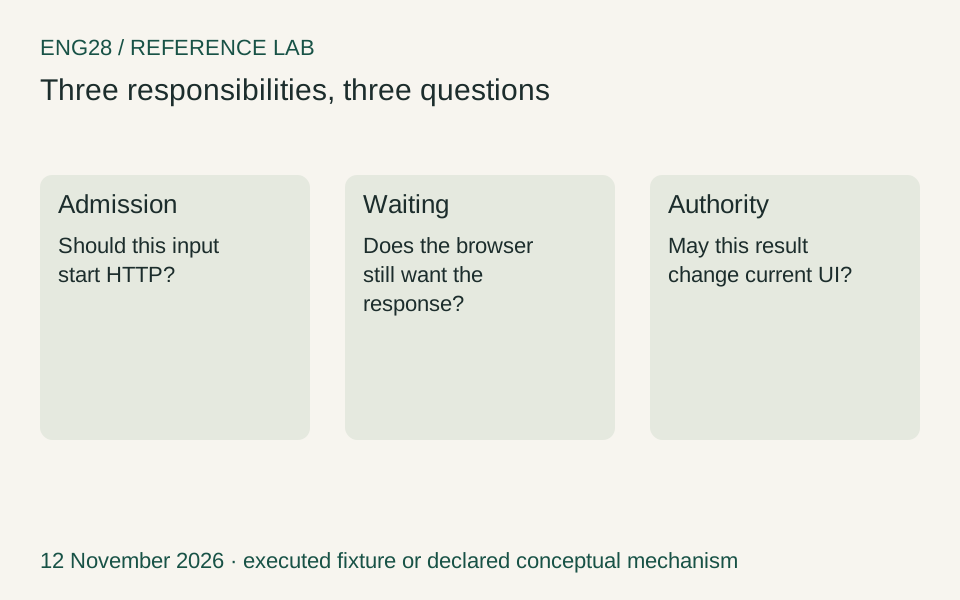
Debounce decides whether to admit work, abort ends a client wait, and revision correlation controls the right to update the UI. Passing one check does not prove the other two.
Interpretation and evidence
- Admission controls starts.
- Abort controls client interest.
- Revision guards visible authority.
Admission answers whether the current input deserves a request yet. Immediate mode says yes for every event. Debounced mode waits 180 milliseconds, with a cancellation token that belongs to that particular delay. A newer event cancels the previous delay. Only a delay that completes while its revision remains current may start a request.
Waiting is a different object. Once fetch has started, canceling the delay's token does not automatically cancel that fetch. The JavaScript adapter therefore keeps the active AbortController. In debounced mode, a newer input calls abort() before starting its own delay. That operation affects the browser request and response consumption. It does not constitute an application-level promise that the server reversed any work already admitted. The Fetch standard's abort processing defines the client-side mechanism; our server trace shows the narrower application consequence.
Authority is the final check. After the awaited result arrives, the handler compares its captured revision with the current revision. If they differ, the response is obsolete and cannot replace the visible suggestion. This check remains necessary even when cancellation is requested. Cancellation can race with completion, and a provider may finish work before the client asks it to stop.
These responsibilities map to three different questions during review. Did unnecessary work start? Did an active wait stop? Did an obsolete result alter the page? A single “cancellation works” test does not answer all three. The lab records separate request, abort and stale-response counts so that success in one dimension cannot conceal failure in another.
The component also clears ownership carefully. Each handler owns its own cancellation source. In finally, it clears the component field only if that field still points to its source, then disposes its source. An earlier handler finishing late must not clear a newer handler's cancellation object. The same identity check appears in the JavaScript adapter when it clears the active controller. Small ownership mistakes here can disable cancellation without producing an obvious exception.
Write the revision check before the optimistic update
03 / Watch the mechanism
Two waits need two revision checks
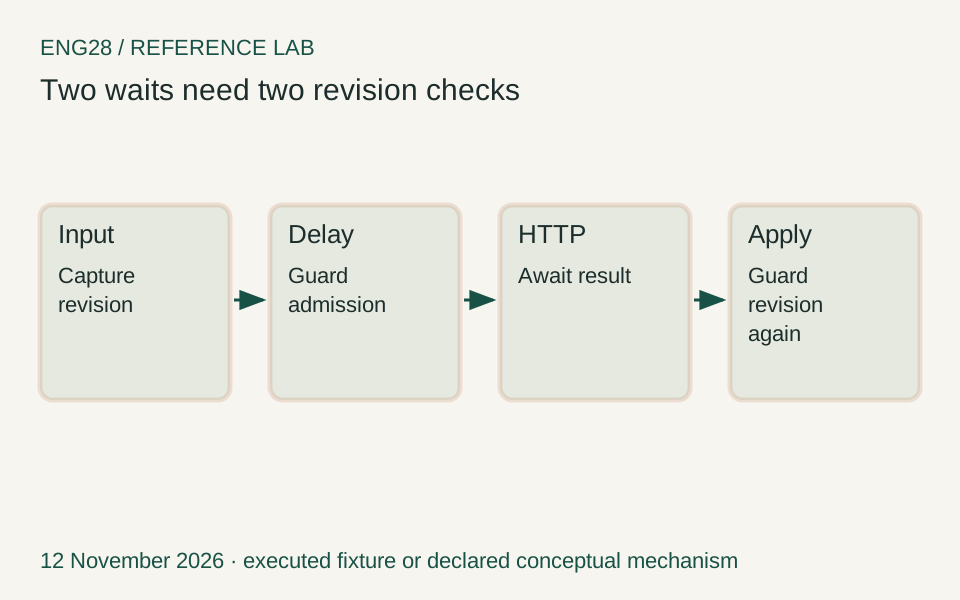
Static view. Play to see how the mechanism unfolds.
An input waits for admission, starts HTTP and waits for a response. Revision guards protect both admission and the later state mutation.
Interpretation and evidence
- Capture revision before awaiting.
- Recheck before admission.
- Recheck before applying a result.
The relevant C# path is intentionally compact:
long mine = ++revision;
debounce?.Cancel();
var cancellation = new CancellationTokenSource();
debounce = cancellation;

if (typingMode == "debounced")
{
    await JS.InvokeVoidAsync("boundaryApi.abort");
    await Task.Delay(180, cancellation.Token);
}

if (mine != revision)
    return;

var result = await JS.InvokeAsync<Suggestion>(
    "boundaryApi.suggest", mine, text);

if (mine != revision)
{
    ignored++;
    return;
}

suggestion = result.Text;
The first revision check protects admission after the delay. The second protects state mutation after the request. They occupy different positions because a new input can arrive during either wait. Removing one check because the other exists would confuse the two boundaries.
This is not a multithreaded memory race in the usual sense. It is an asynchronous ordering problem. The component may resume after an awaited operation while a later event has already changed its state. Microsoft's synchronization-context explanation explicitly distinguishes a single logical execution thread from a single asynchronous control flow. That distinction is enough to explain why a revision guard remains useful in a browser application.
The lab increments revision on every event, including events that never become requests. Consequently the server sees revisions one, two, three, four, eight, nine and ten in the complete scenario. Missing numbers are not lost requests. They are input states rejected by admission policy. If an operational dashboard treated gaps as transport failures, it would misread a successful debounce as an outage.
The response echoes its revision, but the component currently uses the captured invocation revision as its authority check. A stronger public protocol should also verify that the echoed response revision matches the request, especially if responses pass through caches or adapters. In this reference endpoint the echo is deterministic. The lab's acceptance claim is therefore about the implemented correlation path, not a complete adversarial response-integrity protocol.
Control completion order instead of sleeping until a race appears
02 / See the idea
Later request, earlier completion
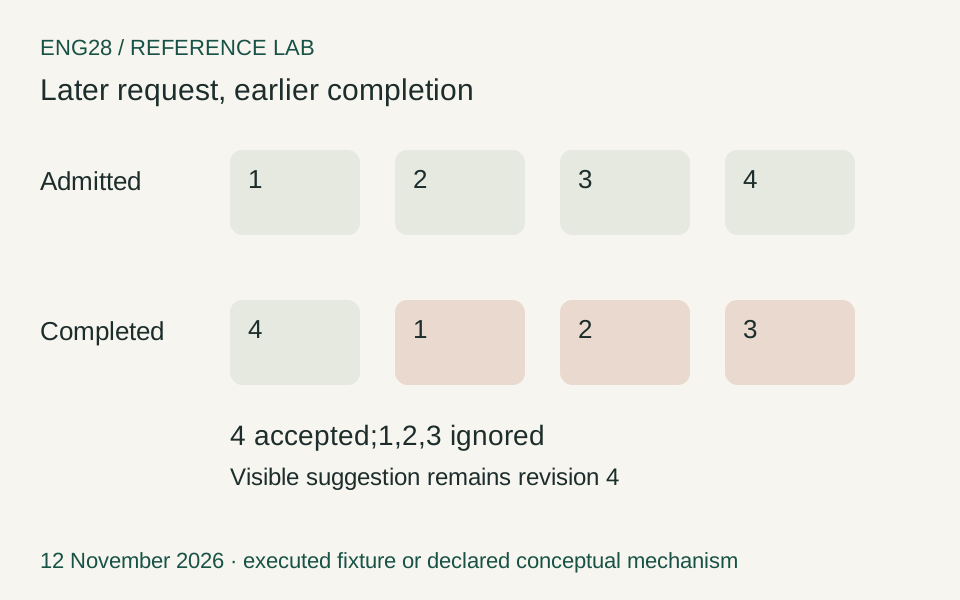
Requests1 to 4 are admitted, then4 is released first. Releasing1,2 and 3 afterward increments the ignored counter without replacing the current suggestion.
Interpretation and evidence
- Completion order is controlled.
- Three stale responses are ignored.
- Revision4 stays visible.
The endpoint accepts a revision and stores a TaskCompletionSource<string> for it. The request remains pending until the test calls /api/release/{revision}. The completion source uses asynchronous continuations. Requests also have a bounded timeout so that a failed test cannot leave an unbounded wait behind. The process wrapper closes the browser and server in finally.
This mechanism is a test fixture, not a queue service. It has no durable storage, no user identity and no production admission controller. Its purpose is to make order explicit. A test that merely inserts random sleeps might pass without ever exercising the problematic order. Here the test knows that revisions one through four reached HTTP before it releases revision four first.
Once revision four is accepted, the test releases one, two and three. All three responses complete, but each handler sees that its revision is no longer current. The visible suggestion remains “Suggestion for revision 4,” and the stale-response counter becomes three. The important result is not that the last request happened to be fastest. The test deliberately made it complete first and verified that older completions could not overwrite it.
This pattern is useful beyond suggestions. A hypothetical details panel might load a different customer when the selected row changes. A chart might request a different date range. A search page might change both query and scope. In each case, authority should correspond to the full user intent, not merely the most convenient variable. If scope changes without advancing the revision, a response for the old scope may still appear current.
The lab uses one integer revision because its input state is intentionally small. A richer implementation could capture an immutable request descriptor containing query, tenant, filters, locale and data version. The exact representation is less important than the invariant: a result may mutate visible state only if it belongs to the state the interface currently claims to represent.
Observe the requests that debounce actually removes
04 / See the idea
Four controlled input events
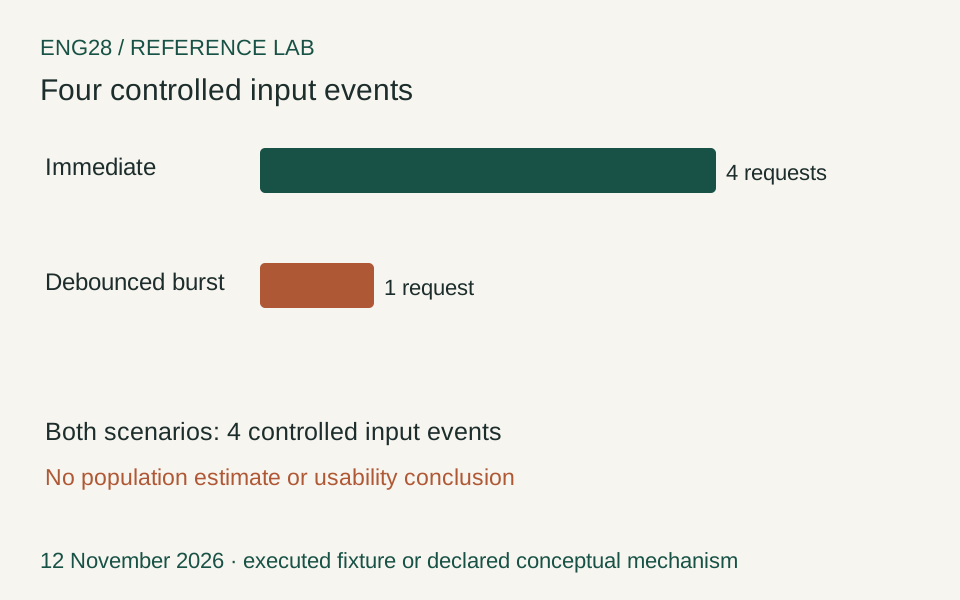
Immediate mode sends four requests for four tested events. One controlled burst under the180 ms debounce sends one; this is not a population estimate or recommended universal interval.
Interpretation and evidence
- Counts come from HTTP admission.
- Burst timing is controlled.
- No human behavior is inferred.
The accepted browser run produced the following controlled result:
| Scenario | Input events | Requests reaching HTTP | Relevant visible outcome |
|---|---|---|---|
| Immediate, four changes | 4 | 4 | Revision 4 accepted; revisions 1, 2 and 3 ignored when released later |
| Debounced burst | 4 | 1 | Revision 8 admitted and accepted |
| Debounced request then newer input | 2 | 2 | Revision 9 browser wait aborted; revision 10 accepted |
The complete server received list is [1,2,3,4,8,9,10]. Its completion list is [4,1,2,3,8,10,9]. At the end, no request gates remain pending. These are actual endpoint observations from the reference run. They are not synthetic predictions calculated from the number of letters in a string.
The four-event burst avoids three requests relative to the immediate policy for that specific sequence. Describing this as a general percentage reduction would be misleading. A person who pauses longer than the debounce interval between every input event could still generate a request for each event. A person who types a long uninterrupted sequence could generate one. The policy's effect depends on the input distribution, which this controlled test does not estimate.
There is another tradeoff: the admitted request starts later. That delay may improve efficiency while making a short interaction feel slower. The lab does not contain a usability study and cannot choose an optimal interval for all users. The value 180 milliseconds is a declared fixture parameter, not a recommendation justified by behavioral research.
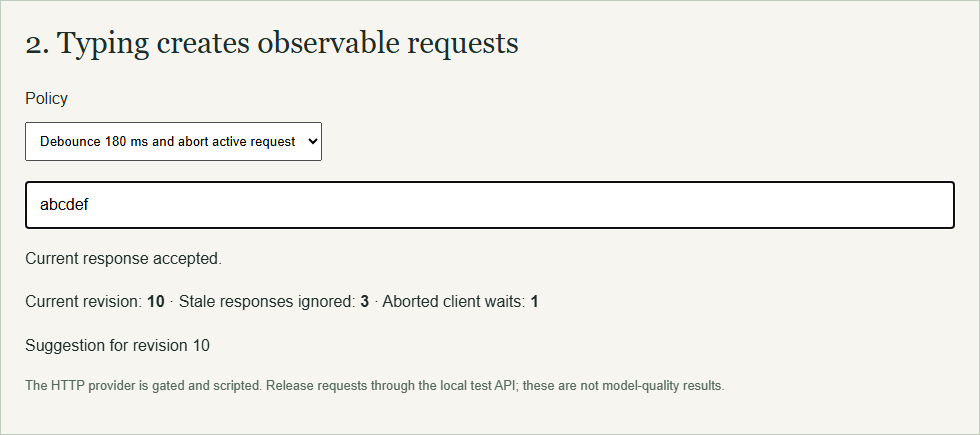
The screenshot shows a state reached by the actual browser test. The JSON record contains the request sequence and assertions. Together they show how the selected policy changed this application, while leaving the broader product decision open. That is stronger evidence than a polished animation of a debounce timeline with no executed requests behind it.
An aborted browser wait is not erased server work
05 / See the idea
Revision9: interest ends, work continues
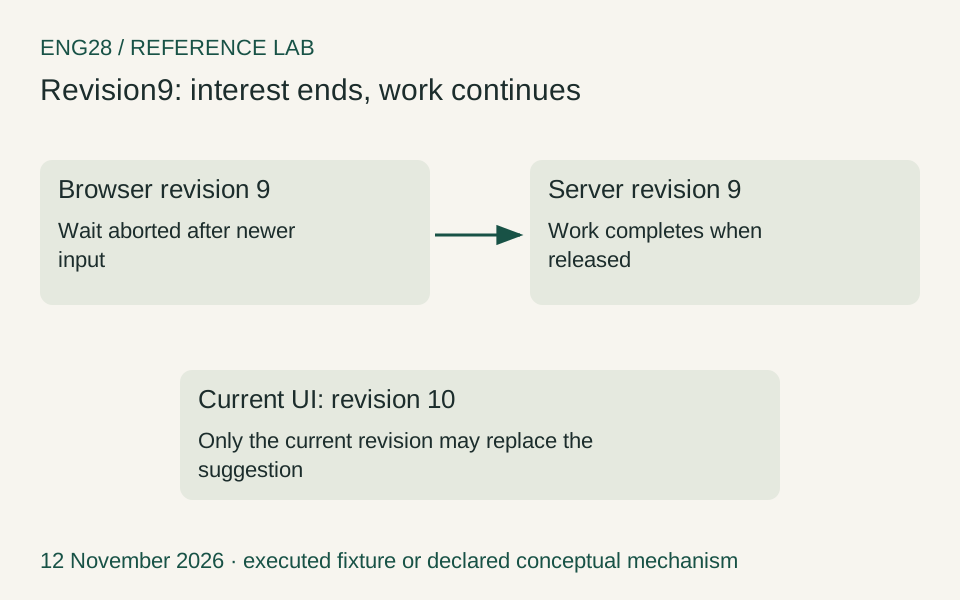
The browser aborts its wait for revision 9 after newer input arrives. The controlled endpoint still completes9 when released, while revision 10 remains the accepted suggestion.
Interpretation and evidence
- Abort is not rollback.
- Server completion remains observable.
- Current revision retains UI authority.
The most instructive case begins after revision nine has already reached the endpoint. The test sends newer input, causing the client to abort its active fetch and start a new debounce delay. Revision ten eventually reaches HTTP and is released first. The browser accepts its suggestion. The test then releases revision nine on the server.
The server completes revision nine even though the browser no longer waits for it. This is deliberate. The fixture does not pass RequestAborted into its release gate. It therefore makes a boundary that production systems often obscure directly visible: stopping client interest does not prove that remote work stopped. The accepted evidence records one aborted browser wait and a completed server revision nine.
This does not mean cancellation is useless. Canceling response consumption can release client resources and avoid obsolete UI processing. Propagating a server cancellation token can prevent some downstream work. But each dependency must cooperate, and already committed effects may not be reversible. A cancellation result should describe the boundary it actually reached.
For a hypothetical expensive suggestion service, the next step would be to record separate states such as request admitted, inference started, cancellation observed and inference completed. If the engine cannot cancel an in-flight operation, the service may still avoid starting queued obsolete work. If the operation has already produced a durable side effect, a compensating business action may be required instead. A browser abort cannot answer these questions by itself.
The current service has no external effects and performs no suggestion-model inference. Its provider is scripted so that ordering can be controlled independently of model latency. That is a strength for the selected correctness question and a limitation for performance or quality claims. We can prove which responses change the interface without pretending that a string fixture measures the cost of an AI model.
Error handling should preserve meaning, not just appearance
The component distinguishes an aborted wait from an unexpected request failure. An abort increments its own counter. A failure for the current revision produces a failure status. An obsolete failure does not replace the current status. This keeps a late error from announcing that a newer successful interaction failed.
There are deliberate limits to the current error UI. It is a laboratory panel, not a finished accessibility pattern for every suggestion interface. Status text is exposed through role="status", controls have labels, and the mobile layout is checked for horizontal overflow. The test does not establish screen-reader behavior across products, keyboard navigation through a complex result list or correct input-method composition handling. Those would require targeted interaction tests.
The implementation also does not automatically retry failed suggestions. An automatic retry would need to preserve the same revision and recheck authority before admission and application. Retrying an obsolete request because a generic networking helper considers it transient can reintroduce work the component had already decided was irrelevant. Retry policy should understand request lifetime rather than operate as an invisible loop beneath it.
Switching admission modes is another explicit boundary. The lab changes modes between completed scenarios. It does not claim to validate every possible mode switch while requests are pending. A production settings change should either advance the request generation, cancel outstanding interest or document that the new policy affects only subsequent input. A dropdown is not a complete state-transition specification.
These limitations should guide the next useful test, not trigger an endless checklist. If the product introduces composition-aware input, test composition. If it introduces retry, test retry after supersession. If it introduces navigation while pending, test disposal and late callbacks. The acceptance boundary should grow with actual behavior rather than with an ambition to call one small test comprehensive.
Make network ownership visible during component review
A component review often starts with markup and rendering. For asynchronous components, I would also ask who owns request admission and who owns the result's right to update state. A reusable child component may expose an event callback while a parent supplies an implementation that performs network work. That arrangement can be reasonable, but the performance boundary is no longer obvious from the child's visual simplicity.
The remedy is not to forbid callbacks or force every component to know about HTTP. It is to document the contract between the component and its caller. Does the callback report every raw input event or only a settled value? Can callbacks overlap? Does the component await them? Who cancels obsolete work? Who rejects stale completion? A callback name such as ValueChanged does not answer these questions by itself.
This article's component keeps the boundary close to the UI so the mechanism is visible. A production design might move it into a scoped service or a view model. That refactoring should preserve the same executable assertions. Otherwise an architectural cleanup can silently change ordering semantics while leaving the public component API unchanged.
The distinction between render modes also belongs in that review. Our WebAssembly event handler runs in the browser and explicitly initiates HTTP. An interactive server component has a different event transport. A static-rendered component has different capabilities again. The controlled request counts here describe this implementation only. They are not a universal statement about the network cost of @oninput in every Blazor application.
An effective diagnostic trace therefore includes event revision, admission decision, request identifier, completion and application decision. It need not record raw user text. The fixture's revision-only ledger is enough to explain the demonstrated ordering while avoiding unnecessary content capture. Production telemetry should be designed around the question being answered, not around collecting every available field.
Choose what to count before optimizing it
The server's received count is not the same as the browser's attempted count. A browser can begin a fetch that fails before the application handler runs. An endpoint can accept a request whose response the browser never consumes. A provider can complete work after the user has stopped caring. The fixture demonstrates the last case directly, so a single request counter would hide part of its behavior.
For this experiment, the useful ledger has three levels. Input revisions describe proposed UI states. Received revisions describe admitted server work. Completion and application decisions describe what finished and what was allowed to affect the screen. The numbers can differ without indicating a bug. Their relationship, together with the policy, explains the system.
Suppose a hypothetical production trace shows many requests admitted but few results applied. That could mean users frequently supersede requests, the provider is too slow for the interaction, or the page dispatches work too eagerly. It does not by itself prove that debouncing is the best repair. A smaller payload, a local cache, an explicit submit action or a different information architecture might address the real problem more directly.
Conversely, a very low request count can conceal poor interaction. A long debounce interval can suppress useful intermediate feedback. A broken cancellation source can prevent the final request from starting at all. Optimizing the counter without checking the visible outcome would reward both failures. The accepted test therefore requires the current suggestion to reach revision ten, rather than treating fewer requests as sufficient success.
The same discipline applies to errors. An aborted wait is expected under the selected policy, while an unexpected failure for the current revision requires attention. Grouping both under one error-rate metric can make a healthy supersession policy look unreliable. Suppressing both can hide a real outage. The fixture records them separately because their meanings differ, not because one category is more flattering.
Before adding instrumentation to another component, write the question each field should answer. Revision explains relevance. Admission explains server work. Completion explains provider outcome. Application explains visible authority. A raw timestamp on every line may help ordering, but it cannot replace these meanings. This is how a small component trace becomes a diagnostic tool rather than another stream of events nobody can interpret.
The test's explicit release mechanism also makes a useful distinction between a pending operation and a slow operation. The request is pending because the fixture withholds permission to complete, not because an inference engine or network was observed to take a long time. We should therefore describe the scenario as controlled supersession, not measured service slowness. That wording preserves the strongest part of the evidence: the ordering was guaranteed rather than accidentally encountered.
When replacing the scripted provider, keep the same ordering tests alongside any performance study. A faster service can reduce the frequency of a race without eliminating the invalid state transition. A slower test machine can make an unguarded implementation appear easier to diagnose without making the test more deterministic. Correctness should survive both cases because authority is checked explicitly, not because a response usually arrives in a convenient order.
Reproduce the mechanism before choosing a policy
The shared application is built with SDK 10.0.400 and .NET 10.0.15. Its browser harness launches one headless Chrome instance, starts one loopback server and executes deterministic input sequences. The provider gates are released explicitly. The report records request and completion lists, ignored responses, aborted waits, final state and resource closure. No human review time, model throughput or workforce productivity is inferred from these observations.
The accepted run closes both browser and server with no pending gates. The server is intentionally unsuitable for external exposure: it has test-control routes, synthetic fixtures and no authentication. Its purpose is to make a component contract observable. Reproduction should retain those boundaries instead of placing the same routes on a public endpoint.
Before adopting the pattern in another application, define the interaction's tolerance for delay and stale content. A financial approval action should not inherit the same casual “latest input wins” rule as a suggestion list. Some operations must complete exactly once even after the user navigates away. Others should be discarded before admission when their relevance disappears. The UI pattern follows the domain's meaning; it does not supply that meaning.
For a suggestion field, the combination demonstrated here is a useful starting point: debounce to avoid starting obviously obsolete work, cancel interest when newer input arrives, and correlate every completion before changing state. Keep the three mechanisms separately observable. That separation is what allows an engineer to explain why the screen is correct even when the server still performed work, or why fewer requests did not necessarily make the interaction better.
The hidden network work of a component becomes manageable when it stops being hidden. Count admissions, name ownership, control completion order and test the visible result. A small interface can then remain small in the code review without becoming vague in the system design.
Source code and execution evidence
Download the complete lab, source record and raw execution results. This package supports the specific execution claims in this article. It is not a production certification.