Result Freshness: From Source Event to the Screen
A versioned HTTP fixture and Blazor UI distinguish source, ingest, publication and display, refusing late updates while keeping logical age separate from query latency.
Explore the mechanism ↓
Reading tools Listen or translate
Read aloud
Uses an installed voice on your device.
Translate article
Machine translation. Code and evidence notes stay in English.
Original English text.
START WITH THE MECHANISM
Interactive companion and laboratory update: 12 November 2026. The editorial date places the topic on the timeline; this current explanation and its measured evidence retain their actual preparation and execution dates.
THE FULL INVESTIGATION
Result Freshness: From Source Event to the Screen
Dates and technology context
This is a retrospective editorial timeline. Topic context: 27 August 2026. First publicly available: 12 November 2026. Current text, visuals and laboratory revisions were prepared on 12 November 2026.
The actual ASP.NET/Blazor10.0.15 application, controlled clock values, version rejection, UI screenshots and HTTP evidence are 2026-11-12 additions. Fixture ages are not historical production latency.
Prepared on 12 November 2026. The reference application uses real HTTP and a real Blazor interface, with deliberately controlled fixture clocks rather than invented production latency observations.
A query can finish quickly and still tell us something old. This sounds obvious until the operational dashboard reports a healthy response time, the page displays a green success state and nobody can identify which source event the visible result represents. The system has answered. That is not the same as the system being current.
My argument is that freshness should be described as a chain of explicit transitions. A source event exists. The application ingests it. Some publication boundary makes a snapshot available. The interface reads and displays that snapshot. Each transition can succeed while a later transition has not happened. Treating all of them as one timestamp makes it difficult to distinguish an old source, a delayed ingest, an unpublished update and a stale screen.
The accompanying application makes those transitions small enough to inspect. A loopback ASP.NET process accepts versioned events, retains the latest accepted event and exposes a separately published snapshot. A Blazor WebAssembly component reads that snapshot and displays its version, source time, ingest time, publication time and age at a controlled render clock. The test deliberately delivers an older version after a newer one and verifies that the older value cannot replace the accepted state.
This is not a streaming platform, watermark implementation or distributed-clock experiment. The state is in memory, the fixture contains one logical object and the times are abstract logical units. Those restrictions are deliberate. They let us test the difference between arrival, acceptance, publication and display without pretending that a few local requests establish a production freshness service level.
Ask which state the screen claims to represent
Imagine a hypothetical operations panel showing the status of a document-processing job. An event says the job reached version two. The ingestion endpoint accepts that event, but a publication step has not yet exposed it to readers. The browser refreshes successfully and receives the previously published version one. Is the page wrong?
The answer depends on its claim. If the page says “latest published snapshot, version one,” it may be accurately describing an intentionally lagging view. If it says “current job state” without qualification, it may create an expectation the architecture does not satisfy. Correct transport and truthful presentation are related but distinct responsibilities.
The lab therefore separates its accepted event from its published snapshot. latest is the newest event admitted by the version rule. published is the object returned by /api/snapshot. Ingesting a new event changes the former, not the latter. Only an explicit publication operation creates a new snapshot. This is a simplified materialization boundary, not a claim that a production event bus behaves exactly like two fields in one process.
The UI exposes the snapshot's provenance rather than displaying only its value. That allows the reader to distinguish a value that is old because its source has not changed from one that is old because publication is behind. A source can legitimately remain unchanged for a long time. Age alone is not proof that a pipeline is unhealthy. The interpretation depends on expected source behavior and the meaning of the displayed field.
For this reason, freshness indicators should be attached to a defined object or result set. A dashboard-wide “updated recently” badge can conceal a mixture of versions. One tile may have refreshed, another may be cached and a third may derive from a slower publication pipeline. The present fixture avoids that complexity by using one object, then makes the limitation explicit rather than presenting a single timestamp as a universal answer.
Keep four times separate
01 / See the idea
Four times, four different meanings
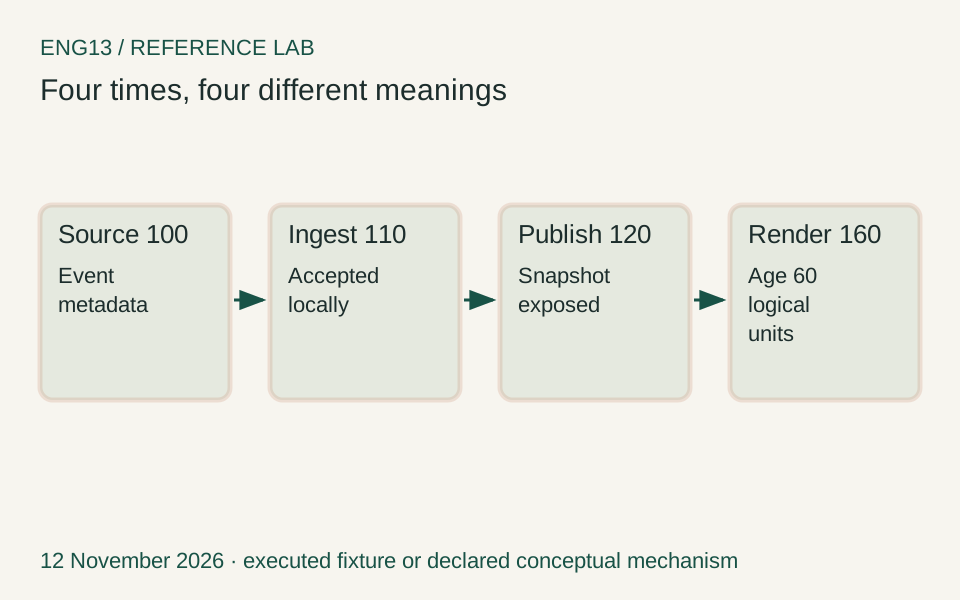
The fixture distinguishes source 100, ingest 110, publication120 and render160. Their differences are logical units assigned by the test, not observed wall-clock latency.
Interpretation and evidence
- Name each timestamp owner.
- Do not relabel units as milliseconds.
- Display age is render minus source.
The event carries a source time and an ingest time. Publishing creates a publication time. The interface supplies a controlled render clock. These values support several different intervals, each with a different interpretation:
| Interval | Formula in the fixture | Meaning |
|---|---|---|
| Source to ingest | Ingest minus source | Time assigned between event creation and acceptance |
| Ingest to publication | Publication minus ingest | Time assigned before the accepted state becomes readable |
| Publication to render | Render minus publication | Time assigned between published state and the displayed observation |
| Displayed source age | Render minus source | Age of the source represented by the visible snapshot |
All four are fixture arithmetic, not measured wall-clock durations. The test assigns their values to establish a causal order. It does not read them from synchronized machines, estimate clock skew or measure browser paint latency. The term render clock means the controlled clock value shown by the component, not a requestAnimationFrame timestamp or evidence of the exact physical pixel update.
This distinction is central to the article. If I label the age value 30 milliseconds, I would be inventing a measurement. If I call it 30 logical units and show the underlying times, it becomes a valid executable example. The arithmetic can still teach the mechanism without pretending to be an operational observation.
In a real deployment, source timestamps might come from another machine, device or business system. Comparing them with an application clock requires a policy for trust and skew. A clock that jumps backward can produce negative ages. An event generated offline can arrive long after its business meaning changed. The present code checks only a small local invariant, source time must not exceed ingest time. It does not solve distributed time.
Version and time therefore have different jobs. Version establishes the accepted ordering of updates for this object. Source time describes when the represented event occurred according to the source. A larger timestamp is not used as a substitute for a larger version. That decision makes a late delivery test precise even when arrival order differs from source order.
Accept a version before publishing a snapshot
02 / See the idea
Accepted state is not published state
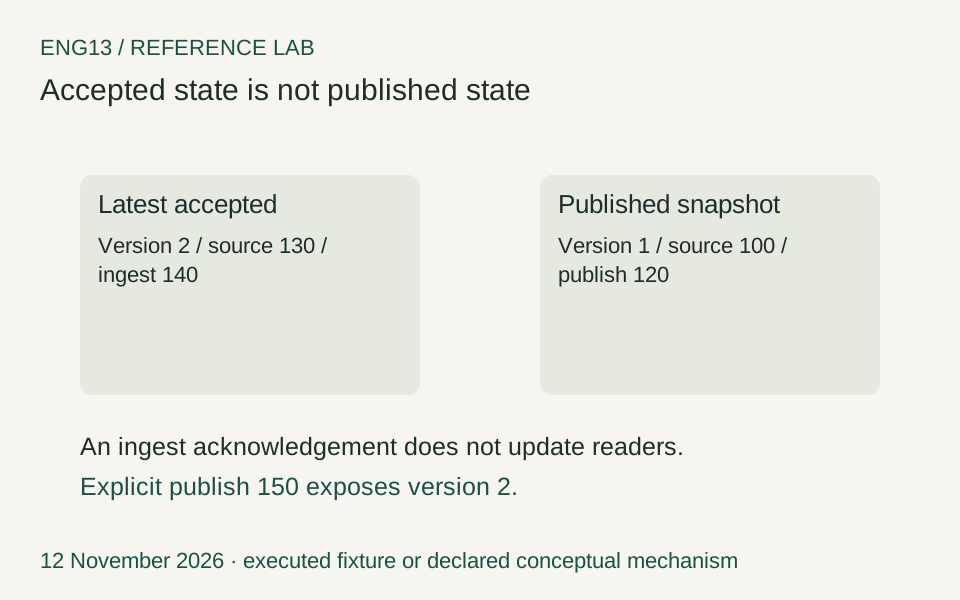
After ingesting version 2, latestaccepted is2 while the published snapshot is still1. An explicit publication transition is required before readers can observe2.
Interpretation and evidence
- Ingest acknowledgement is narrower.
- Readers see the published snapshot.
- Publication is a separate decision.
The ingestion path takes a lock around the small in-memory transition. Its core policy is straightforward: reject impossible fixture clock order, accept a version newer than the current one, treat an identical current-version payload as a duplicate and refuse stale or conflicting updates. The code below expresses the actual rule in a more readable layout:
if (incoming.SourceTime > incoming.IngestTime)
    return "invalid-clock";

if (latest is not null && incoming.Version <= latest.Version)
{
    bool identical = incoming.Version == latest.Version
        && incoming.Value == latest.Value
        && incoming.SourceTime == latest.SourceTime;
    return identical ? "duplicate" : "stale-or-conflict";
}

latest = incoming;
return "accepted";
The duplicate rule deliberately ignores a later ingest timestamp. Redelivery can occur later without changing the source fact. Conversely, the same version carrying a different value or source time is not silently accepted as a harmless retry. The fixture returns a combined stale-or-conflict status; a production service might separate those categories for diagnostics while preserving the same refusal to overwrite current state.
Publication is another transition. It requires an accepted event and a publication clock no earlier than that event's ingest time. It copies the accepted event into an immutable snapshot record with the publication time. Readers obtain that record rather than a partially updated set of independent fields. The lock makes these transitions atomic within this process.
There are important limits to the policy. It accepts version gaps and does not require the next version to be exactly current plus one. It has no object identifier because the fixture contains one object. It has no tombstones, cross-object transaction or durable replay log. It also does not fully enforce monotonic publication clocks across repeated publication calls. The test uses a valid increasing sequence and does not turn that sequence into a broader guarantee.
Those limits suggest concrete next work for a real service. A multi-object implementation needs a per-object ordering key. A deletion policy needs to prevent a delayed update from resurrecting a deleted object. A durable pipeline needs atomic persistence and restart behavior. A business process that cannot skip intermediate states needs a gap policy. These are domain decisions, not details to infer from the existence of a version property.
Deliver the old event late on purpose
04 / See the idea
Source age changes with the represented event
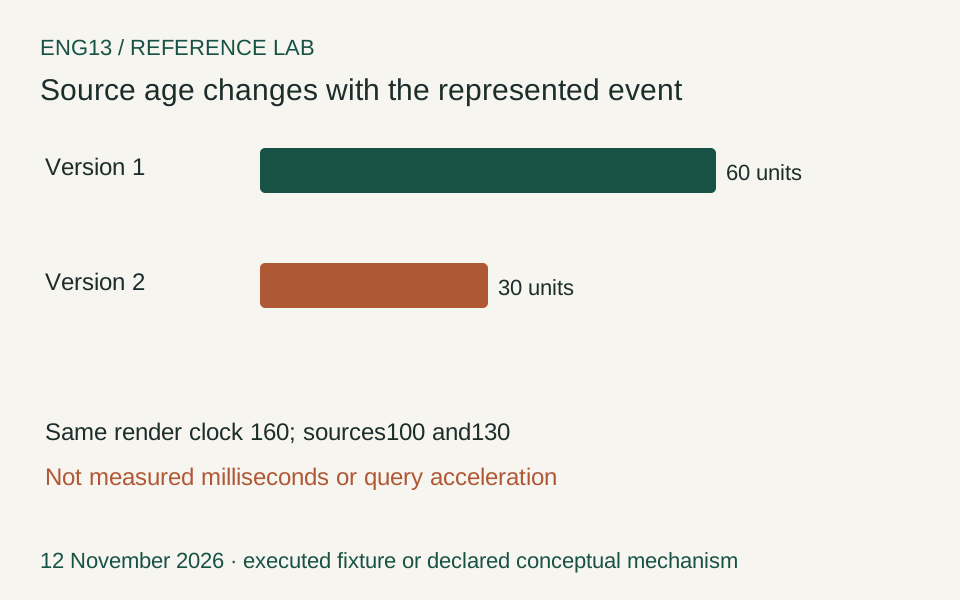
At render clock 160, source 100 has age60 and source 130 has age30. The age change identifies a newer represented event, not a faster query.
Interpretation and evidence
- Before: version 1 and age60.
- After: version 2 and age30.
- These are logical fixture units.
03 / Watch the mechanism
A late version cannot roll the object back
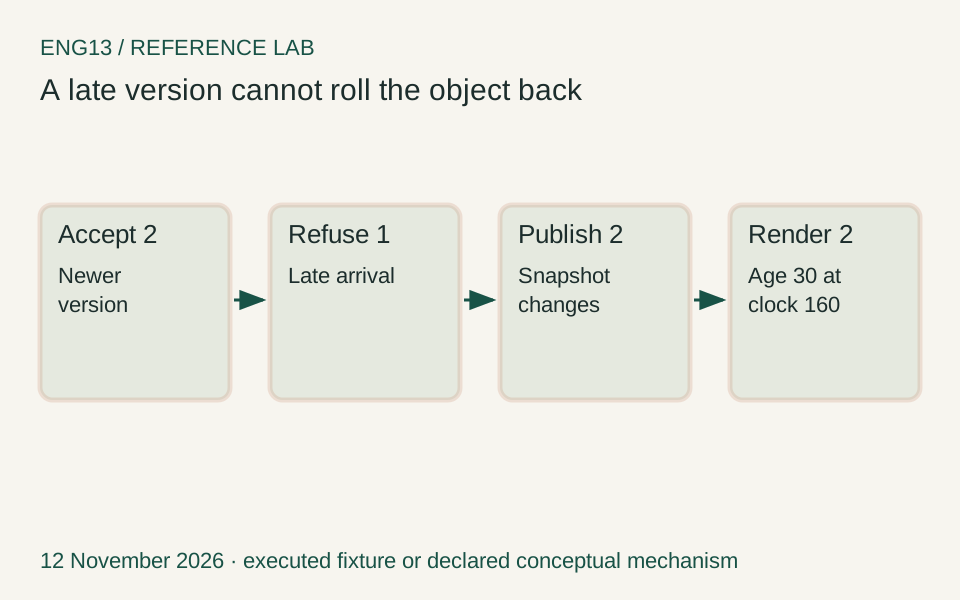
Static view. Play to see how the mechanism unfolds.
The controlled sequence accepts2, refuses late1, publishes2 and renders2. Motion highlights the actual causal sequence without treating the fixture clock as measured time.
Interpretation and evidence
- Arrival order is not version order.
- Refusal preserves latest state.
- Publish precedes visible change.
The test begins with version one at source time 100 and ingest time 110. It publishes that event at 120. The browser reads the snapshot with a controlled render clock of 160. The page displays version one and a source age of 60 logical units.
Next, version two arrives with source time 130 and ingest time 140. The endpoint accepts it. The browser reads again before publication and still sees version one. This is the decisive check: a successful ingest did not silently become a successful publication. The test examines the actual HTTP response and the rendered version, rather than checking only an internal dictionary.
An older event then arrives after version two. It carries version one and an ingest time of 150. Arrival is later, but its version is older. The endpoint refuses it. The accepted state remains version two. A same-version event with a conflicting value is also refused. An identical version-two event is treated as a duplicate, and a future-source-time event is rejected by the fixture clock rule.
Finally, the test publishes at 150 and refreshes the browser. The visible snapshot becomes version two, its source time becomes 130 and its age at clock 160 becomes 30. The test has exercised admission, publication and rendering in one finite flow. It has not inferred correctness from a unit-level return value alone.
| Step | HTTP transition | Published version visible to a read | Controlled source age at 160 |
|---|---|---|---|
| Accept and publish version 1 | Accepted, then published | 1 | 60 |
| Accept version 2 only | Accepted | 1 | 60 |
| Deliver late version 1 | Refused | 1 | 60 |
| Publish version 2 | Published | 2 | 30 |
The change from 60 to 30 is not a performance improvement. It is a different source event represented by the screen. Query duration could be identical in both cases and the freshness result would still differ. That is why plotting these ages next to HTTP milliseconds without separate labels would be misleading.
Read the screen as evidence, not as decoration
The Blazor component displays the snapshot record it actually receives. It does not calculate a version from the current input or copy the latest ingested version into the page through a test-only shortcut. Its refresh button calls a JavaScript adapter, which fetches /api/snapshot, parses the response and returns it through JS interop. The component then renders the record.
The Blazor event-handling model supplies the asynchronous button handler. The freshness semantics are our application policy, not an automatic framework guarantee. A framework can rerender a component correctly while the application displays an old snapshot with an overconfident label.
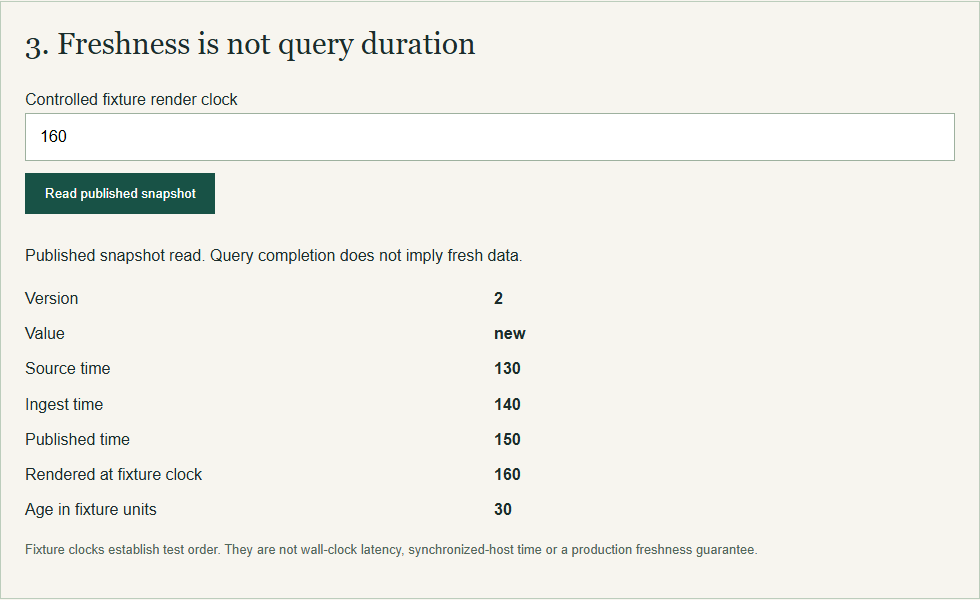
The screenshot records the final visible state. The saved browser evidence records the earlier version-one observation, refusal responses and final assertions. This division matters because a single final screenshot cannot prove that an out-of-order event was refused or that an intermediate refresh remained on the old published version.
The displayed status explicitly says that query completion does not imply fresh data. That sentence is useful because the successful interaction otherwise looks ordinary: the button works, the HTTP request returns and the page updates. The application should not require the user to infer a materialized-view boundary from a hidden implementation detail.
For a production page, the wording could be more domain-specific. A hypothetical inventory screen might say “Published inventory snapshot, source observed at...” and show a warning only when the domain's freshness threshold is exceeded. A historical report might intentionally show an old source time and require no warning. The same numeric age can mean different things in those two products. The UI should express the promise it actually makes.
Query latency and freshness need different acceptance criteria
A latency check asks how long an operation took within specified boundaries. A freshness check asks which source state the result represents and how that state relates to a defined observation point. The former can use an elapsed-time measurement around a request. The latter needs provenance and ordering information. Neither metric can be reconstructed reliably from the other.
The current freshness flow records no wall-clock latency claim. It uses logical times to validate causality and presentation. The shared application has a separate inference boundary experiment with real browser timing, but those inference intervals do not measure this snapshot's source age. Keeping the records separate prevents an attractive performance number from being attached to the wrong question.
Consider a hypothetical cache that answers in two milliseconds but refreshes once per hour. A direct source query might take longer while returning a more recent version. Whether either is acceptable depends on the decision the user makes with the result. A planning dashboard and a safety-critical control action should not inherit the same freshness threshold simply because they share a frontend component.
A meaningful freshness service level would therefore define the object, source event, accepted clock interpretation, publication boundary and allowed age. It would also specify what happens when freshness is unknown. A missing timestamp should not become zero age. A failed refresh should not reset the “last updated” label to the current clock. A stale successful response should not look newer merely because it arrived recently.
The lab does not implement such a service level. It provides the smaller prerequisites: explicit fields, tested version ordering, a separate publication transition and a visible provenance record. Those prerequisites make a future policy testable. Without them, a threshold would be a number attached to an ambiguous measurement.
What this reference does not prove about streaming systems
05 / See the idea
The reference boundary is deliberately small
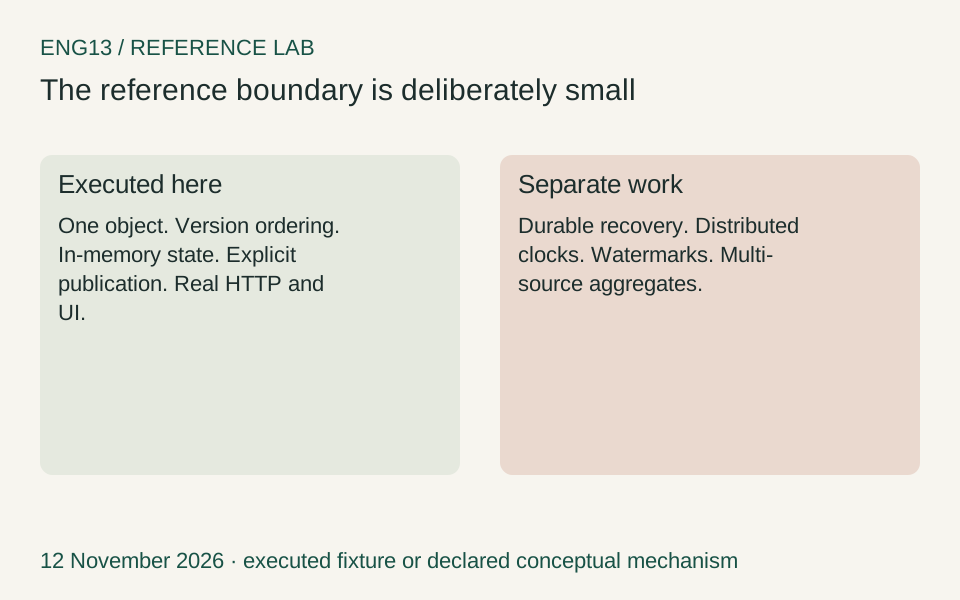
The executed application has one object, in-memory state and explicit publication. Durable recovery, distributed clocks, watermarks and aggregate correction are separate untested extensions.
Interpretation and evidence
- One object with version ordering.
- No durable restart guarantee.
- No stream watermark claim.
The application has no broker, durable queue, partition rebalance or event-time window. It does not implement watermark estimation or late-event correction. Calling its fixture clock a watermark would add terminology without adding the underlying mechanism. The code demonstrates one versioned object's path through explicit transitions, which is enough for the selected question.
A real aggregate introduces additional choices. Suppose a hypothetical dashboard shows total orders for a period. A late event may belong in a previously published period. The system could revise that aggregate, publish a correction record or declare the period closed under an explicit policy. A single latest-version rule for one object does not decide which choice is appropriate. Aggregation semantics must be designed and tested separately.
Likewise, a version counter may be local to a source partition rather than globally comparable. Combining two sources can require a vector of positions or another checkpoint representation. One large integer that happens to increase in a test is not evidence that the same ordering exists across a distributed pipeline. The current fixture avoids that claim by keeping one source and one object.
Persistence is another boundary. If this process exits, its in-memory latest event and snapshot disappear. The test wrapper intentionally closes the process after acceptance. It does not claim restart recovery. The durable-agent laboratories elsewhere in the library examine persisted transitions and replay; importing their conclusions into this in-memory example would be inappropriate without implementing and testing the missing storage path here.
These exclusions do not make the experiment trivial. They locate its contribution. Many freshness bugs occur before sophisticated stream processing becomes relevant: a UI labels read time as source time, an ingest acknowledgement is mistaken for publication, or a late version overwrites a newer value. The small lab makes those failures observable without requiring a platform that would obscure them beneath unrelated infrastructure.
Design a useful freshness diagnostic
For the demonstrated flow, a useful diagnostic record contains version, source time, ingest time, publication time and the snapshot version actually read by the UI. It also records the decision made for each incoming event: accepted, duplicate, stale or conflicting, or invalid clock order. That record explains why the visible value changed or did not change.
The record should not imply more precision than the system possesses. If source time is reported by an untrusted client, label it accordingly. If publication time is local to one service, record its clock domain. If the browser computes age using its own wall clock, account for the fact that the client's clock may be wrong. An honest unknown is more useful than a precise-looking negative duration silently clamped to zero.
In the reference UI, the operator can edit the fixture render clock. That makes the arithmetic visible but is not a production feature proposal. A clock earlier than the source could produce a negative displayed age because the UI has no complete skew policy. The accepted scenario fixes the clock at 160 and validates a causal sequence. This boundary should remain explicit when reusing the component.
A practical next iteration would separate event metadata from diagnostic observation metadata. Source time belongs to the event. Ingest observation belongs to the receiving service. Publication observation belongs to the materializer. UI-read observation belongs to the client. Keeping ownership visible helps prevent later code from overwriting one meaning with another simply because all fields share the type DateTimeOffset.
It is also useful to distinguish freshness from completeness. A snapshot can be recent but incomplete if some required sources have not contributed. Conversely, a complete historical snapshot can be intentionally old. The present fixture proves neither multi-source completeness nor business reconciliation. It shows one source's version and publication boundary, leaving those larger claims for a separate design.
Give unknown freshness a first-class state
The reference begins with no published snapshot. Its read endpoint returns null, and the page says that no snapshot has been published. That is a more accurate starting point than inventing a source time at application startup. A process boot timestamp describes the process, not the data it has not yet obtained.
The same principle should survive partial failures. If a hypothetical production read fails, the page may retain its previous value for continuity, but it should retain that value's previous provenance as well. Updating a “last refreshed” label while leaving the old value in place can create a false impression of freshness. The successful UI action and the successful acquisition of new evidence should not share a timestamp unless they actually coincide.
Unknown also differs from stale. Stale means the system has enough trustworthy information to judge that the represented source is older than an allowed boundary. Unknown means some prerequisite for that judgement is absent or unreliable. The appropriate action can differ: stale data might still support a low-risk historical comparison, while unknown provenance might require refusal for a sensitive decision.
A useful production design could therefore expose separate states such as no snapshot, published with known provenance, published with uncertain clock interpretation, and read failed while showing an earlier snapshot. This is a proposed extension, not a set of implemented states in the small application. Its purpose is to prevent the next version of the UI from collapsing all nonideal conditions into a single red badge.
The existing test already provides one anchor for that design: publication is explicit. A future refresh policy can ask whether a new published version was observed, whether the same version was confirmed or whether the read failed. Those are different outcomes even when the visible business value happens to be identical. Without version and provenance, the interface cannot reliably distinguish them.
The publication record should also identify the transformation that created it when that transformation matters. In this fixture publication copies a single accepted value, so a separate transformation version would add little explanatory value. A derived business metric is different: a new calculation rule can change the result without a new source event. Its provenance may need both source positions and calculation identity. Otherwise a reader can see a recent publication timestamp while remaining unable to reproduce what was published.
This is another reason to resist treating freshness as one universal column. Source recency, publication recency and interpretation version answer different questions. The small application intentionally implements only the first two transitions for one value. It gives us a place to add transformation provenance later without pretending that a new timestamp alone would establish reproducibility.
Reproduce the causal chain and keep the claim bounded
The shared source package builds with SDK 10.0.400 and .NET 10.0.15. The test starts an ephemeral loopback server, opens a real Blazor WebAssembly page and executes the sequence described above. HTTP calls perform the event and publication transitions. Browser assertions verify the rendered version and age. The report records stale refusal, conflict refusal, duplicate handling and invalid-clock refusal.
The accepted run passes the full flow and closes both browser and server. No public service, customer dataset or hosted model participates. The endpoint's control routes are intentionally available only inside this local reference setup. They should not be treated as an authenticated production administration API.
To extend the lab responsibly, choose the next unresolved promise. If restart recovery matters, add durable storage and a process-reopen test. If multiple objects matter, add object identity and independent version histories. If aggregation matters, define correction semantics before measuring throughput. If a freshness threshold matters, define the clock domains and unknown-state policy before adding a colored badge.
The most important improvement is often conceptual before it is infrastructural. Ask what source state the screen represents. Then preserve enough evidence to answer that question after an out-of-order event, a delayed publication or a successful read of an old snapshot. A system that responds quickly but cannot answer this question is responsive in one sense and opaque in another.
Freshness becomes an engineering property when the path from source to screen is explicit. The reference's final age of 30 logical units is not an impressive latency result. It is an inspectable statement about a specific version, a specific publication and a specific observation point. That modest precision is a better foundation for production guarantees than a green success indicator attached to an unidentified state.
Source code and execution evidence
Download the complete lab, source record and raw execution results. This package supports the specific execution claims in this article. It is not a production certification.