Buying an AI Demo Versus Buying an Operable System
A convincing demonstration leaves unanswered questions about data rights, recovery, operating cost and evaluation ownership.
Explore the mechanism ↓
Reading tools Listen or translate
Read aloud
Uses an installed voice on your device.
Translate article
Machine translation. Code and evidence notes stay in English.
Original English text.
START WITH THE MECHANISM
Interactive companion and laboratory update: 12 November 2026. The editorial date places the topic on the timeline; this current explanation and its measured evidence retain their actual preparation and execution dates.
THE FULL INVESTIGATION
Buying an AI Demo Versus Buying an Operable System
Dates and technology context
This is a retrospective editorial timeline. Topic context: 26 August 2025. First publicly available: 12 November 2026. Current text, visuals and laboratory revisions were prepared on 12 November 2026.
The operability examples use November 2026 controlled laboratories; they are not observations of a 2025 procurement engagement or customer.
The demonstration ends with an answer everyone wanted to see. A complicated request becomes a clean summary, a document appears in the right place, and a process that normally takes an afternoon seems to finish in a minute. The buyer can imagine a less frustrating working day. The supplier can imagine a contract. Both may be right about the opportunity while misunderstanding what has actually been demonstrated.
A demo proves that a particular path can work under the conditions of the demonstration. Purchasing a system means accepting responsibility for the paths that were not shown. The distance between those statements is where much of the useful buying conversation belongs.
That does not make demos worthless. They create a shared object around which people can clarify a problem. They can reveal that a previously awkward interaction is now feasible. The mistake is to let the emotional clarity of the experience stand in for evidence about a wider operating environment.
The following is a proposed decision framework, illustrated with hypothetical situations. It is not an account of a purchase, client engagement or investment made by the author. The aim is to make a serious evaluation proportionate: enough evidence to support the next commitment, without demanding a mature enterprise platform before anyone is allowed to learn.
Buy a change in a workflow
Imagine a hypothetical manufacturer evaluating an assistant for internal maintenance documentation. The demonstration finds a fault code, summarizes the likely causes and drafts a work order. Calling the proposal “an AI maintenance assistant” leaves too many decisions unresolved. Is the buyer purchasing faster document lookup, fewer incorrect work orders, shorter equipment downtime or reduced training effort?
Those outcomes require different evidence. A search improvement might be judged on finding the right passage. A work-order drafting tool must also be judged on the fields it fills and the assumptions it carries forward. A claim about downtime reaches beyond the assistant into scheduling, spare parts and technician judgement. The more distant the promised outcome, the less reasonable it is to treat the model's answer as the final measure.
Write the workflow before scoring the technology. Identify the person starting it, the information available at that moment, the decision being supported, the action that follows and the person accountable for the result. Then choose a narrow unit of acceptance. A correct answer that arrives after a technician has already made the decision may contribute little value.
This framing also allows a fair comparison with a simpler alternative. An improved search interface, a structured form or a deterministic rule might solve the selected problem adequately. Anthropic's engineering guidance distinguishes predetermined workflows from agents that direct their own process and recommends starting with the simplest adequate design. That is a useful challenge to the proposed scope, rather than an argument for any particular vendor. Building effective agents.
Ask where the demonstration received help
01 / See the idea
The work around the demo
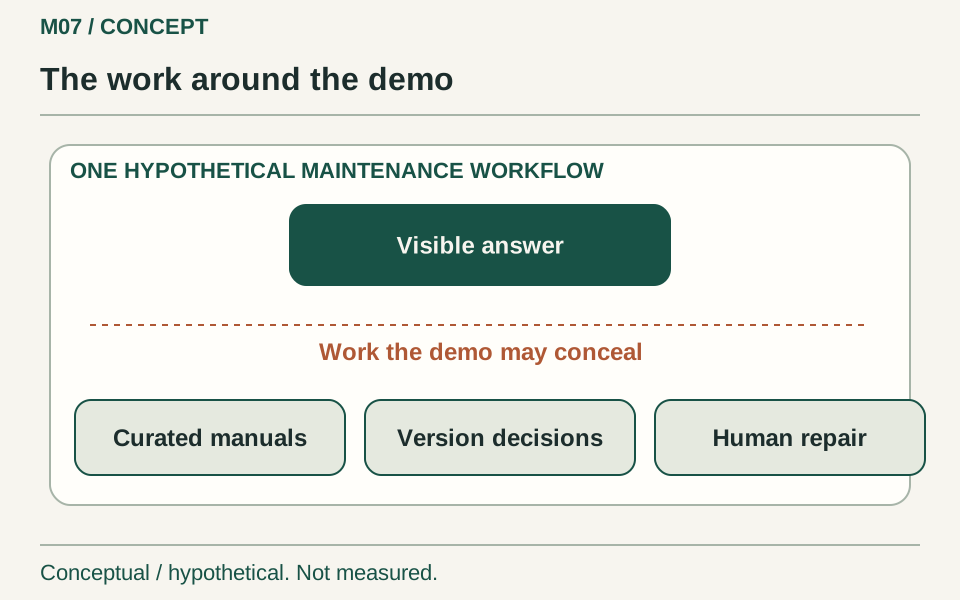
Imagine a maintenance demo built from manuals that someone cleaned and versioned beforehand. Its output is visible, but curation and recurring ownership remain part of the purchased workflow even when they happen off screen.
Interpretation and evidence
- Identify curated inputs.
- Separate product from implementation service.
- Name the recurring owner.
A prepared corpus is not deception. Most useful products need preparation. The relevant question is which preparation steps become part of the buyer's recurring responsibility.
Perhaps the supplier removed contradictory manuals, converted scanned pages, selected the right version of a service bulletin and labelled the customer-specific terminology. Those activities may account for much of the demonstration's quality. If the buyer assumes the product performs them automatically, the acceptance test and the operating plan will describe different systems.
Request a map of the assistance around the demo. Which inputs were curated? Which requests were rehearsed? Which tools were available? Was a person selecting the best answer or repairing an action behind the scenes? These questions are not accusations. They establish the boundary between a product capability, an implementation service and an ongoing operational task.
Then repeat a small part of the demonstration with material chosen by the buyer and withheld until the session. Include one routine case, one ambiguous case and one case that should not produce an answer. The refusal is important. A system that always says something can appear more capable than a system that recognises the limits of its evidence, especially when the audience knows the intended answer in advance.
Treat evidence quality as a purchasing input
The supplier's evaluation should describe where its cases came from and how success was judged. An impressive percentage is difficult to interpret without a denominator. Does it count individual sentences, completed requests, fully correct documents or answers that a reviewer considered acceptable after editing?
Ask to see a small sample of failures alongside successes. The request need not expose another customer's confidential data. Synthetic examples, appropriately licensed public material or a buyer-controlled test set can reveal the shape of the evaluation. What matters is whether the test is capable of producing an inconvenient answer.
For the maintenance assistant, a useful acceptance rubric might require the correct document version, a citation to the relevant instruction and an explicit statement when two sources conflict. A proposed repair action could require a separate approval. The criteria should reflect the consequences of error rather than copying a generic model benchmark.
NIST's 2024 generative AI profile places evaluation in a broader risk-management context. It is a useful source for identifying categories of uncertainty, but it does not certify a particular assistant or prescribe this purchasing rubric. NIST AI 600-1. The rubric remains a decision the buyer must own.
Make failure an ordinary part of the demonstration
02 / A concrete example
A timeout leaves two possibilities
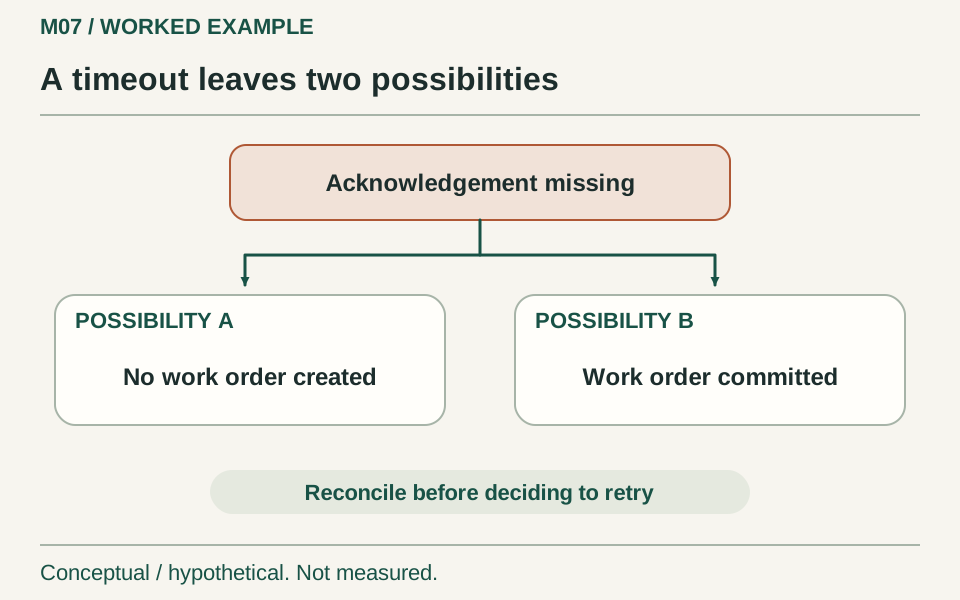
Imagine a work-order request timing out before its acknowledgement arrives. The receiver may have committed the order or may have done nothing, so the product must reconcile the outcome before choosing whether to retry.
Interpretation and evidence
- Do not equate timeout with failure.
- Find the destination operation identity.
- Keep the human fallback informed.
Ask what happens when the document store is unavailable, the model call times out, the user's permissions change or a downstream action succeeds but its confirmation is lost. A supplier who can discuss these cases precisely may provide more confidence than one who promises that the platform handles everything.
The most revealing question is often about uncertainty after an action. Suppose the assistant submits a work order and the network fails before it receives an acknowledgement. Retrying blindly can create a duplicate. Refusing to retry can leave work undone. The product needs a way to establish what happened, or a clear route for a person to resolve it.
This is not a demand that every integration support the same transaction mechanism. It is a demand that the behaviour be described. A credible response may be a stable operation identifier, a lookup in the destination, a human reconciliation screen or a deliberate limitation on which actions the product can perform. The right mechanism depends on the receiving system.
Also test the human fallback. “The user can take over” is incomplete if the user receives neither the attempted steps nor the relevant source material. An effective handoff should transfer enough context to continue the work without repeating the entire investigation. The fallback is part of the user experience, not an appendix to the sales architecture.
Separate permission to process from possession of data
Having a folder of documents does not settle whether every user should retrieve every passage. A maintenance manual may be broadly accessible, while incident records or supplier agreements may have a narrower audience. The assistant should preserve those boundaries throughout retrieval, generation, logging and support access.
The purchasing discussion should identify the owner of each data decision. Who approves ingestion? Who decides retention? Who can inspect prompts during support? Who can delete an item from the searchable corpus and establish that the change took effect? These are operational questions that can be answered concretely without pretending that the product itself determines the organisation's policy.
There is also a distinction between the rights required for an evaluation and those required for continuous operation. A buyer may be comfortable supplying a small, approved test corpus while wider access remains unresolved. That can justify a bounded pilot. It should not be presented as evidence that the production data path has been approved.
Avoid turning this stage into a generic questionnaire completed independently of the workflow. Follow one document and one user's request through the system. The resulting diagram will often expose a missing owner more effectively than a long list of affirmative answers.
Price the completed task, including the work around it
A quoted model price is only one component of the operating model. The relevant task may include retrieval, document processing, retries, storage, monitoring, review and corrections. Some costs are variable, some are shared and some arrive as human effort after the software has declared success.
For the hypothetical manufacturer, consider two configurations. One produces a draft quickly but often needs a technician to verify every field. Another is slower and more expensive per request but reliably identifies the cases that need escalation. Neither wins automatically. The buyer needs to understand how each configuration changes the total workflow and the scarce attention of the people using it.
Use an explicit sensitivity analysis instead of a single optimistic forecast. What happens if request volume doubles, the corpus changes weekly, review time is longer than expected or a model replacement requires reevaluation? These are scenarios, not predictions. Their purpose is to reveal which assumptions dominate the decision.
The supplier should be able to explain which parts of the estimate it controls and which it does not. A transparent estimate with a range and a measurement plan can be more useful than a precise-looking number built on unobserved user behaviour. Buying certainty that nobody has measured is an expensive way to avoid discussing uncertainty.
The strongest objection: this can become procurement theatre
03 / Watch the mechanism
Evidence earns a larger scope
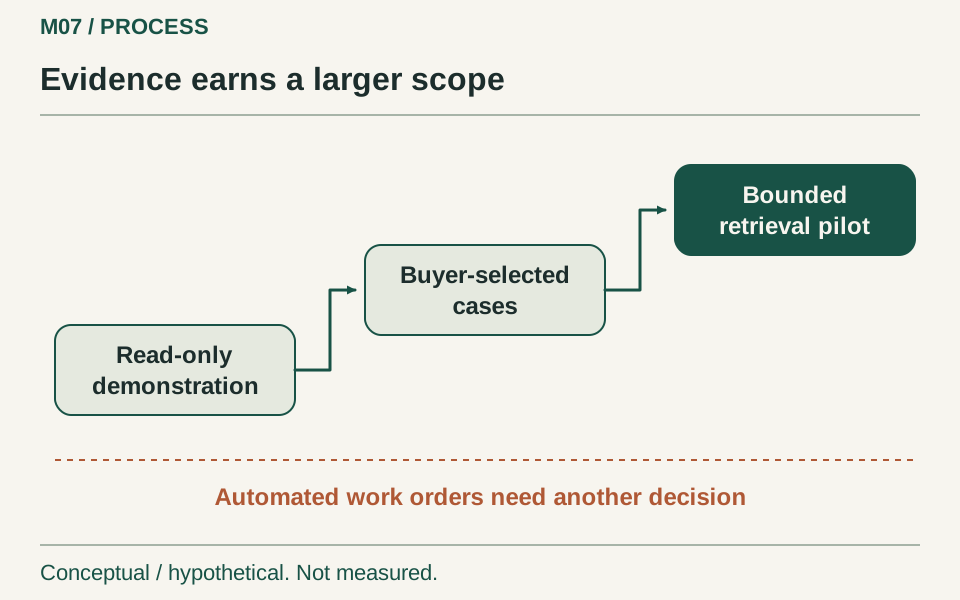
Static view. Play to see how the mechanism unfolds.
Imagine that buyer-selected maintenance questions return version-correct citations. That evidence can justify a retrieval pilot, while the authority to create work orders remains a separate decision with separate recovery evidence.
Interpretation and evidence
- Scope the next commitment.
- State what success permits.
- Keep autonomous writes behind their own gate.
A founder could reasonably object that this process favours established suppliers. A small team may have a genuinely useful product without polished operations documents, extensive audit material or a large evaluation function. Requiring all of those before a first pilot can prevent the buyer from learning anything.
That objection should change the shape of the evaluation. Match the evidence to the commitment. A read-only pilot using an approved synthetic corpus can proceed with fewer operational obligations than an autonomous system changing live records. A narrow deployment with an accountable reviewer can tolerate limitations that would be unacceptable in an unattended workflow.
The remedy is staged commitment. Define what the pilot may do, who observes it, how long it runs and which result would justify the next stage. Keep the restrictions visible so success inside the boundary does not silently become permission to remove it. A pilot that tests document retrieval cannot establish the safety of executing maintenance instructions.
The buyer also owes the supplier a decision. If the agreed evidence arrives, either advance, stop or identify a new material concern. Repeating diligence because a committee is uncomfortable with uncertainty is not rigour. It is a failure to establish who can accept a bounded risk.
Buy an acceptance boundary before buying a scale promise
01 / See the idea
Buy responsibility in explicit stages
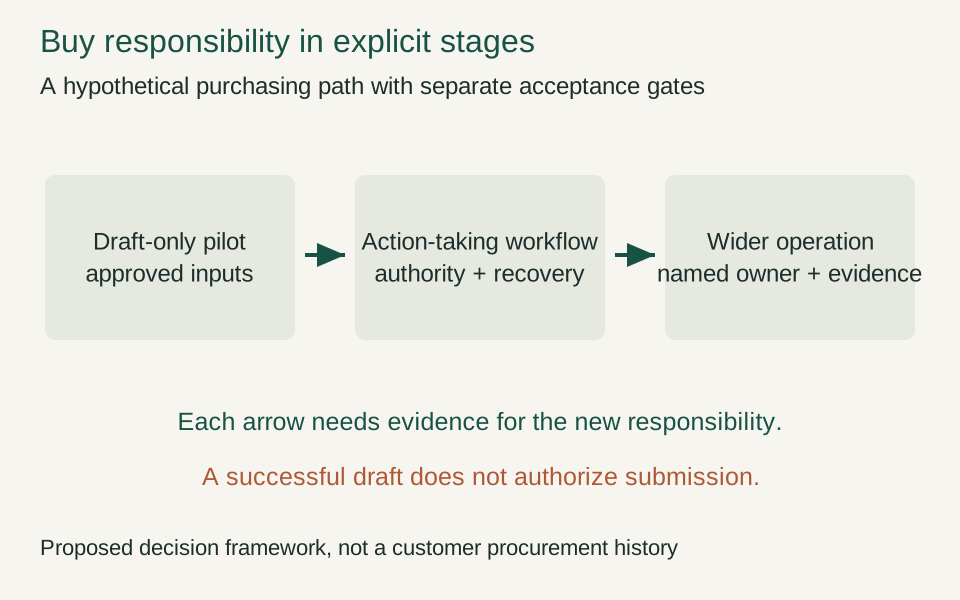
The interface can look unchanged while the system gains authority. The purchase should identify the new effect and the evidence needed before allowing it.
Interpretation and evidence
- Name the permitted effect.
- Test the new failure boundary.
- Do not expand scope by implication.
Consider a hypothetical supplier offering to automate the creation of maintenance work orders. A useful first agreement might authorize drafting only, using a buyer-approved corpus and a named reviewer. A later agreement might authorize submission to the operational system, but only after duplicate handling, permissions and reconciliation have been demonstrated.
Those are different purchases of responsibility, even if the interface looks identical. The first buys assistance with a document. The second introduces an actor into an operational workflow. A successful drafting pilot should not silently authorize the second responsibility merely because the user can already imagine pressing a submit button.
The acceptance boundary should name an observable outcome. For drafting, it could be a reviewable work order with the required fields, source version and explicit uncertainty. For submission, it could include a stable operation identifier, an independently confirmed destination record and a visible route for resolving an unknown acknowledgement.
The buyer should also name the evidence that would stop expansion. Perhaps the product cannot distinguish two document versions, or the reviewer cannot identify which fields need checking. A pilot that can only produce permission to continue is a sales process with measurements attached, not a discriminating evaluation.
This does not require negotiating every future operating detail before learning anything. It creates a sequence in which the next commitment has a clear purpose. The supplier can focus its work, and the buyer can avoid adding new criteria after the agreed result arrives unless a material concern has actually emerged.
The boundary is especially useful when enthusiasm is high. It lets both parties say that the demonstration was valuable without pretending it answered questions that were not part of the test. Progress then means a justified increase in responsibility, not merely a broader description of the same demo.
Contemporary laboratory results show why operability needs separate evidence
The following examples come from controlled laboratories executed on 12 November 2026, after this article's August 2025 context date. They are contemporary illustrations of the purchasing questions, not customer deployments or claims about a supplier's product.
In the recovery laboratory, a checksummed SQL backup was verified and actually restored into a separate database on a second instance. The expected transactions matched. The application probe still refused readiness because a required external template was absent. Copying the matching template allowed that bounded probe to pass.
The lesson for a buyer is not that every product needs the same restore mechanism. It is that a database recovery claim and an application recovery claim are different. The acceptance test should include the dependencies needed for the selected workflow rather than stopping at the most impressive administrative command.
In the related cutover exercise, a transaction committed before its acknowledgement was deliberately delayed until the client timed out. A separate read established that the write existed. Replay on the older target then distinguished an absent effect, a matching duplicate and a conflicting payload. This was controlled application cutover, not automatic failover or recovery from an unavailable source.
That boundary matters in a buying conversation. A supplier demonstrating this case could legitimately show how its operation identity supports reconciliation. It could not use the same test to claim regional resilience, multi-writer fencing or recovery when the only source of transaction evidence has disappeared.
A separate diagnostic-agent laboratory verified actual database denials of update, drop and unauthorized reads. Its provider was scripted, and its trusted host used an impersonated restricted user. The evidence demonstrated that permission context and fixed tool contract; it did not prove language-model quality or isolation from arbitrary code running inside the host.
These examples suggest a practical question for every impressive result: which additional responsibility is the audience tempted to infer? That inferred responsibility is often where the next acceptance gate belongs. The buyer need not dismiss the result to keep its meaning precise.
Make the fallback a deliverable with a user and a deadline
02 / See the idea
The fallback is part of the purchased workflow
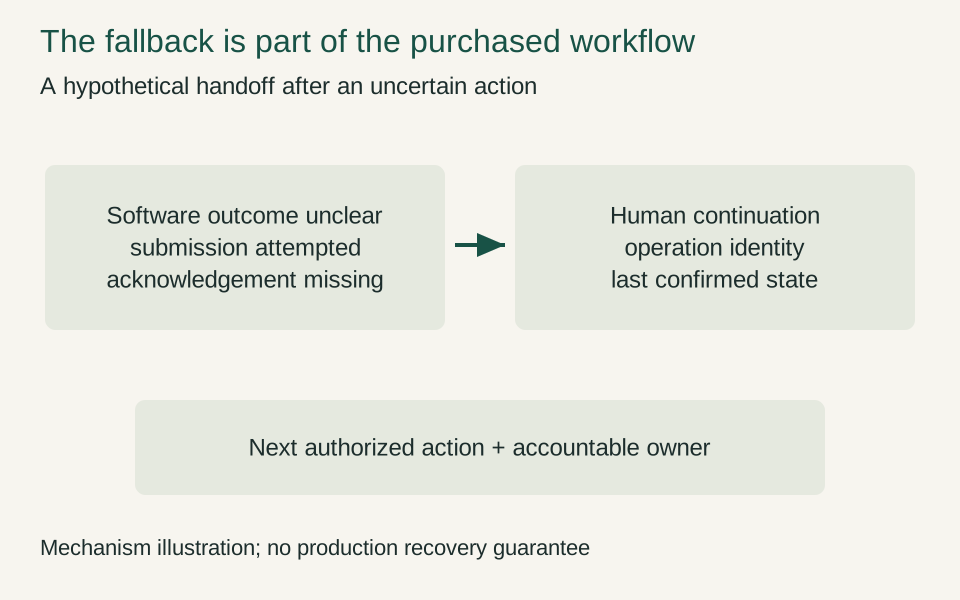
Contact support is not enough if the recipient cannot tell whether retry is safe. The handoff should preserve the information needed to continue responsibly.
Interpretation and evidence
- Transfer evidence, not only an error.
- Separate attempt from final effect.
- Assign the next decision to an owner.
Suppose the hypothetical maintenance assistant cannot confirm whether a work order was submitted. A fallback that merely says contact support leaves the technician with an unresolved operational obligation. A useful handoff would identify the intended operation, the destination, the last confirmed state and the action the human is authorized to take next.
The buyer can ask to rehearse that handoff with a person who did not build the demo. Can they identify whether retry is safe? Can they find the relevant source instruction? Can they distinguish a failed attempt from a completed business action whose confirmation was lost? The rehearsal should use synthetic or approved material, not a fabricated story about a previous customer.
The fallback also needs an owner on the supplier's side. If the product's behavior is ambiguous, who investigates it and what evidence can the buyer provide? If the corpus is wrong, who can correct it? If an integration has changed, which party is responsible for the adapter? These questions turn an abstract support promise into an operating model.
There is a reasonable counterargument: elaborate fallback requirements can overwhelm a small pilot. The proportional response is to reduce the pilot's authority. A draft-only tool may need a straightforward manual continuation, while an unattended action-taking workflow needs a stronger reconciliation path. The evidence requirement follows the effect, not the supplier's company size.
The buyer should avoid demanding a fully automated recovery for every failure if a clear human path is adequate. Human intervention can be a legitimate design choice. What is unacceptable is pricing and presenting the workflow as unattended while leaving essential work to an unnamed person after every uncertain outcome.
Tie commercial stages to demonstrated responsibilities
A hypothetical evaluation can have three stages: establish that the interaction is useful, establish that the selected workflow is correct under its bounded cases, and establish that someone can operate it when dependencies fail. The stages may overlap, but their evidence should remain distinguishable.
The first stage can justify spending time on integration. The second can justify a limited deployment. The third can justify a larger operational commitment if the remaining conditions are acceptable. These are proposed decision relationships, not a universal procurement schedule or an estimate of implementation time.
The supplier benefits from this structure too. A clear gate protects it from a buyer who keeps expanding the meaning of success. If a retrieval pilot met the agreed citation and access criteria, a later request for autonomous actions should be recognized as a new responsibility rather than described as a defect in the original delivery.
The buyer benefits when each stage leaves usable evidence even if the next stage is declined. A failed expansion test may reveal a data ownership problem or a workflow that needs a deterministic control. That knowledge can support a better decision without forcing the organization to continue because it has already invested in the demo.
The practical commercial question is therefore what becomes possible after this deliverable is accepted. A generic promise to make the organization AI-ready is hard to price or verify. A bounded responsibility with an owner, an observable result and a clear stop condition gives both parties something concrete to discuss.
Leave the meeting with a decision record
The most useful output from an AI buying discussion is a short record that another person could challenge. It should state the workflow, the intended improvement, the evidence inspected, the limitations accepted and the unanswered questions that block expansion.
A hypothetical next step might be: run a read-only evaluation on an approved document set; require version-correct citations; record human review time; prohibit automated work orders; compare against the existing search workflow. A positive result permits a broader retrieval pilot, not automatic approval for action-taking agents.
Record the person responsible for deciding whether the evidence is sufficient. Without that owner, evaluation work tends to accumulate while the original business problem remains untouched. With an owner, a disappointing result can still be productive: it may reveal that the corpus needs repair, that a simpler interface is enough, or that the proposed workflow is not worth automating.
The system worth buying is the one whose behaviour, obligations and limits the buyer can understand well enough to operate. The demo helps open that conversation. The evidence and decision record determine whether the conversation has earned the next commitment.