Automating a Task Does Not Remove a Profession: Where Responsibility Moves
Automating a visible task can move verification, authority and correction elsewhere. A practical way to examine changing roles without confusing capability with a forecast of job loss.
Explore the mechanism ↓
Reading tools Listen or translate
Read aloud
Uses an installed voice on your device.
Translate article
Machine translation. Code and evidence notes stay in English.
Original English text.
START WITH THE MECHANISM
Interactive companion and laboratory update: 12 November 2026. The editorial date places the topic on the timeline; this current explanation and its measured evidence retain their actual preparation and execution dates.
THE FULL INVESTIGATION
Automating a Task Does Not Remove a Profession: Where Responsibility Moves
Dates and technology context
This is a retrospective editorial timeline. Topic context: 21 May 2025. First publicly available: 12 November 2026. Current text, visuals and laboratory revisions were prepared on 12 November 2026.
Links to AI13 and November2026 labs are later additions. Preserve the absence of an author employment study.
A customer receives an answer in seconds. An analyst produces a report before the meeting begins. A planner compares alternatives that would previously have taken an afternoon to assemble. Each improvement can be real. None, by itself, tells us what has happened to the profession around that task.
This distinction is sometimes used as reassurance: jobs are bundles of tasks, therefore people will remain necessary. I do not think it offers that comfort. A task can disappear, a role can shrink, and a worker can lose an opportunity even while the larger function still requires human judgment. Organizations can redistribute remaining work among fewer people. They can also create new services because previously expensive work becomes affordable. The direction is not contained in the existence of a capable model.
The useful question is more demanding than whether AI can perform an activity. What happens to the chain of responsibility when that activity becomes cheaper, faster or easier to delegate? Who defines the acceptable result, notices the exception, corrects the error and answers to the person affected?
This essay examines that question through hypothetical work in analysis and customer support. These are constructed scenarios, not interviews, customer cases or measured workplace experiments. They help expose choices that an impressive demonstration can leave outside its frame. The argument is about how to investigate a change, not a prediction that a particular occupation is safe.
The visible artifact is often an intermediate result
Imagine a retailer whose analyst prepares a weekly explanation of inventory risk. The visible artifact is a table: products, quantities, expected demand, delayed shipments and suggested action. A generative system can help assemble that table and explain its contents. It may make the analyst's most visible output much faster to produce.
But what was the organization relying on the analyst to do? Perhaps it relied on a particular definition of available stock, an understanding of how late supplier updates enter the system, and a judgment about which uncertainty deserves attention before the next purchasing decision. The report is where those responsibilities become visible. It is not necessarily where they begin or end.
Suppose the system produces a polished recommendation to reduce an order. The arithmetic is correct for the data it was given. The trouble is that one warehouse's recent receipts have not arrived in the reporting dataset, and the apparent excess elsewhere cannot be transferred in time. The generated explanation can be internally coherent and operationally unhelpful.
A human analyst can make the same mistake. The point is not to assign humans an exclusive gift for context. It is to identify the context and the checking obligation that somebody or something must supply. If the new system handles that obligation reliably, it has automated more of the role. If it does not, the obligation has moved to whoever accepts the report.
This is why a before-and-after comparison should follow the work past the first artifact. Producing a table is one boundary. Producing a decision that remains defensible when the data changes is another. The organization needs to know which boundary its new arrangement actually reaches.
A profession bundles activities, authority and obligations
01 / See the idea
A role contains more than its visible output
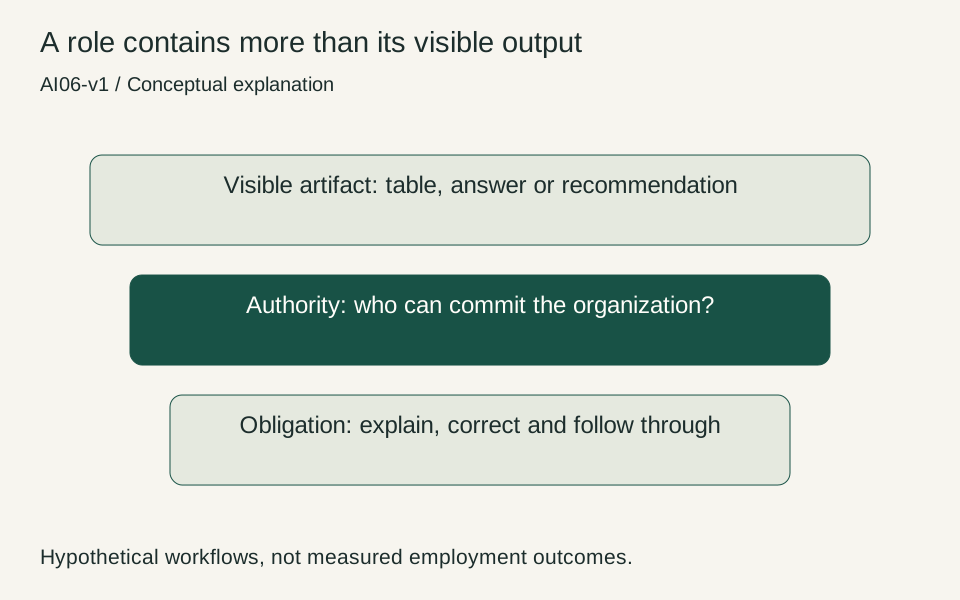
A generated report can replace part of artifact creation while leaving authority and correction duties elsewhere. Those duties need an explicit owner.
Interpretation and evidence
- Name the activity being automated.
- Locate the authority to approve its use.
- Keep the obligation after delivery visible.
A task inventory is useful, but it is not a complete description of a role. Two people can perform similar activities while holding different authority and facing different consequences. One can draft a recommendation; another can commit the organization to it. One can flag uncertainty; another must decide whether work proceeds despite it.
The distinction becomes important when a system performs the drafting activity well enough to make the approval look routine. Approval can then become a place where the unresolved work accumulates. The approver receives more outputs, less time per output and an implied expectation that the automation has already done the difficult part.
A role also includes obligations that are activated infrequently. Handling a strange exception may occupy little of an average week but determine whether the process is trustworthy. A demonstration dominated by common cases can miss the value and cost of that responsibility. Conversely, an organization may decide to centralize rare exceptions rather than retain the same specialist in every team.
That is a real possibility, and it should be examined directly. Saying that an exception still needs expertise does not prove that every existing position remains economically unchanged. It tells us to inspect how the expertise is distributed, whether it is available when needed, and what happens when the central queue is full.
A useful map therefore has at least three layers: the activities performed, the authority to make consequential choices, and the obligations that survive after a choice. Automation may affect each layer differently. Treating them as one box labelled with a job title hides the actual redesign.
Exposure is a question about capability, not a headcount forecast
The ILO's 2025 working paper on occupational exposure to generative AI uses task-level information, worker input and expert assessment to refine an exposure index. It estimates that roughly one in four workers worldwide is in an occupation with some exposure. The paper also emphasizes variation across tasks and the likelihood of transformation in many roles that retain human input. Those are findings about the study's model and evidence, not a count of jobs already eliminated. ILO Working Paper 140.
For a workplace deciding what to change, that distinction is practical. A capability assessment does not by itself establish data availability, integration quality, customer acceptance, the cost of review or whether the new workflow is worth operating. It does not tell the employer which specific arrangement of people and systems will produce a better result.
Nor does a successful pilot settle every employment question. A pilot may be staffed by unusually experienced people, use a carefully selected queue, or receive more attention than the eventual service can afford. Its result can still be valuable. The mistake is to erase those conditions when interpreting it.
I would use an exposure finding to choose questions worth investigating. Which activities are likely to change? Where can assistance remove low-value friction? Which obligations are being transferred without an explicit owner? What new work becomes possible if the cost really falls? Those questions turn a broad signal into a local investigation instead of a slogan about the future.
The analyst's report becomes a maintained claim
02 / See the idea
The report becomes a maintained claim
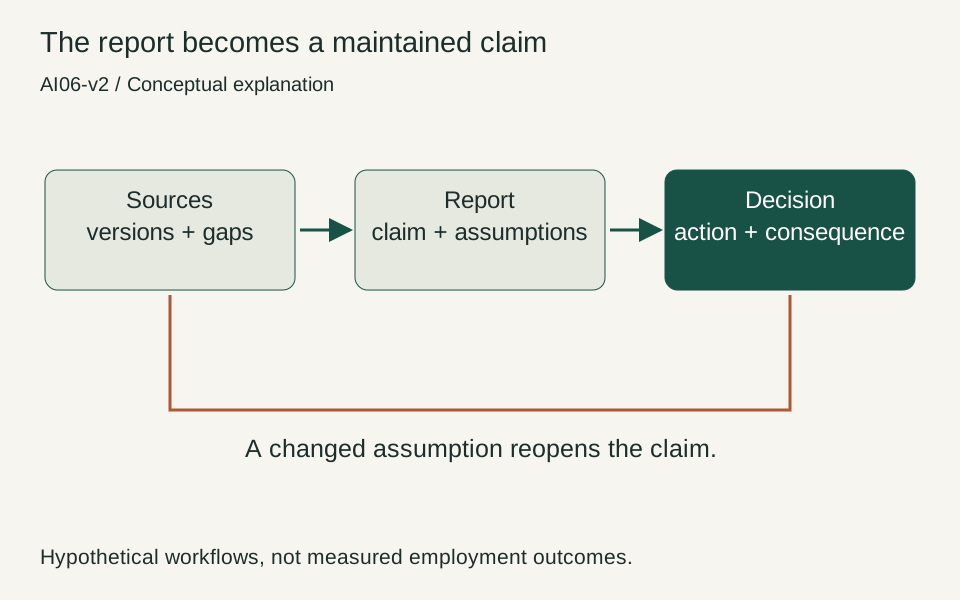
The hypothetical inventory report depends on timely and compatible data. Maintaining its usefulness includes revisiting a recommendation when an assumption changes.
Interpretation and evidence
- Show what each number depends on.
- Distinguish an estimate from an observation.
- Make revision part of the workflow.
Return to the inventory report. A well-designed assistant might expose the source of each number, record the data version, distinguish observed quantities from estimated demand and mark a recommendation that depends on a late feed. That moves the work beyond producing fluent commentary. It creates a claim that someone can inspect and revise.
The analyst's contribution could then change. Less effort may go into copying figures between tools. More may go into defining what the figures mean, resolving incompatible sources and deciding which unresolved issue is significant enough to delay action. Some of that work can itself be encoded and tested. Other parts may remain a negotiation about priorities and acceptable risk.
The design choice is whether the system makes those remaining decisions legible. A clean answer that hides a dependency can reduce the reader's ability to judge it. A slightly less polished answer that reveals the missing feed can support a better decision. Presentation quality and decision quality are related, but they are not interchangeable.
A concrete evaluation would preserve the same inventory cases across the old and new workflow. It would record not only time to produce a report, but also the corrections, delayed decisions and issues discovered after the recommendation was used. The criteria must be defined before inspecting which workflow looks better.
This is a proposed evaluation, not one performed for this essay. Its purpose is to show what would need measuring before claiming that the analyst's role has been replaced or improved. The work that moves into verification should remain visible in the comparison.
In customer support, an answer can become a promise
03 / Watch the mechanism
A fast answer can create a lasting promise
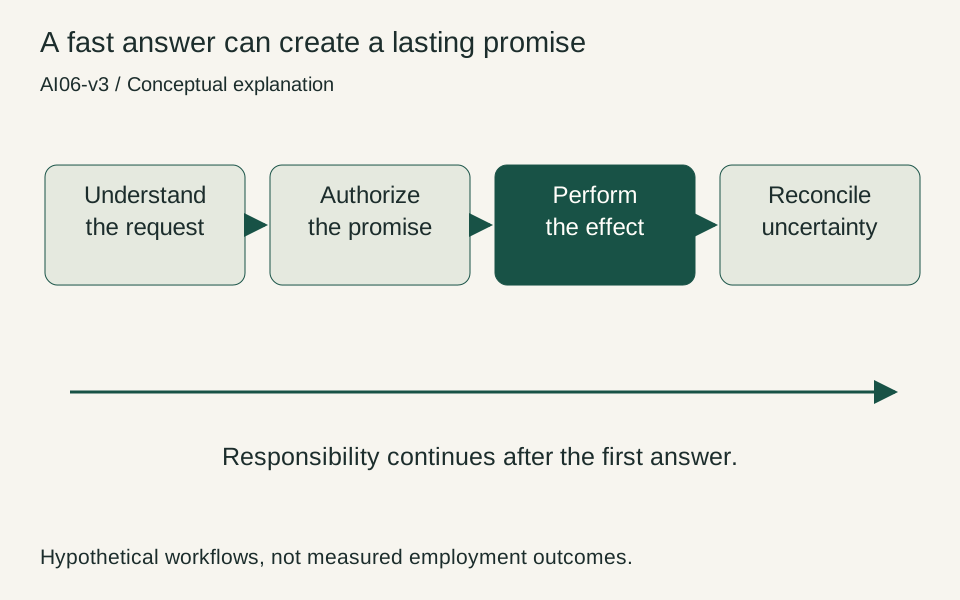
Static view. Play to see how the mechanism unfolds.
The animation shows a conceptual sequence, not task durations. A response can be fast while an uncertain external effect still needs resolution.
Interpretation and evidence
- Separate words from authorized action.
- Keep an uncertain outcome visible.
- Do not repeat an effect merely because its reply was lost.
Now consider a support team responding to a delayed delivery. A system can classify the message, retrieve an order status and draft a clear reply. It may offer a useful answer quickly. But a reply can also contain a promise: a refund, an expedited replacement or a delivery date.
The authority to make that promise matters as much as the ability to phrase it. If a support worker approves a refund, the organization needs to know whether the worker had the necessary scope and whether the amount still matches the approved action. If an agent calls a tool, the same questions remain, even when the call is syntactically valid.
There is also a boundary after the action is requested. A timeout can leave uncertainty about whether the refund was processed. Repeating the request without reconciliation may create a second effect. Telling the customer that nothing happened may also be wrong. The person handling the conversation inherits the need to explain and resolve that state.
The support role therefore contains several potentially separable activities: understanding the request, gathering evidence, applying policy, authorizing an effect, communicating the result and handling an uncertain outcome. Automating one does not prove the others are covered. Automating all common paths still leaves a decision about who handles the uncommon ones.
The customer does not experience these as internal architectural boundaries. They experience whether the organization knows what it has promised and can follow through. A redesign that makes individual messages cheaper while making commitments harder to reconcile may reduce a local cost and weaken the service.
The software can carry some responsibility, but not by declaration
It would be a mistake to use responsibility as a mystical property that software can never help with. A well-designed system can enforce limits, retain evidence, prevent certain duplicate effects and refuse an action that no longer matches its approval. These are real contributions to dependable work.
The agent-authority laboratory provides a narrow engineering example. It uses synthetic accounting units and a local receiver, not real payments. Its checks include an uncertain response after an effect and reconciliation without performing the effect twice. That does not prove how a support organization should be staffed. It shows that part of the required operational discipline can be implemented and examined.
The organization still chooses the policy, the permitted scope and the consequence of uncertainty. Somebody decides whether an unknown result remains pending, whether an exception requires escalation and what the customer is told. Those decisions can be explicit enough to encode, or they can remain ambiguously distributed among a prompt, a support worker and a manager.
The better question is which obligations the system actually discharges. Does it merely suggest the next action, or enforce its preconditions? Does it store a useful record, or merely emit a log line? Can another person reconstruct what happened after the original operator has left? These are observable differences, not marketing descriptions.
An effective human-and-software arrangement may allocate authority differently from the previous workflow. That can be a substantial improvement. It becomes credible when the new allocation is testable and when the unresolved responsibilities have somewhere to go.
Review can become invisible labor
A familiar promise is that AI will produce the first draft and a human will review it. That can be a good division of labor. It can also conceal the most important cost in the new process.
What does review require in the particular case? Checking spelling is different from validating a calculation. Confirming that a citation exists is different from confirming that it supports the recommendation. Approving an ordinary refund is different from resolving an unknown transaction. Calling all of these activities review makes the workflow sound simpler than it is.
The reviewer needs both the evidence and the capacity to use it. If output volume rises while available review time remains fixed, the organization has made a new decision about scrutiny, whether or not it describes the change that way. It may accept a different level of checking, triage cases, add reviewers or constrain the amount of generated work.
The consequential question is whether that decision is explicit. A process can appear more productive because the work of verification is delayed, moved to another team or performed by customers who discover errors. Those costs do not disappear because they fall outside the metric used to celebrate the automation.
I would therefore put a named review obligation beside each consequential output. What must be established? What evidence is available? Who can reject the output? What happens when the queue exceeds that person's capacity? The answers determine whether review is a real control or an optimistic word in a process diagram.
Learning is part of the workflow being redesigned
A profession reproduces its expertise through opportunities to do work, receive feedback and gradually handle more difficult cases. Automating introductory tasks can remove drudgery and make learning more accessible. It can also change where practice happens.
Suppose a junior analyst no longer prepares a recurring table manually. That does not imply that manual preparation was the best way to learn. Some of the effort may have taught only spreadsheet mechanics. But it may also have exposed missing data, inconsistent definitions and the questions experienced colleagues ask before trusting a number.
A sensible redesign identifies which learning opportunities mattered and recreates them more deliberately. The junior analyst might inspect source discrepancies, explain a recommendation's assumptions, or compare outcomes when a feed is missing. Assistance can support these exercises. It should not make a finished artifact the sole evidence that the person understands the decision.
This is a design argument, not a measured claim about every training program. It also does not imply that employers will automatically make the investment. If short-term incentives reward throughput alone, the organization may remove the old learning path without creating a new one.
The question belongs in the adoption decision because capability has a future supply. A process that relies on expert review while steadily reducing opportunities to develop reviewers may create a dependency it has not priced or planned. The problem is not solved by saying that humans remain in the loop.
The benefits can be real and unevenly distributed
04 / See the idea
Benefits and obligations can move differently
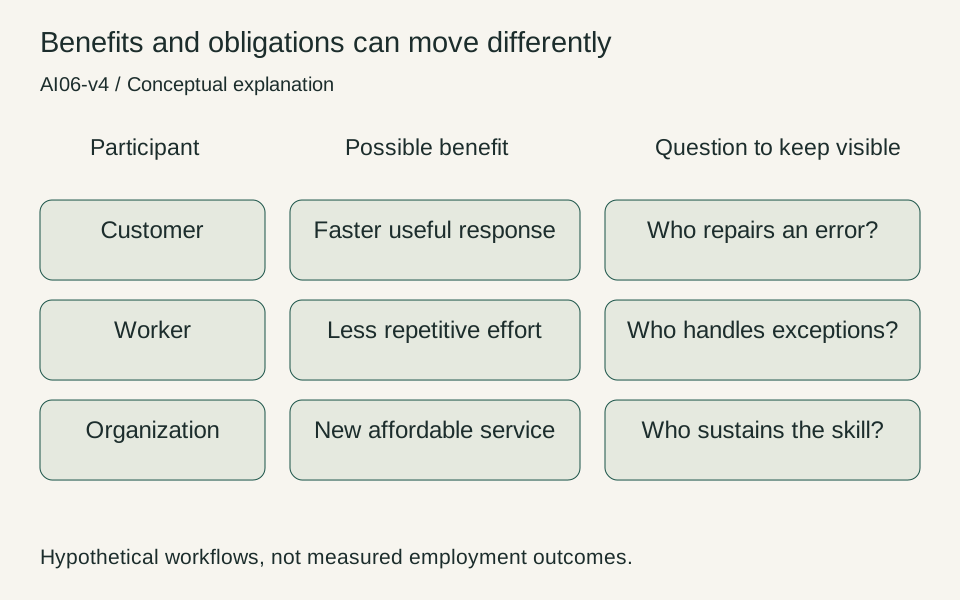
The same redesign can change different participants’ work in different ways. The table identifies questions for evaluation, not predicted outcomes.
Interpretation and evidence
- Do not infer every outcome from time saved.
- Include downstream correction work.
- Evaluate the arrangement, not only the model.
The counterargument deserves its strongest form. Cheaper assistance can make useful work possible for people and organizations that previously could not afford it. A small team may investigate more alternatives, communicate more clearly or provide a service it could not staff before. Removing a repetitive task can improve the experience of work as well as its speed.
It would be narrow to evaluate automation only by asking which existing task disappears. New demand and new arrangements can matter. A person may gain access to a tool that reduces dependence on a scarce specialist. An expert may focus on difficult cases instead of repeating the same explanation many times.
But the existence of a benefit does not establish who receives it. Customers may receive faster service, workers may face a more intense queue of exceptions, and the organization may capture the financial gain. Another deployment may genuinely reduce pressure on the team. The distribution is a property of the arrangement, not a fixed property of the model.
That is why I would avoid an evaluation with a single winner metric. Time saved, correction burden, customer outcomes, worker autonomy and opportunities to learn can move in different directions. A decision may still favor the change, but the trade should remain inspectable.
The aim is not to demand that every change improve everything. It is to stop treating a local efficiency result as an answer to every social and organizational question attached to the work.
Examine a workflow before announcing the future of an occupation
A practical investigation can begin with a limited set of recurring cases. Map the current path from request to outcome, including the information needed, the decisions made and the person who handles exceptions. Record the observed path rather than an idealized process that nobody actually follows.
Then describe the proposed allocation of work. Which steps are automated? Which are assisted? Which move to another role? Where can the system refuse to proceed? How is uncertainty represented? Include the customer or downstream team that may inherit errors, even when that team is outside the immediate project.
Choose observable outcomes before the pilot. A support workflow might track correct resolutions, repeated contacts, unauthorized promises and time spent resolving uncertain effects. An analysis workflow might track source discrepancies found before a decision, corrections after use and the time needed to revise a recommendation when assumptions change.
A small pilot cannot predict the whole labor market. It can reveal whether the local arrangement is doing what its advocates claim. Preserve difficult cases and rejected hypotheses. If the system performs well only while a particular expert quietly repairs it, that expert is part of the measured system.
Finally, keep the decision revisable. A workflow may work under one volume or policy and fail under another. Make the conditions of acceptance explicit enough that the organization can recognize when the original evidence no longer applies.
A role can change before anyone renames it
The most consequential changes may arrive through ordinary operational decisions. A team stops preparing one artifact, begins reviewing many more, centralizes exceptions, changes who can approve an action or removes an entry-level practice opportunity. The job title can remain unchanged while the actual work becomes very different.
This is why I would pay attention to responsibility moving through the system. It gives us a way to connect technical capability to the lives of people doing and receiving the work. It also makes the engineering more concrete: authority, evidence, exceptions, recovery and feedback all have implementation consequences.
There is no general guarantee that every profession remains intact. There is also no logical shortcut from a model performing one visible task to a claim that the whole role has been replaced. Between those statements lies the design of an organization and a service.
The standard I would use is whether the new arrangement can explain its commitments. What result does it promise? Who or what has established that the result is acceptable? Where does uncertainty go? Who can correct the decision, and what evidence will they have when it matters?
If automation makes those answers clearer while reducing unnecessary effort, it has done more than produce an impressive artifact. If it makes them harder to find, the remaining work has not vanished. Someone is carrying it, often without being counted.
Sources and editorial evidence
Download the source notes and visual explanations. This essay contains no new workplace measurements.